
Seventy years after the overthrow of the Guatemalan Revolution, Tim May looks at the prospects for democracy in the country today.
On June 27th 1954 the Guatemalan Revolution was nipped in the bud by a US-orchestrated coup d’état. During this so-called ‘10 years of Spring’, the Revolution’s two successive socialist Presidents did much to address the country’s colonial structural inequalities, entrenched since the Spanish Invasion. The coup reversed these gains and set Guatemala on a dark road of instability and genocidal violence against the country’s oppressed Indigenous majority. 70 years later, Bernardo Arévalo, son of the Revolution’s first President, won the Presidential elections, defying expectations and the establishment’s blatant attempts to subvert democracy. Five months after his inauguration, it’s unclear whether his will alone is enough to loosen the elite’s grip on power and make good on his father’s revolutionary promise of a Guatemala for all Guatemalans.
Before the Guatemalan Revolution, 90% of Indigenous children did not attend school and 2% of the population controlled 72% of the country’s arable land. In the country’s encomienda (plantation) economy, Indigenous Guatemalans were trapped in a brutal system of debt servitude. This was the legacy of colonial rule, which had continued despite Guatemala’s formal independence from the Spanish crown in 1821. The country’s European-descended elite merely replaced the Spanish in the racial hierarchy, exploiting the Indigenous for profit.
Discontent eventually reached fever pitch against the brutal dictator Jorge Ubico, who had ruled the country with a fist of iron since 1931. In 1934 Ubico issued a vagrancy law that mandated Indigenous peasants to work for landowners for 150 days a year, and workers deemed insubordinate could be legally killed. His regime was upheld through censorship, secret police, and brute military force.
In 1944, a popular uprising uniting the urban working and middle classes of Guatemala City led a campaign for Ubico’s resignation. When his crackdown against the protesters failed, Ubico fled the country, and an interim government took power. When it became clear that they also wouldn’t permit a democratic transition, a general strike of workers, students and the middle class called for free elections.
The university philosophy professor Juan José Arévalo quickly emerged as a leader of the strike. Once the interim government was militarily defeated, he was elected President in the country’s first democratic elections with more than 85% of the vote. Arévalo was a socialist, but not a radical. The Communist Party remained outlawed, and he endorsed a more moderate ideology of what he termed as ‘spiritual socialism’. Still, during his term a number of reforms were enacted which significantly expanded labour rights. Most notable was the 1947 Labour Code which set minimum wages, equal pay, social security, and the right to strike, despite fierce objections from the US and the United Fruit Company.
Arévalo’s democratically elected successor, Jacobo Árbenz had deeper communist sympathies, and he took a much firmer stance against capitalist interests. After his inauguration in 1951, Árbenz made agrarian reform a priority. He sought to undo the encomienda system granted to the conquistadors through Decree 900 (enacted in 1952). Before Árbenz was overthrown, through this land reform law, one quarter of all arable land in Guatemala had been expropriated to the benefit of 138,000 landless peasant families.
Árbenz’s actions were not well received by the largest landowner in Guatemala, the United Fruit Company. It pressed its powerful allies in the US government, most notably the Dulles brothers (Secretary of State John Dulles and his brother CIA Director Allen Dulles) to lobby for Árbenz’s overthrow. The result was President Harry Truman’s authorisation of a covert CIA operation ‘PBFortune’, which supplied arms and money to the exiled Guatemalan military Colonel Carlos Castillo Armas.
The CIA’s anti-communist activities accelerated under Dwight Eisenhower, who was elected in 1952 during the height of McCarthyism. Eisenhower immediately endorsed actions against left-leaning governments deemed hostile to US interests, such as Iran’s socialist president Mohammad Mosaddegh in ‘Operation Ajax’. The US feared that Guatemala’s independence would inspire other nationalists seeking social reform throughout Latin America. And so Árbenz became the next victim of US foreign policy in ‘Operation PBSuccess’.
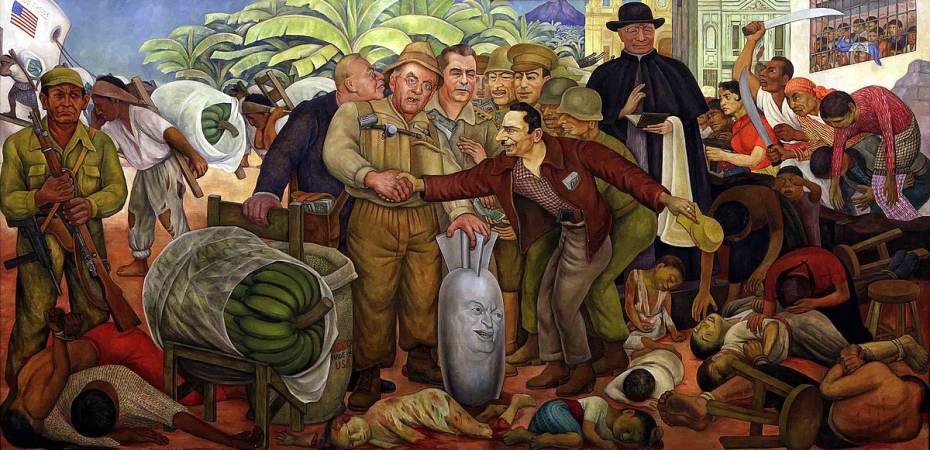
This Operation carried a $2.7 million budget for ‘subversion’ and ‘psychological warfare and political action’. The anti-Árbenz propaganda campaign entailed radio broadcasts, anti-communist news articles, the air dropping of leaflets, and death threats against Árbenz loyalists. The US isolated Guatemala diplomatically within the international community, and conducted a naval blockade. Guatemalan exiles were trained by the CIA in camps in neighbouring countries, and the exiled Colonel Castillo Armas was provided with money to recruit a band of mercenaries, and supplied with weapons and bombers.
Up until Árbenz’s resignation, “the option of assassination was still being considered”, but this would not prove necessary. Operation PBSuccess successfully terrorised the Guatemalan military into submission and, backed by the threat of a possible US military intervention, Carillo Armas’s invasion succeeded in ousting Árbenz, and forcing him into exile. A witness to this event was a young Argentine doctor, Ernesto Guevara, who had travelled to the country due to his admiration of Árbenz’s socialist policies. Years later as the dedicated revolutionary Che, he vowed that “Cuba would not become another Guatemala.”
For the next 40 years, Guatemala was plagued by instability and a succession of right-wing military dictators. They reversed all the Revolution’s progressive reforms, and terrorised the Indigenous population during the 36-year long armed conflict. The conflict reached its apogee in the early 1980s with the genocidal scorched earth campaign of President Ríos Montt. By the time the Peace Accords were signed in 1996, the conflict had cost 200,000 predominantly Indigenous lives.
Unfortunately, the return to democracy did not bring any significant efforts to address the country’s structural inequalities, largely due to the influence of the powerful business coalition CACIF (the Coordinating Committee of Agriculture, Commercial, Industrial, and Financial Associations). CACIF forms one of the most visible instruments of the elite’s control. Its close alignment with politicians, the military, drug cartels, and public authorities maintains a system known as ‘the Pact of the Corrupt’.
In 2015, the depth of government corruption was publicly exposed in the ‘La Linea’ scandal by the anti-corruption taskforce CICIG (the International Commission Against Impunity in Guatemala). Both then President Otto Peréz Molina and Vice-President Roxana Baldetti were implicated in the corruption ring, and the huge anti-corruption protests which followed led to their eventual imprisonment.
Echoing Ubico’s downfall in 1944, the government’s collapse in 2015 in the face of popular protests brought Guatemala to a crossroads, and with it, an opportunity to build a more equitable society. Sadly, this opportunity was lost with the election of the populist President Jimmy Morales. Despite framing his candidacy as a break from the influence of the Pact of the Corrupt, he proved to be just as entangled in their web as his predecessors. To shield himself from impunity, he began to systematically dismantle the few democratic mechanisms in place, most notably through his aggressive termination of CICIG.
This democratic backsliding accelerated under President Alejandro Giammattei, who succeeded Morales in 2020. His term saw the co-optation of the country’s public institutions, and the intense persecution of independent judges, journalists, and civil society leaders by the attorney general, María Conseulo Porras. At this point, Guatemala seemed to have passed the point of no return. That’s why Arévalo’s 2023 Presidential win came as such a huge surprise.
Arévalo’s inclusion on the ballot was a miscalculation on the part of the Pact of the Corrupt. They had already disqualified the other serious contenders to their grip on power, through making spurious legal charges widely understood to be politically motivated. Yet Arévalo and his Semilla Party slipped through the cracks because they were not deemed to be a major threat. Weeks before the election, Arévalo was polling only at less than 3 percent of the vote. However, the establishment quickly realised their mistake when he came in second place with 12 percent of the vote in the first round of elections in June.
In the months leading up to August’s Presidential runoff, they did their utmost to obstruct Arévalo’s campaign, from manufacturing claims of electoral irregularities, to attempting to disqualify his party. These legal efforts to subvert Arévalo’s election result were universally denounced as illegitimate by the State Department, the Organisation of American States (OAS), and the EU. Even after Arévalo won the Presidential runoff in a landslide victory with 60% of the vote, their efforts to dislodge him intensified.
Guatemalans were not willing to allow this once-in-a-generation opportunity to slip away. They steadfastly took to the streets to defend democracy. While the urban middle-class form Arévalo’s key support base, the rural Indigenous population also united behind him. They proved pivotal in ensuring his inauguration came to pass on January 15th this year, maintaining numerous roadblocks across the country for months.
With such a diverse range of supporters to please, as well as the weight of 70 years of unfulfilled democracy, it was always going to be difficult for Arévalo to meet the public’s high expectations. As the exiled Guatemalan attorney Juan Francisco Sandoval recently stated “the inequalities and problems in the country are so vast that they cannot be solved in four years”. And while Arévalo has made some progress in cleaning up public works contracting and pushing meritocracy in the Cabinet, he has been criticised for failing to define a clear strategy to address corruption. Conspicuously absent from his 100-day plan were some of his key campaign promises, such as the creation of new anti-corruption bodies, and legislation to bar corrupt officials from office.
It is no easy task to undo the years of entrenched corruption in the country’s public institutions. Mirroring the situation in other ‘second pink tide’ countries in Latin America like Peru and Colombia, Arévalo faces a hostile Constitutional Court and Congress. The gains of these new left wing governments have been somewhat muted due to a variety of factors. Firstly, their victories were attained more through dissatisfaction with the status quo than the popularity of leftist ideologies, giving them less scope for policy reversal than their first wave predecessors. Whereas the first wave benefited from legislative majorities, which enabled the speedy passage of ambitious bills, the second wave’s governments are weaker, and also face a rejuvenated right wing.
The biggest thorn in Arévalo’s side is Attorney General Consuelo Porras, whose office has a monopoly on state prosecution. Despite having been sanctioned by the US and EU for undermining democracy, Arévalo cannot remove her from office before the end of her term in 2026. Porras continues to exercise significant power, and she has shut down many of Arévalo’s anti-corruption investigations. Many fear that corruption networks will outmaneuver Arévalo during nominations to the Supreme Court of Justice in October.
Still, despite these setbacks, one key advantage that Arévalo possesses is the support of the US and the wider international community. While the US undermined his father’s fledgling democracy, this time, the US sees its interests (and the issue of immigration) best served by a stable Guatemalan democracy. Biden’s administration has pledged its support to Arévalo’s government, and met with him in person to discuss ways to strengthen human rights and fight corruption.
Given the US’s stance, violent overthrow of Arévalo’s government appears unlikely, although not unthinkable, as last week’s failed coup attempt against Bolivia’s socialist President Luis Arce attests. Although Arévalo’s government has thus far demonstrated integrity, the greatest danger still lies in its possible co-optation into a political system where corruption is pervasive and simply required to get things done.
Fortunately, 70 years after the Guatemalan Revolution was cut prematurely short, the revolutionary spirit of the Guatemalan people remains alive and well. They have proven time and time again that they will fight tooth and nail to defend democracy.
Tim May is a curator and researcher interested in issues of social justice and decolonisation.
Image: The painting ‘Gloriosa Victoria’ by Diego Rivera depicts the story of the 1954 coup. Colonel Carlos Castillo Armas greets US Secretary of State John Dulles, who holds a bomb with the face of Eisenhower. CIA director Allen Dulles is shown whispering in his brother’s ear.
Source: https://commons.wikimedia.org/wiki/File:Gloriosa_victoria-Diego-Rivera-1.jpg. Author: TortugaHalo, licensed under the Creative Commons Attribution-Share Alike 4.0 International license.
 Labour Hub
