
By David Osland
As Northampton goes, so goes the nation. Its two constituencies are both classic bellwether seats.
Northampton North has picked an MP from the party that went on to form the government in every election since its inception in 1974, and Northampton South has only failed to do so once.
This year was no exception. Congratulations to Labour’s Lucy Rigby and Mike Readers on their recent victories.
There’s no indication either will draw inspiration from the distant time when their most illustrious forerunner was at the forefront of radical politics in this country, which nowadays would rank among the most un-Northampton-like eventualities imaginable.
In 1880, the town sent Charles Bradlaugh to Westminster. While a Gladstonian Liberal and an avowed anti-socialist, Bradlaugh was a supporter of the nascent trade union movement, a republican, and most importantly in this context, a leading secularist and freethinker.
His refusal to swear a religious oath became one of the era’s defining scandals, leading to a prison sentence and a £1,500 fine – around £150,000 in today’s money – for voting illegally in the House of Commons.
But he stood his ground, and was returned no less than four times in a series of by-elections. In 1888, the law was finally amended to allow affirmation instead.
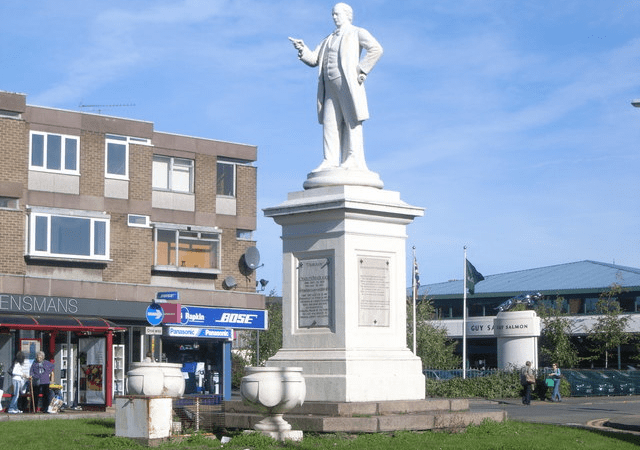
Posterity has treated Bradlaugh well. He has been immortalised in stone in a statue near Northampton’s Abington Park, looking down on me from his plinth when as a 1970s teenager I hung out there to smoke furtive cigarettes and turn up for awkward assignations with local girls.
He has also given his name to a rather nice boozer, The Charles Bradlaugh. Do go there if you’re ever visiting and fancy a drink. TCB, as residents call it, regularly hosts gigs, sometimes featuring the current iteration of punk legends the Aliens, whose many line-ups long ago featured me on bass guitar.
Such posthumous fame is entirely deserved and carries lessons for the present day. Well over a century later, the question of the oath taken by MPs at the start of each Parliament is still a live issue. Then as now, MPs must swear allegiance to our unelected head of state, and some are clearly unhappy doing so.
Jeremy Corbyn, the independent member for Islington North, was this week caught on a hot mic correctly branding this arcane formality as “nonsense”, which is if anything an overly polite description.
As ever, you can’t fault the guy for consistency. In 1991, he seconded Tony Benn’s unsuccessful Commonwealth of Britain Bill, which proposed that MPs and other officials should take their oaths to the constitution rather than the crown.
Labour’s Clive Lewis also made clear that he was acting under duress, stating openly that his promise was provisional until the establishment of a republic and tweeting a clip of his defiance to publicise his stance.
There have been other dissidents in the past. The late Tony Banks, an affable leftish Labour maverick in the 1980s and 1990s, always used to joke that he took the pledge with his fingers crossed behind his back, so it didn’t count.
In the Scottish Parliament, former Scottish Socialist Party MSP Rosie Kane notoriously inscribed the words “My oath is to the people” on her palm and held her hand up for the cameras as she was inducted in 2003. And good for her.
Republican politicians surely have reason on their side. What on earth is the logic of asking them to avow fealty to an institution that is several hundreds of years past its sell-by date and to which they attach zero legitimacy?
This whole idea is roughly equivalent to asking me to swear on my undying love of Coldplay or constant craving for cauliflower. If anything it’s even more pointless; I have no principled objection to spectacularly tedious rock bands or foul-tasting cruciferous vegetables if other people enjoy them. But such a commitment could hardly be binding.
Yet this preposterous mechanism is the necessary corollary of an anachronistic semi-constitutional settlement that dates back to the imposition of William and Mary on the English throne in 1688.
A Labour government that emphasises its mission to modernise Britain is still insisting that its 411 MPs mouth feudal platitudes, whether they mean what they say seriously or not.
Marxist thinker Tom Nairn once described Labour’s attitude on these things as “relic-worshipping”, an adjective that seems as unerringly accurate now as it did when he coined it many decades ago.
Nor is this charade a harmless piece of traditionalist flummery. Keir Starmer’s list of nominees for ministerial office have all been prefaced with the words “the King has been pleased to approve the following appointments”.
His government could entirely legally be removed tomorrow, in the unlikely event of it undertaking any actions that might incur Charles III’s displeasure.
Meanwhile, the oath of allegiance remains as a standing symbolic rebuke and deliberate humiliation to radicals of all stripes, from Corbyn and Lewis to the seven-strong Sinn Fein contingent chosen by voters in the north of Ireland on 4th July, who cite it as one of the grounds on which they refuse to take office.
Sadly, none of them seem inclined to press the case. Where are the twenty-first century Charles Bradlaughs when you need them?
David Osland is a member of Hackney North & Stoke Newington CLP and a long-time leftwing journalist and author. He also writes for Labour Research magazine. Follow him on X at @David__Osland
Image: Charles Bradlaugh monument. Author: Nicholas Mutton. Source: From geograph.org.uk, licensed under the Creative Commons Attribution-Share Alike 2.0 Generic license.
 Labour Hub