
Jeff Slee is optimistic about Labour’s plans for trains and buses.
This website will, I am sure, include much disagreement with the Labour government over the coming years. But let’s give credit where it is due. Louise Haigh has made a great start as Secretary of State for Transport.
The King’s Speech, on Wednesday July 14th, included the Passenger Railway Services (Public Ownership) Bill and the Railways Bill, which together will carry out Labour’s policy on bringing rail back together in public ownership. I wrote about Labour’s policy here in May.
On the same day, the Passenger Railway Services (Public Ownership) Bill was published and had its first Reading. It will make the default position that Train Operating Company (TOC) franchises, when they end – through reaching the end of their term, or because the Secretary of State decides that the company is failing its passengers – will be brought back into the public sector. At present, they can be taken over by the Department for Transport only temporarily and as a last resort. Four TOCs are now run by the DfT’s ‘Operator of Last Resort’, and three others by the Welsh and Scottish governments. The terms of the other ten TOCs all expire withing the first term of this government, starting with Greater Anglia and West Midlands Trains on September 15th this year, so I hope that the core of the rail industry will be in the public sector within a few years.
The Railways Bill has not been published yet. It will set up Great British Railways, which will include Network Rail and those TOCs in the public sector, and bring them together into a unified rail network. This will end the fragmentation of the rail industry which wastes money at all the interfaces between different companies, and makes it harder for the rail industry to work together. A unified rail system will be better, easier to understand, and hopefully cheaper for passengers.
The King’s Speech also included the Better Buses Bill, which will give new powers for local authorities to franchise local bus services, so that they can decide the details of bus services provided by private companies, such as routes, timetables and standards. At present, only London and Manchester Mayors have this power – all other local councils and Mayors do not. It works in London and Manchester, and this power should enable local authorities to provide badly needed better bus services.
The Bill will also give local authorities the power to set up publicly owned bus companies to run their buses, which they can’t do now. In most of the country, bus services are being cut especially at weekends and in the evenings, and bus use is declining. Better bus services will benefit those who can’t afford, or choose not to, run a car. And they could be an important part of local authorities’ efforts to cut carbon emissions. But local authorities will need the funds to be able to make use of the new powers they will get.
The third action of Louise Haigh that we should welcome is arranging meetings between the DfT and ASLEF to try to settle and end the ongoing dispute over train drivers’ pay. This is one of the disputes still unresolved from the widespread pay disputes that started in 2022. ASLEF have held strikes on many TOCs this year to get pay rises for drivers, who are still on pay rates set in 2019 and 2020. ASLEF have welcomed these talks – they have not met the DfT for over a year despite the DfT controlling what TOCs can offer – and are hopeful that this dispute can finally be settled.
Jeff Slee is a retired rail worker and former RMT National Executive Committee member.
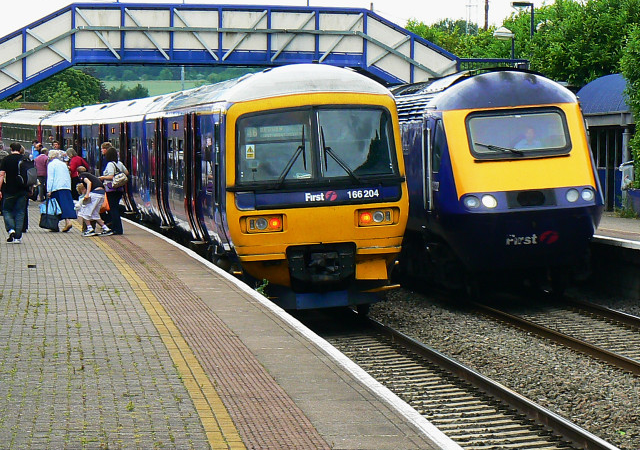
Image: Trains at Hungerford Station. From geograph.org.uk; transferred by User:oxyman using geograph_org2commons. Author: Mandy Barry-Cades, licensed under the Creative Commons Attribution-Share Alike 2.0 Generic license.
 Labour Hub