

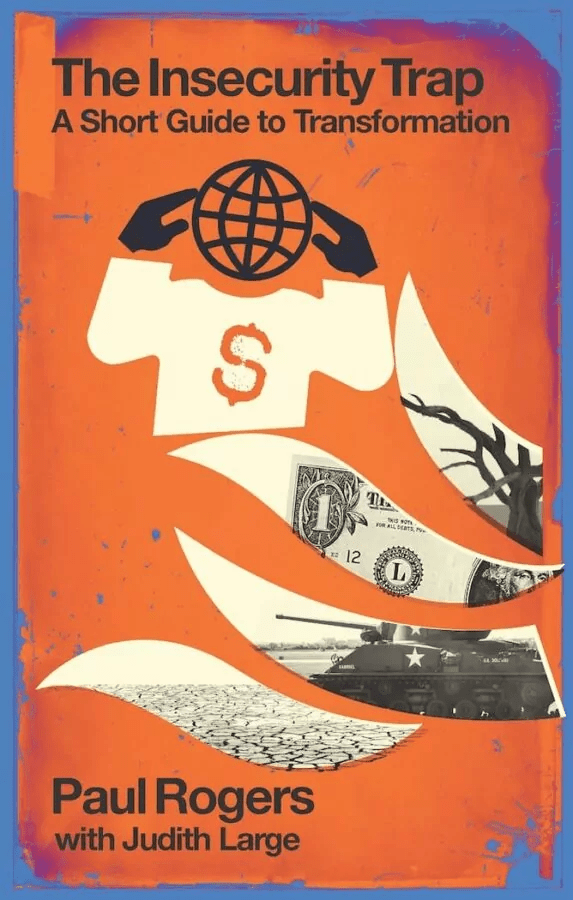
Paul Rogers explains why security policy needs to break with past priorities and outlines some of the issues explored in his latest book, published today.
The Labour Government’s Strategic Defence Review, announced after the election in July and now under way, was launched as “A root and branch review of UK Defence”. If it really does turn out to be a fundamental reassessment then well and good, but the indications so far are that yet another traditional review is far more likely.
In the run-up to the election, Starmer and shadow cabinet politicians made it abundantly clear that Labour would play it absolutely mainstream when it came to military matters. It would remain fully committed to NATO and would increase military spending while maintaining the Trident upgrade programme. Given that Trident will cost at least £200 billion over the lifetime of the new system, that alone will have a long-term impact right across the UK military posture, leaving little room for ‘root and branch’ change.
Instead, a Strategic Defence Review must relate to the main international security challenges that face us and that should include an honest assessment of Britain’s abject failures in recent wars, especially Afghanistan, Iraq and Libya. The UK armed forces have been integral to the coalitions involved in all three of those wars, just as it has been a close partner to the United States in the devastating 2014-18 air war against ISIS and is far more involved in Israel’s current wars than it will acknowledge.
According to the Cost of War programme at Brown University: “Over 940,000 people have died in the post-9/11 wars due to direct war violence” and “an estimated 3.6-3.8 million people have died indirectly in post-9/11 war zones, bringing the total death toll to at least 4.5-4.7 million and counting.”
Unless the impact and consequences of the disastrous war on terror are recognised in the review, it will have very little credibility. Furthermore, it must be rooted in a recognition of the three main challenges ahead. One of these, the persistent reliance on military solutions to complex human problems, certainly relates to those failed wars, but the other two look very much to the future – climate breakdown and the unjust global economic system.
The marginalisation of hundreds of millions, if not billions, of people in the wake of 45 years of the neoliberal transition leads to deep resentment, anger and violence at the unfairness of the global economy. It makes it far more likely that we are moving into an era of revolts from the margins than any supposed ‘clash of civilisations’.
Moreover, this is hugely exacerbated by the immediate challenge of climate breakdown from the use of fossil carbon – coal, oil and gas – as the primary source of energy. Radical and rapid decarbonisation is essential and the current efforts have to be greatly accelerated in this decade if catastrophes are to be prevented.
In short a meaningful strategic defence review has to respond to three questions:
- Can we respond to climate breakdown in time?
- Can we transition to a much fairer economic system?
- Can we change from hard security to human security?
These challenges are interrelated, not separate, and this makes for a triple crisis to which the Strategic Defence Review must respond. The current neoliberal or market fundamentalist system with its strong preference for a deregulated free market economy cannot respond to climate breakdown in time. Instead, the emphasis will likely be on hard security relying on military force, which will exacerbate the crisis.
The most telling example is the Global North’s response to asylum seekers and migrants who are seen as threats, not people desperate to move for a chance of a better life. Even now, the response is one of ‘closing the castle gates’ and this will become far more intense as the impact of climate breakdown leads not to millions but tens of millions of people desperate to move.
More than fifty years ago, the economic geographer and former Labour MP Edwin Brooks warned of the risk of a “crowded glowering planet of massive inequalities of wealth buttressed by stark force yet endlessly threatened by desperate men in the global ghettoes.” We are far closer to that now, yet there are many ways out of the mess, with the Strategic Defence Review a good opportunity to take some forward.
Going back to those questions, responding to climate breakdown may be getting rapidly more urgent but several factors are increasing the chances of doing it in time. For a start, the climate science community is getting far more funding than in the past and there is far greater confidence in their forecasts. Then the public awareness of the risk of breakdown has increased, even to the extent of people being prepared to be imprisoned for their beliefs.
Thirdly, there have been significant improvements in the processes of radical decarbonisation and such a decrease in the costs of renewable energy resources that they are frequently below grid parity compared with fossil carbon. Finally, and in marked contrast to a decade ago, the early signs of climate breakdown are there for all to see, especially in extreme weather events leading to huge wildfires, as well as droughts, flooding and storms.
Labour started to set in motion some changes in UK policy before 2010 but momentum was lost under the Tories. Labour has now started to turn that around, not least due to pressure from campaigners and the determined pushing from Ed Miliband and a handful of MPs, but it has a very long way to go and time is short.
The response should be twofold: national and global. At the domestic level, the pace of change must be ramped up, starting with accelerating the change to wind and solar power, a national strategy of home and workplace insulation and a rapid transition away from fossil carbon-based transport. Much of the increased cost should come from decreasing traditional defence spending, since what is needed is a rethinking of the whole approach to security where preventing climate breakdown is the priority. In this green transition, the UK should be the world leader and this should be reflected in the second element – global action.
In parallel with the domestic transition, the UK should put substantial funding into enabling weaker states across the Global South to make the direct transition to green economies. A good start would be to reconstitute the Department for International Development (DfID) while tripling its budget with much of the addition focused on that green transition.
Of the three questions put forward earlier, the need to prevent climate breakdown may take centre stage but this inevitably has to be focused on governmental and intergovernmental action which is a useful step towards an era of post-neoliberal governance. It might also do much to change the national pro-military culture. It is no accident that Britain has over 140 war museums and just one peace museum. Perhaps even that will change with time.
Paul Rogers is Emeritus Professor of Peace Studies at Bradford University and has also lectured regularly for over forty years at Britain’s senior defence colleges. The issues in this article are discussed fully in his new book, The Insecurity Trap: A Brief Guide to Transformation, published today by Hawthorn Press.
 Labour Hub
[…] starts, as Paul Rogers has argued, with “an honest assessment of Britain’s abject failures in recent wars, especially […]