
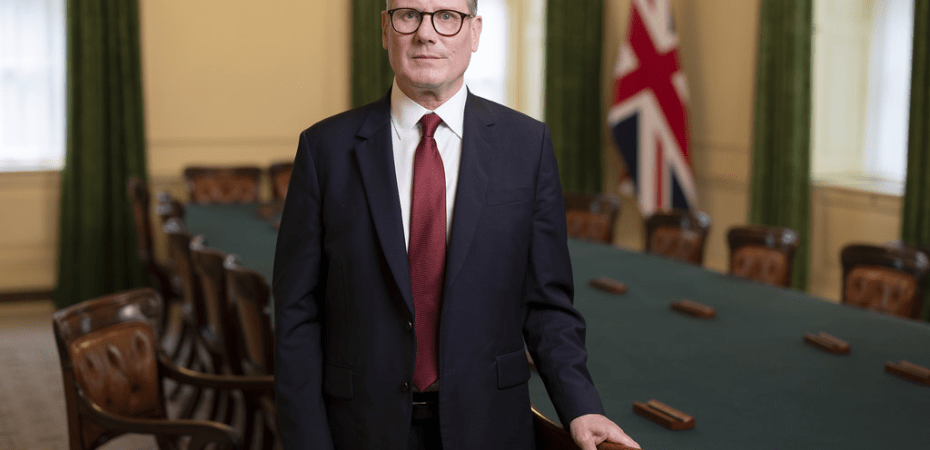
The Starmer government looks set to entrench, rather than challenge, the Tories’ erosion of civil liberties, but its overall lack of ideas could allow the left to shape the agenda. Labour Hub is pleased to publish the editorial from the latest issue of Soundings, by Dave Featherstone.
During the 2024 general election campaign in a phone-in organised by the Sun newspaper, Keir Starmer argued that rather than putting asylum seekers on planes to Rwanda he would invest in putting “staff back in the returns unit” – in order to facilitate deportations. Asked what his alternative was to Conservative measures of ‘deterrence’, he responded: “At the moment, people coming from countries like Bangladesh are not being removed, because they’re not being processed.”
Comments such as these serve to both normalise and legitimise the languages of racialised division and the demonisation of asylum seekers that have become all too commonplace across mainstream political discourse in the UK.
The remarks caused significant offence, particularly to British Bangladeshis. They also resulted in the resignation from the Labour Party of Sabina Akhtar, the deputy leader of Tower Hamlets Labour group, while Apsana Begum, Labour MP for Poplar and Limehouse, and a long-term advocate for migrant and refugee rights, stated: “It’s totally unacceptable for politicians of any party to use dog-whistle racism against Bangladeshis or any other migrant community.” Begum also spoke of the long battle of Bangladeshi communities in the East End against the racism they have experienced – drawing attention to the mobilisations in the wake of the racist murder of Altab Ali in 1978 – and their message “here to stay”.
Starmer’s comments also draw attention to the extent to which the Labour campaign was fought on the grounds staked out by a racialised right-wing populism, rather than seeking to break with such divisive rhetoric or to offer more hopeful and positive agendas. While the leadership’s approach has clearly been successful in narrow electoral terms, Starmer has so far failed to do the work of building an electoral coalition or bloc with significant foundations of support, or of shaping a broader articulation of what Starmer’s Labour stands for.
This editorial seeks to put forward some initial positions, which will be developed further in Soundings and elsewhere over the coming years. This commentary focuses in particular on the authoritarian trajectories that inform Starmer’s’ politics; the failure of the party to challenge common sense on the economy; and the potential pressure points that the left may develop in mobilising for a change of direction, not simply one of management.
Authoritarian trajectories
One of the main characteristics of the current conjunctural context is a resurgence of different forms of authoritarian politics. Engaging with Starmer’s ‘authoritarian statism’ is thus a necessary part of any critical analysis of his political leadership. Commentary on Keir Starmer from the left has consistently drawn attention to the authoritarian tendencies that mark his politics and which marked his approach as a holder of key public offices, for example when he was the Director of Public Prosecution.
The authoritarian trajectories that have shaped Starmer’s political style and approach are likely to significantly shape agendas during Labour’s time in office. The ways in which Labour responds to the resurgence of rightist authoritarianism globally and violent far-right politics on the streets in parts of the UK will have a profound and long-term impact. This is of particular significance given the ugly forms of right-wing populism currently being encouraged by Farage and others.
The urgent need to contest the resurgence of the far right is underlined by the racist and violent disorders of July 2024 in England and Northern Ireland, as a manufactured response to the horrific knife attack in Southport (racist attacks earlier in the summer on the Ballycraigy estate in Antrim had already led to eight families having to leave their homes).
It is crucial that this violence is tackled as part of a broader anti-racist strategy, which moves beyond a narrow focus on criminality. At the time of writing, Starmer and Yvette Cooper had largely ignored the broader context of these events. They had failed to engage with a wider agenda of challenging the populist racialised discourses that have been circulating in the public domain for a very long time and the related long-term demonisation of refugees and asylum seekers, and those from racialised minorities. It is also indicative that the Paymaster General Nicholas Thomas Symonds has cautioned against people joining the ‘counter-protests’, despite their significant role in challenging far-right mobilisations.
It is important, too, to recognise a longer-term history of Labour authoritarianism. Harold Wilson, currently being claimed by some as a sort of centre-left hero, was associated with pernicious red-baiting, not least through his notorious attack on the 1966 Seafarers’ strike as resulting from the actions of a “tightly knit group of politically motivated men”. Wilson also declared a state of emergency during the dispute, as Attlee had done against unofficial dockers’ strikes in the late 1940s. New Labour subsequently contributed a tranche of repressive measures to this tradition – including setting up Prevent and instituting Antisocial Behaviour Orders (ASBOs). These were part of a broader entrenching of racialised divisions and rhetoric during its period in office.
As Stuart Hall argued in 2006, multiculturalism, “which for a time was government doctrine” had been “quietly buried” in the context of “the ‘War on Terror’, the adventure in Iraq, and rising new immigration numbers.” He continued: “As the barriers to migration across Europe have become entrenched, the pursuit of illegal immigrants more vigorous, and the policing of borders more systematic, so a widespread assimilationism not seen in the UK since the 1970s is rising to the surface and becoming de rigeur.”
Starmer’s ‘authoritarian statism’ thus builds on, rather than breaks with, the toxic legacies of New Labour’s racial politics, which helped to prepare the ground for the Conservatives’ ‘hostile environment’ strategy. Netpol’s Kevin Blowe sees the Prevent measures as “the defining legacy for Labour, along with the War on Terror”, which then came to be applied to entire communities.
Blowe also emphasises Starmer’s failure to situate questions of justice within the context of unequal power relations, and his track record of ignoring the “massive imbalance in power between the individual and the state.” In similar terms, as Oliver Eagleton notes, Starmer’s time as adviser to the Northern Irish Policing Board was characterised by “studiedly uncritical” engagement with the Police Service of Northern Ireland.
This is arguably reflective of the ‘muscular’ unionism that has informed his approach to devolved politics, particularly in the North of Ireland and Scotland, most notably when in 2021 he indicated that Labour would campaign in favour of the union in the event of a border poll – a position that would be in contravention of the Good Friday Agreement.
These authoritarian trajectories have, however, perhaps been clearest in the current Labour leadership’s relentless attacks on the left/ centre-left within the Labour Party, in order to “show that it has changed”. As the Welsh Grassroots Labour activist Darren Williams noted in his letter resigning from the party: “It’s the ruthlessness of the party’s internal regime under Starmer that has been hardest to live with.”
This repressive internal party culture has intersected with and reproduced institutional racism within the party. And it can also be seen in the failure of the leadership to properly respond to the Forde report, which highlighted “serious problems of discrimination in the operations of the Party.” It is further evident in the ways in which leading women of colour within the party, such as Diane Abbott and Faiza Shaheen, have been treated in clearly discriminatory ways.
The Labour leadership’s repressive culture has been shaped by specific racialised geographies, particularly in relation to party members who have opposed the leadership’s failure to take an unambiguous stance against the genocide in Gaza. Some of the Labour councillors who resigned over this issue were described by a party spokesperson as “fleas”; debate in Constituency Labour Parties has been silenced; and it has been alleged that Starmer seriously misrepresented the nature of a visit he made to the South Wales Islamic Centre in Butetown, Cardiff, which was intended to help shore up ‘community relations’.
As Mike Makin Waite notes in relation to Burnley, where mass resignations of Labour councillors took place over the leadership’s position on Gaza, these issues relate to broader issues with “the party’s ‘top-down’ managerialism”, which “has long meant that grass roots members are not given genuine scope to reshape party culture and policies.”
This authoritarian edge, which seems integral to Starmer’s politics, is of particular concern given that Labour has come to power after a long period in which rights to protest have been so relentlessly stripped away. Pro-Palestine solidarity protests have been demonised as ‘hate’ marches, and protesters have been subjected to harsh policing. Thus there were allegations of police brutality against demonstrators at the Thales weapons manufacturing plant in Glasgow in early July; participants in a Palestine Action protest at an arms factory were arrested “on suspicion of being part of an organised crime group”; and peaceful Just Stop Oil activists have recently been sentenced for up to five years in prison merely for planning Non-Violent Direct Action.
In this respect the likelihood is that the party will entrench rather than challenge the Tories’ authoritarian measures; and there is little chance that the new government will rein in such policing of protest. This approach is connected to a broader lack of commitment to bringing about transformative political change.
What kind of change? Growth on what terms and for whom
The first few weeks of the Labour government in summer 2024 brought some key changes of tone, and opened up the possibility of leaving behind the horrors of the fourteen years of Tory rule and austerity. As the subsequent upsurge in far-right violence emphasises, however, it is going to be hard to recover from the shadow and legacies of this period. This makes it all the more disappointing that the core slogans of the election campaign have remained ill-defined – or defined in ways that are unpromising. As regards ‘Change’, the emphasis seems to be on better management rather than new directions; and ‘growth’ seems to be predicated on a continued neoliberal paradigm, particularly in the emphasis on deregulation.
While part of the point of the slogan was to enable a broad electoral coalition, there has so far been little sense of what change might mean in practice. Indeed key Labour figures have often evaded questions about what kind of change is being envisioned, or on what terms growth is being planned. Discussion of ‘growth’ has been of particular concern: it has been alarming to see Rachel Reeves recycling the ideological tropes used to justify austerity, rather than critiquing its destructive logics. This also means that more progressive interventions, such as the commitment to nationalise rail and to develop a nationalised energy company, are not being articulated as part of a broader political alternative.
As Aditya Chakrabortty has pointed out, in wheeling out tired rhetoric such as the need for ‘emergency cuts’ and a ‘maxed-out Credit card’, Reeves is using the “analogies and arguments” of the Conservatives, in ways that are closing down political options. In her account of the economy, so many questions seem already settled, while ‘growth’ is positioned as the self-evident answer to everything. It has been constructed as the only available answer to poverty: there is to be no questioning of whether growth is in itself desirable, or acknowledgement of the evident link between poverty and inequality.
There has also been remarkably little discussion of what kind of growth is envisioned – ideas about ‘green growth’ and the care economy have faded from the discussion. (During the Covid pandemic, interesting alternative agendas were developed around care which were associated with different ways of thinking about, or evaluating the economy: see for example the Care Collective, The Care Manifesto, London, Verso 2020.) Deregulation is presented as self-evidently a good idea. The private sector is seen as a neutral partner and there is little consideration of alternative forms of ownership. As Doreen Massey argued in ‘Vocabularies of the Economy’, a key contribution to the Kilburn Manifesto, the “vocabulary we use to talk about the economy… has been crucial to the establishment of neoliberal hegemony.”
Reeves’s vocabulary of ‘growth’ closes down from the outset a set of foundational questions about what the economy is for, how it is shaped and how the markedly uneven geographies of ‘growth’ – with all the attendant inequalities which result from this – are to be negotiated. And it need hardly be said that this unquestioning focus on ‘growth’ is most obviously disastrous in terms of its lack of engagement with pressing environmental agendas.
Reeves also has little to say about which constituencies growth will benefit and which it will not, and the choices this involves – and how this relates to the fractured, uneven geographies of the UK. This ignores some of the potential antagonisms which her policies might serve to further solidify. Alex Burt notes that “‘the promise of further austerity under Chancellor Rachel Reeves would only further sow discord and depression in working-class communities that the far-right will exploit.”
Andy Beckett, among others, has argued that the Labour leadership’s rhetoric has failed to articulate a broader analysis of power beyond focusing on the incompetence of the Tories. Indeed, early indications strongly suggest that Keir Starmer’s government is most likely to define change against the (Labour) left, rather than to face down powerful interests.
The six-month suspensions of the seven Labour MPs brave and principled enough to vote against the government’s retention of the two-child benefit cap – one of the most pernicious legacies of the Tory government – is indicative here. So too is the announcement of means testing for winter fuel payments – an attack on ‘progressive universalism’ that the party opposed in opposition.
Even more telling is the fact that these refusals of social support coincided with arguments making the case for higher defence spending. Such a failure to articulate a transformative political agenda comes with significant risks and dangers in the current political conjuncture.
The consequences of failing to give content, shape and values to the meaning of ‘change’ can be seen all too clearly in France, where Macron’s empty centrist politics has helped open up space for the growth of the far right. Reform UK’s very strong showing at the election is a warning of a potentially similar development in the UK: while Farage’s talk of providing ‘real change’ indicates the extent to which a failure to engage politically with inequality offers wide open spaces for the far right to occupy. This is particularly concerning given the Tories’ current state of flux as an opposition, and the significant and pernicious role that Reform politicians such as Farage and Lee Anderson have played in articulating a politics around the recent riots.
Left agendas and possibilities
The current political context is structured by a paradox: whilst there is undoubted relief at getting rid of the Tories, the resulting electoral landslide for Labour is not underpinned by significant enthusiasm for the electoral ‘product’ of Starmerism. What’s more, the landslide was partly the result of divisions on the political right, and was delivered on a very low turn-out – which indicates a significant disaffection with political engagement more generally (and was exacerbated in Scotland by both the timing of the election and issues with postal voting). Unusually, a number of significant figures associated with the incoming administration, on the right of the party, either lost seats to pro-Palestinian independents, as in the case of Jonathan Ashworth in Leicester South, or were run very close, as in the case of Wes Streeting, who was challenged by Leanne Mohamad in Ilford North.
More generally, Starmer’s administration is defined more by the absence of ideas or project than by any sense of a plan to reshape society along new lines. This means there are some significant possibilities for the left to put forward its own ideas, even though it clearly faces a difficult situation in other ways. Starmer also inherits a situation where significant strikes have been led by combative union leaders such as Sharon Graham and Mick Lynch, unlike Tony Blair, who faced a largely quiescent labour movement. This means that on some questions there is a possibility that Labour can be pushed or pressured to be more radical – and here there are further positive signs, for example the commitment to reversing some of the Tory anti-strike legislation.
The current political conjuncture has also been shaped by important trajectories of resistance, notably the Black Lives Matter movement and the Palestine solidarity movement, which have resulted in the election of four pro-Palestine independent MPs, alongside Jeremy Corbyn’s strong showing as an independent candidate. These are forms of engagement with radically different constituencies than those imagined as being important by Starmer’s anodyne centrism. As Nesrine Malik has argued, rather than being somehow “politically sectarian”, “Gaza’s resonance stretches across diverse demographics,” and is ‘both connected to and informed by other political grievances.”
Mars Zaslavsky notes in an article co-published by Eurozine and forthcoming in Soundings that the Palestine solidarity movement has been shaped in important ways by a younger generation which has often articulated such solidarities in relation to queer and trans politics. Student protest in relation to Gaza has also consistently linked the issue of Palestine to higher education’s substantial investment in the ‘Military-Industrial-Academic Complex’.
The making of these connections potentially reflects the emergence of a more plural terrain of left politics. This is also indicated in the more diverse electoral success of parties broadly on the left, as with the election of four Green MPs, and political changes within the different countries and regions of the UK. Shifting political dynamics in Wales, Scotland and the North of Ireland may offer more political space for the left in the future, while the very significant gains for Labour in rural seats suggest the opportunity to break with the Conservatives’ longstanding hegemony in the countryside.
Starmer’s failure to put forward a compelling political agenda also leaves open significant political space for the left to seek to reshape common sense. As Mike Rustin puts it in his article in the latest issue of Soundings, might it be that ‘this apparent theoretical nullity leaves space in which debates can take place’? One area where there is the potential to reshape the agenda, as Andy Cumbers argues in the issue, is on the idea of public ownership, which remains very popular, at times across the political spectrum. This is an issue where there are clear possibilities for building on existing experience and support.
The battle to shape common sense is up for grabs: there is a big political space for making arguments that face down the hollow calls for ‘real change’ from the likes of Farage. It is important that the left makes every effort to participate in this debate, to help shape support for change that takes from the rich and redistributes to the poor – the opposite of what the Tories have been doing these last fourteen years. It is also crucial to create broad-based solidarities through anti-racist mobilisation against the demonisation of refugees and asylum seekers, whether this is done by the far right or centre-left politicians like Starmer.
Mick Lynch noted on election night, referencing Starmer’s notoriously cautious electoral strategy, that it is impossible to carry a Ming vase for five years. The resurgence of the far right that has occurred since Labour’s time in office emphasises the urgent need for transformative political change, and for opposing rather than acquiescing in racist rhetoric. The extent to which such political change can be mobilised will depend in part on the ability of the left to push for a more progressive political direction and to mobilise around alternative political demands and futures.
Dave Featherstone is a Professor in Human Geography in the School of Geographical & Earth Sciences at the University of Glasgow. The current issue of Soundings, a journal of politics and culture, can be accessed here.
Main image: https://www.flickr.com/photos/number10gov/53836009867. Creator: Simon Dawson / No 10 Downing Str | Credit: Simon Dawson / No 10 Downing Str Copyright: Crown copyright. Licensed under the Open Government Licence Attribution-NonCommercial-NoDerivs 2.0 Generic CC BY-NC-ND 2.0
 Labour Hub