
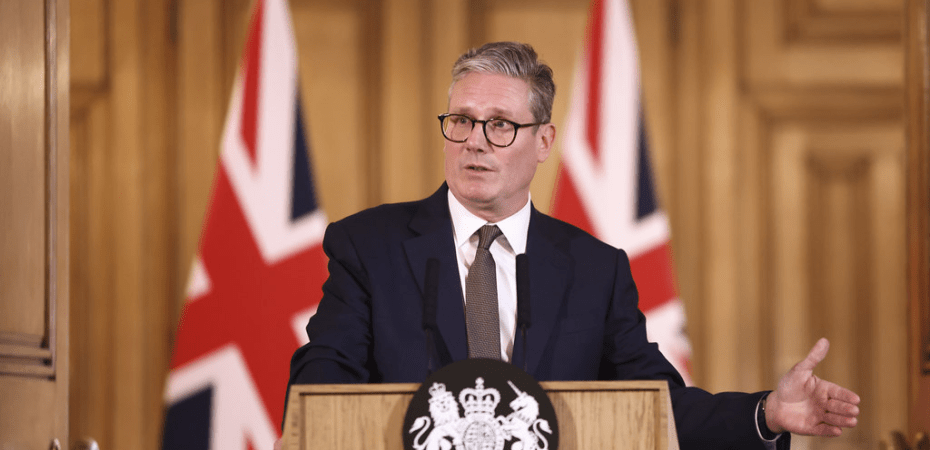
The rocky start to Keir Starmer’s Government is no accident given who is running it, argues Mike Phipps.
Three months into a new Labour Government following a landslide victory, things are not going well. Keir Starmer’s personal ratings have fallen precipitously since the general election – by 45 points between July and September. In fact, his ratings among voters are the lowest after three months in office of any UK prime minister in the last three decades, according to the latest polls – just 27%, compared to the 40-50% satisfaction levels enjoyed by the often maligned Gordon Brown who hadn’t even had the advantage of winning an electoral mandate – let alone a landslide.
Currently, just 18% of people surveyed approve of the new Labour Government. Nearly 60% disapprove. While two-thirds of Labour voters thought the Party was doing well two to three weeks after winning the general election, only 36% currently believe that to be the case – and over half say the Party is performing poorly.
Since the general election, Labour has lost a dozen council seats in by-elections. This week alone it lost four, and last week it lost two seats in the northwest to the Greens and Reform UK on huge swings.
To understand what is happening, we need to drill down below appearances. The appearances, however, are themselves telling: two major policy errors – retaining the two-child benefit restriction and means-testing the winter fuel payment for pensioners; the controversy over freebies and gifts for the Prime Minister and Cabinet colleagues, which reek of the outgoing Conservative administration’s venality, which Labour was supposed to sweep away; and the unseemly battle for control in Number Ten which has seen the exile and demotion of former Chief of Staff Sue Gray.
The general election was not an endorsement of Keir Starmer
There are three things in particular that need to be understood. First, the general election result was never likely to produce much of a honeymoon period. Despite the unprecedented landslide in seats, July’s election produced a complex set of results, reflecting a fragmented electorate and the distorting effects of our first-past-the-post electoral system.
The Conservative humiliation was overwhelming. It reflected the fact that 55% of Labour voters said they voted as they did to get the Tories out. But this was scarcely an endorsement of Keir Starmer. His government was elected with just 35% of the popular vote. That’s a lower vote share than Labour got under Jeremy Corbyn in 2017 when it lost to Theresa May’s Conservatives and about the same as when Ed Miliband lost in 2015.
Pollster John Curtice went so far as to say: “Actually, but for the rise of the Labour Party in Scotland… we would be reporting that basically Labour’s vote has not changed from what it was in 2019.” In fact, only 1% of voters recently surveyed said they voted Labour because of Keir Starmer.
Record low voter turnout, for an election which saw a change of governing party, underlined the malaise. It was a verdict on the entire political class, seen as untrustworthy and even indistinguishable. Focus groups repeatedly told pollsters they had no faith in politicians nor in any party to sort out the problems the country faces. This is one of the reasons why the revelations about gifts and freebies is especially damaging at this time. Three months in, nearly 60% of voters think the Labour Government is “sleazy.”
Labour’s election campaign chiefs have won widespread praise for squeezing so many seats out of the Party’s relatively low vote. But there were significant weaknesses – including errors and factional stupidities – in the campaign as well.
Shortsightedly campaign strategists were content to see Reform UK take Tory votes. As I have argued elsewhere, “Rather than flooding canvassers into Islington North to defeat Jeremy Corbyn, the Party machine might have used its energies more effectively to mount a campaign against Nigel Farage in Clacton – especially after the Channel 4 exposé of racism and homophobia in Reform. Instead Labour’s young Black candidate was instructed to go campaign elsewhere.”
There were other problems with Labour’s campaign. We didn’t need the self-inflicted controversy over whether Diane Abbott should be allowed to run, only successfully resolved after a massive campaign by members and supporters beyond the Party. The Labour apparatus cost the Party seats, for example with the factionally motivated deselection of Faiza Shaheen in Chingford mid-campaign, which pretty much gifted the seat to the hated Tory incumbent, Iain Duncan Smith. Romford, where I campaigned on election day, had been denied resources on the ground that the seat was “unwinnable”. We lost it by 1,500 votes – not the first time the Party’s so-called experts misread the runes, something which happened throughout the Corbyn years as well.
Leicester, another focus of leadership factionalism – last year the apparatus deselected 19 sitting councillors – also saw Labour losses, and not just Shadow Cabinet heavyweight Jonathan Ashworth. Leicester East, held by Labour for 37 years, was the only Tory gain on election night.
Three things are clear from the election. Firstly, there is no such thing as a safe seat anymore. That’s not just because of the rise of Reform UK and the resurgence of the Lib Dems. Other factors are in play: independent Leanne Mohamad, for example, came within 500 votes of unseating Wes Streeting in Ilford North.
Secondly, real enthusiasm for Labour is limited: the proportion of those polled who said Labour was fit to govern was 31% in April 2024 and only 24% of people say that Labour has a good team of leaders. That didn’t change suddenly in July and it’s confirmed by current polling.
Thirdly, people want change. In particular, they want an end to austerity. This is why the announcements continuing the two child benefit rule and cutting winter fuel payments are so jarring.
The rise of the far right
The second big thing that needs processing is the rise of the extreme right. Luke Tryl, UK Director of More in Common, tweeted; “If voter disillusionment is not now addressed, this may be our France 2017 election. Here’s one parallel: National Rally 2017: 3 million votes (1st round), 8 seats. Reform UK 2024: 4 million votes, 4 seats. National Rally 2024: 10.6 million votes. Likely 200+ seats.”
We saw a foretaste of that with the fascist riots in August. It’s clear that the far right – well funded internationally – is on the march in Europe and elsewhere. In particular, there is a major shift to the right among young men, which hitherto Britain has been shielded from by 14 years of Tory government – but this will change if Labour fails to deliver.
And again we must remember: it’s the normalization of far right ideas by the mainstream that has fuelled this growth – in the Netherlands, Germany – and here too. Equally the failure by all Governments to make headway on bringing about greater social equality, alongside the fragile advances made on sexual and ethnic equality, are producing a backlash.
It’s not just the prevailing climate of official hostility to migrants that formed the backdrop to this summer’s riots. For the last twelve months, both Government and Opposition have ignored the war crimes and breaches of international humanitarian law that have characterised Israel’s genocidal assault on Gaza. In doing so, they have helped normalise violence against not just Palestinians, but people of colour more generally. We are in a situation where our Government, of whatever stripe, cares more about the human rights of some people than others.
It is truly worrying that fascist marches through London cannot today be outnumbered by militant counter-marches as they could in decades past. But we can take heart from the tens of thousands of ordinary people who came out in the wake of the fascist riots to defend communities and stand together with those targeted. Yet the Labour Party as such was not there. Its response to the riots was short-term and authoritarian – and that authoritarianism continues to characterise its approach to migration and asylum seekers too.
The state of the Party
Thirdly, to fully understand the Government’s recent mis-steps, it is necessary to examine the state of the Labour Party. It remains in the control of a divisive, authoritarian faction whose principal motivation has been to expunge Corbynism. It has deliberately alienated grassroots activists and fostered an arrogance that many people fear will now be extended from the governance of the Party to the governance of the country.
It has endeavoured to stamp out legitimate democratic debate in the Party. Long-standing MPs have lost the Party whip – including seven for voting against keeping the two child benefit rule post-election. Now there are plans to prevent even backbench MPs from speaking freely about Government policy.
Councillors have been suspended for voting for a ceasefire in Gaza, or told they can’t stand again for Labour, despite impeccable records. Popular and successful North of Tyne Mayor Jamie Driscoll was kept off the longlist for the new mayoralty in the North East, despite deep roots in the area – he is consequently setting up a new formation that could well eat into Labour’s now fragile base in the region. Emma Dent Coad who was MP for Kensington MP from 2017 to 2019 was kept off Labour’s list for Kensington, despite being a hugely popular local councillor who campaigned tirelessly on Grenfell.
The alleged justification for these manoeuvres – the need to ensure candidates of better quality – did not appear to apply to those not on the left, as we saw in February’s Rochdale by-election where Azhar Ali was waved though as Labour’s candidate only to be publicly disowned mid-campaign, costing Labour the seat. People from a different wing of the Party have generally been treated far more leniently that those on the left. Neil Coyle MP, for example, had the whip restored after initially being suspended for drunken abuse and making racist comments to a journalist. He had also reportedly previously had a complaint of sexual harassment upheld against him over an incident at a past Labour Conference.
This factional strategy of repressing the left – expelling some in order to demoralise and drive out many more – was originally adopted by the leadership after 2019 in the belief that the Tory 80- seat majority could not be overturned in a single term and that the first few years should be spent cleansing the Party. Until July, this narrow, divisive approach was an internal Party matter, noticed by a relatively small number of activists. Now it’s a national problem – the squabbling over salaries, the briefing against fellow staffers, the driving out of Sue Gray – as if we didn’t have enough of that in the Party already in the Blair-Brown era and again later with Party officials trying to destabilise Ed Miliband and Jeremy Corbyn.
Some of the people involved have known little else other than student politics. But the arrogance and entitlement are things that most people will find repellent. So fixated are some of these apparatchiks on fighting last year’s battles against not just the left but also against what the left stands for, much of which is rightly still hugely popular, that they embrace policies, including the two child benefit policy and the winter fuel payment restriction, that are not just politically stupid – they are morally wrong. Which is why three months in, the government is facing a full-scale ethical crisis.
And because these advisors and staffers, who care primarily about political fixing, have so little knowledge of the real world and have a very shallow understanding of politics, they will inevitably fall prey to the powerful corporate interests that are lining up to ensure precisely that this Government does not deliver change. In short, they are a danger to this Labour Government being successful.
John McDonnell MP tweeted on October 6th: “We’re facing the potential of a war setting the Middle East alight, already thousands are being killed in Lebanon, and what is the focus of the boys around Keir Starmer’s office, carving up Sue Gray and grabbing her job and salary. Words fail me.”
What can we do?
Against this narrow, sectarian, opportunist, morally deficient approach, we have to remember why Labour got elected and why it has been temporarily trusted to run things after 14 years in opposition. This means broadening the base of the project and advancing inclusive, universalist remedies. The winter fuel payments cut has rightly been seen as a kite-flying exercise against universal benefits in general – it could be NHS treatments and concessionary travel next. We have to advance a unifying, inclusive response – only if these benefits are universal will we build a more cohesive, less stigmatising and divisive, society.
On the rise of the far right, Labour must break with the victim-blaming narrative the right has established on migrants, and advance an inclusive, welcoming discourse. And in foreign affairs, it must stop ignoring war crimes when they are perpetrated by the UK’s allies and stand firm for upholding universal human rights. These are obvious basic decent, collectivist, social values. They were expressed by the people who came out and stood in solidarity when diverse communities were facing fascist attack – but it’s a vision that has been in short supply from our leaders.
We also have to ensure Labour delivers real change. We face a threefold crisis in health, the cost of living and the climate emergency. Labour has done some positive things so far, including settling outstanding pay disputes, strengthening workers’ rights, renationalizing rail, setting up a public inquiry into the murder of Northern Ireland lawyer Pat Finucane, relinquishing the Chagos Islands. But it will be succeed or fail on the big stuff. More privatisation won’t help the health service and carbon capture won’t solve the climate crisis. Above all, with departments being asked to draw up plans for potential infrastructure cuts, we will not get growth without investment.
To achieve this, activists will need to push for policy solutions that can realistically address these crises, drawing on the wealth of experience gained by those fighting on these fronts over the last fifteen years and working with those MPs who have championed effective solutions. That means rebuilding the social movements beyond the Party to maintain maximum pressure on the Government on these issues.
The left needs to express these policy needs inside the Party, working closely with the trade unions in particular. The Party Conference vote overturning the Government cut to winter fuel payments – highly unusual in the first few months of a new Labour Government – shows that the left can win on policy when key unions are onside.
It also means organising locally not only to make local councils more responsive on the crises outlined above, but also turning them into focuses of participatory mobilisation. A few years ago, Barcelona en Comú was one expression of this kind of municipalism, constructing its manifesto in a genuinely democratic way, decided in mass Peoples’ Assemblies and with online tools, drawing on its members’ many years of experience in social movements in the city. In the UK, Preston Council’s trail-blazing Community Wealth Building model demonstrates other possibilities. With local communities under threat from the rise of the extreme right, these approaches take on a new urgency.
We can take heart from the fact that the conditions which produced the huge 2017 vote for Jeremy Corbyn’s Labour have not gone away – they have intensified. Radical ideas remain popular, precisely because of the magnitude of the crises: the longest period of stagnation since at least the 18th century; wages lower today in real terms than they were in 2008; public services facing their worst crisis on record; 600,000 more children are in poverty compared to 2010. This is not a time for steady-as-she-goes managerialism.
If we don’t start fixing these huge problems, Labour will be out of office in five years – simple as that. And if the rest of the world is anything to go by, the alternative will be far worse than anything we have yet seen. We have a breathing space – but it’s a short one and activists have to map out a strategy now if they are going to make a difference.
Mike Phipps’ book Don’t Stop Thinking About Tomorrow: The Labour Party after Jeremy Corbyn (OR Books, 2022) can be ordered here.
Image: https://www.flickr.com/photos/number10gov/53839153838 Creator: Simon Dawson / No 10 Downing Str | Credit: Simon Dawson / No 10 Downing Str Copyright: Crown copyright. Licensed under the Open Government Licence: Attribution-NonCommercial-NoDerivs 2.0 Generic. CC BY-NC-ND 2.0
 Labour Hub