
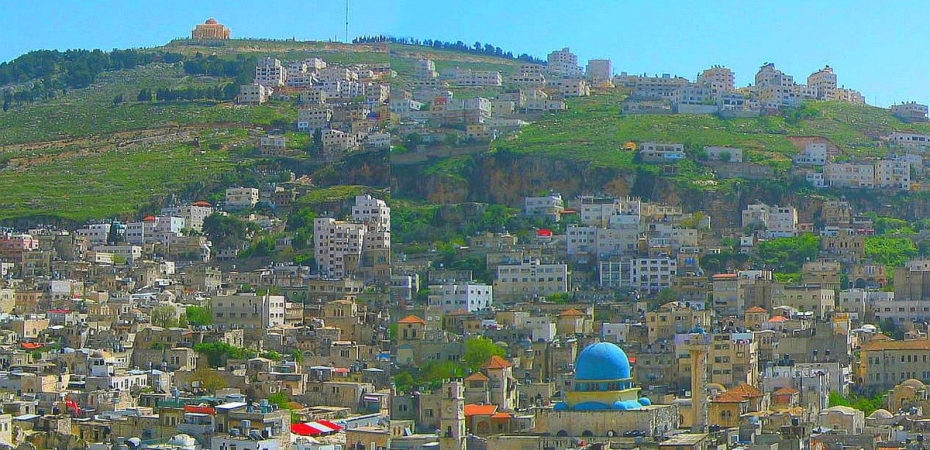
Yihya Sirhan recalls the Palestinian city which holds a special place in his heart.……
Unifiliar dresses, faces and colourful images could be seen as I held my dad’s hand tight on a warm spring day. Greengrocers and market traders shouted loud in competition. As I looked up to see where the shouting came from, I could see the dew still visible on the freshly picked fruits and vegetables that the villagers brought to the market.
Dating back to 4500 BC, located in the north of the West Bank, Nablus is one of the main cities of Palestine. Nablus is situated in a valley between two mountains, Ebal and Gerizim, and is about 70 kilometres from the city of Jerusalem and 114 kilometres from the city of Amman in Jordan. In the 2010 census, the population of the city of Nablus and its villages was about 340 thousand people.
As we strolled out of the market, my dad would stop and greet friends and ask about their welfare. This is my first memory of visiting Nablus city. I still had those images in my mind as we entered the souq al I’tim – the dark market, the oldest market that dates back to the Roman era. The Canaanites founded the city of Nablus in the middle of the third millennium BC and it was called Shechem, meaning the high place. Once the Romans settled in, the city of Shechem was destroyed and the current city of Nablus was built by the Roman emperor Vespasian and called Neapolis, meaning the new city, and then this name was distorted to Nablus.
Some historians put forward another version of how the name Nablus came about, which is closer to the legend that the name of the city of Nablus dates back to the time of the Romans, when a huge snake named Less prevented people from moving through the city, so people gathered and killed the snake and took out its fangs and hung them on the city gate, and from this day it was called Nablus, Nab being the Arabic name for fangs and Less the name of the snake, hence it became Nabless, as pronounced in Arabic.
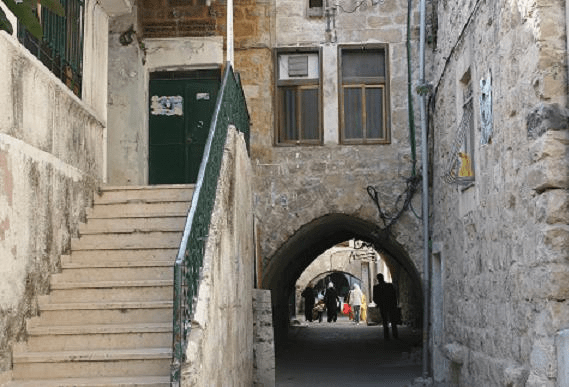
The city’s architecture was so successful that architects build Damascus in Syria in the same way, giving Nablus the nickname of Little Damascus.
The smell of freshly roasted and ground coffee filled the air as my dad and I entered the famous coffee house Kanaan. No visit to Nablus is complete without visiting the sweets parade. Secretly, this is the moment I have been waiting for, a treat of freshly made kunafe.

In 1967, the Israeli occupation authorities seized the city. It was liberated in 1995 after the Oslo Accords, and then reoccupied in 2002. Nablus is the most important city in Palestine in terms of industrialization, as there are many and varied industries in Nablus, and among the most important are the olive and vegetable oil industry, the famous Nabulsi soap industry, the detergent industry, food and beverages, the textile and furniture industries and the confectionery industry, especially the famous Nablus kunafe. Among the most important crops in the city of Nablus are citrus and olive crops.
As I opened my eyes, I could hear a firm voice and see a very high ceiling with vibrant, rich multicoloured great pillars. A few seconds later, I realised that I must have fallen asleep from all the excitement of my first memorable visit to Nablus. My poor dad must have carried me all the way from the souq to the great, old mosque so he can perform Friday prayer.

Nablus will always hold a distinctive superior place in my life and heart, maybe because of being the first in my family to be born in Nablus, the rich culture and tradition that the city is known for or simply because it is part of my homeland!
Yihya Sirhan is a Palestinian living in north London.
Main image: Panorama of Nablus. Author: derivative work: Anna Frodesiak (talk). The original can be viewed here: Nablus panorama.jpg: . Modifications made by Anna Frodesiak.Copyright © The author. This software is provided by The author and contributors “as is” and any express or implied warranties, including, but not limited to, the implied warranties of merchantability and fitness for a particular purpose are disclaimed. In no event shall The author and contributors be liable for any direct, indirect, incidental, special, exemplary, or consequential damages (including, but not limited to, procurement of substitute goods or services; loss of use, data, or profits; or business interruption) however caused and on any theory of liability, whether in contract, strict liability, or tort (including negligence or otherwise) arising in any way out of the use of this software, even if advised of the possibility of such damage. This file is licensed under the Creative Commons Attribution-Share Alike 1.0 Generic license.
mages in text: Old city of Nablus,. Author: Tiamat. Permission: OTRS , licensed under the Creative Commons Attribution-Share Alike 3.0 Unported license. Kunafe: Author: Guillaume Paumier, licensed under the Creative Commons Attribution 3.0 Unported license. Great Mosque, Nablus: Author: عمرو بن كلثوم, licensed under the Creative Commons Attribution-Share Alike 3.0 Unported license.
 Labour Hub
