

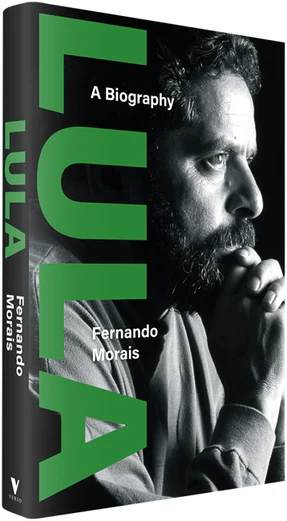
Mike Phipps reviews Lula: A Biography, by Fernando Morais, translated by Brian Mier, published by Verso.
Lula: union leader, founder of the Workers Party; one of the leaders of the 1984 Diretas Já movement, which demanded direct elections; federal deputy in the state of São Paulo from 1986; three times unsuccessful presidential candidate, finally becoming president in 2002; re-elected in 2006; barred from being a candidate in 2018 due to criminal charges; but re-elected for a third term in 2023.
Arrested in 2018
Hardly any of that is in this book, however. Yet it’s a gripping read despite that. The first several chapters are an hour-by-hour account of Lula’s arrest in April 2018 on charges of money-laundering (later overturned), the sheer speed of which shocked many. “By the lethargic and bureaucratic standards of the Brazilian justice system, the rulings leading to Lula’s arrest warrant were made with alarming speed,” writes Morais. “This created suspicion that they had been agreed upon in advance.”
Despite supporters urging him to resist, Lula submitted voluntarily to arrest, convinced that, “whether by political or legal means, he would be a free man within a week, or ten days at most.” In fact, he was to spend 581 days in incarceration.
Some 1,500 people spent the first night of his imprisonment sleeping outside on the street to keep him company. The vigil continued for the duration of Lula’s time in jail. Five foreign ex–heads of state visited Lula in prison, as well as numerous other international politicians, artists, union leaders and intellectuals, including Noam Chomsky and Danny Glover.
It was not the first time Lula had been arrested. Nearly 40 years earlier, in 1980, he had been apprehended in far grimmer circumstances, under Brazil’s military dictatorship, and had been “very afraid. There was no guarantee that these men were the police, or even members of another government security agency.” Lula was only too aware of the brutal torture suffered five years earlier by his communist brother ‘Friar’ Chico (so nicknamed because of his premature baldness).
In fact, the entire regional leadership of the Metalworkers’ Union had been seized, a response by the ruling junta to the huge wave of strikes the union had been organising. Despite the arrests, the strikes continued and 150,000 people turned out for the local May Day celebrations. A month after being lifted, Lula and his comrades were released.
Early life
Lula had a similar background to many of his co-workers in the strikes. He was born in the semi-arid northeast of Brazil, where average life expectancy was just 35 years. He migrated south on the back of a passenger truck at the age of seven, with his mother and seven siblings. “After thirteen days and nights of dirt roads, during which the family ate only pressed blocks of brown sugar and cassava flour, they arrived in Santos.”
Fleeing Lula’s brutal father, the family moved to São Paulo and rented a room and a kitchen, behind a bar. “I know what it’s like to live in the back of a bar,” Lula said later. “We had to use a bathroom where a drunk had just thrown up in the sink, and we’d have to shit on a piece of newspaper.” Seven or eight people slept on folding beds each night in the kitchen.
Lula worked from age eight and did not learn to read until he was ten years old. After he left school, he started an apprenticeship to become a lathe mechanic, becoming the first of his siblings to have a professional job and earn more than the minimum wage. This later brought Lula into contact with the world of labour organising, unsurprising given the conditions of work – Lula himself lost a finger in an industrial accident.
When the 1964 military coup took place, Lula believed the propaganda that it was a democratic revolution against communism. At 20, he was unemployed and reduced to smoking cigarette butts found on the ground. Finally he found a job in Villares, a giant factory in São Caetano do Sul where he would spend the next 18 years. Although he was now earning good money, he didn’t get to keep his wages: his strict mother collected all her children’s earnings and, after paying off household expenses, reallocated them on the basis of need. The system would later inspire Lula’s social equality policies.
Union organiser
Despite initial reluctance and innate shyness, Lula got increasingly involved in his workplace union. This intensified after 1971 when Lula’s new wife died unexpectedly, during her first pregnancy.
The Metalworkers Union of the ABC region of São Paulo were a militant organisation that, despite the military regime, increased its density from 20% to 50% of the workforce by 1972. Lula became an increasingly popular figure, partly due to his open methods of organising, shunning the conspiratorial style of the communist left.
The union began publishing a diminutive six-page newspaper, the Tribuna Metalúrgica, which would play an important role in exposing the true rise in Brazil’s cost of living following the huge oil price hike by Arab states in 1973. This rise was more than double the figure invented by the government and became a key mobilizer in organising support for higher pay demands.
In 1975, Lula became president of the union – against the advice of his communist brother who correctly warned him he would become a target of the state. But it was Friar Chico himself who was kidnapped by undercover military agents and taken to a secret location, where he was tortured non-stop for 15 days. He was fortunate to survive – others, including TV Cultura’s director of journalism, were murdered during this crackdown, an act so shocking that the ruling junta was forced to rein in its repression.
The union movement was aware of the risks, but increasingly undeterred. Lula’s argument was that there were not enough jails to fit everybody, so strikes continued to be called on a regular basis.
Workers Party
Lula’s presidency brought him into contact with members of the national Congress in Brasilia. He was appalled to find that out of 460 members of Congress, only two were from working class backgrounds. This observation led him to drop his blanket hostility to all politics and move towards establishing the Workers Party. This, the reversal of the sentences against him and his comrades following their 1980 arrest, and the establishment of new union federations, showed that the days of the military dictatorship were numbered. The regime announced that free and secret elections for governors, vice governors, mayors, vice mayors and city councillors would take place in 1982, for the first time in 16 years.
Lula ran as the Workers Party candidate for Governor of São Paulo. His campaign was amateur but his team grew in confidence, as he attracted increasingly large crowds – on one occasion, 100,000 people attended one of his rallies.
In fact, on election night, Lula came in fourth, with 11% of the vote. No longer union president, he sank into a depression. Yet four years later, he would run for Brazil’s new National Assembly and be elected with 651,763 votes, more than any parliamentary candidate had ever received in the country’s history.
And that’s where Morais’s account halts. He is working on a second volume that covers Lula’s unsuccessful presidential bids and his two terms in office, which he started three years ago.
This is a sprawling book, which does not follow the usual biographical convention of linear progression. But the narrative is pacy and the reader has a real sense of being in the room with Lula when important events are taking place. The author spent long hours with Lula travelling on aeroplanes: “On one round trip to New Delhi that had layovers in Johannesburg, Luanda, Maputo, and Addis Ababa, I was able to record twenty-three hours of interviews going out and another twenty-three on the return flight.”
So the story so far feels very much like Lula’s version, but none the worse for that. We will have to see how Morais handles Lula’s time as Brazil’s president, which will require a bit more nuance than what he has written here.
Mike Phipps’ book Don’t Stop Thinking About Tomorrow: The Labour Party after Jeremy Corbyn (OR Books, 2022) can be ordered here.
 Labour Hub