
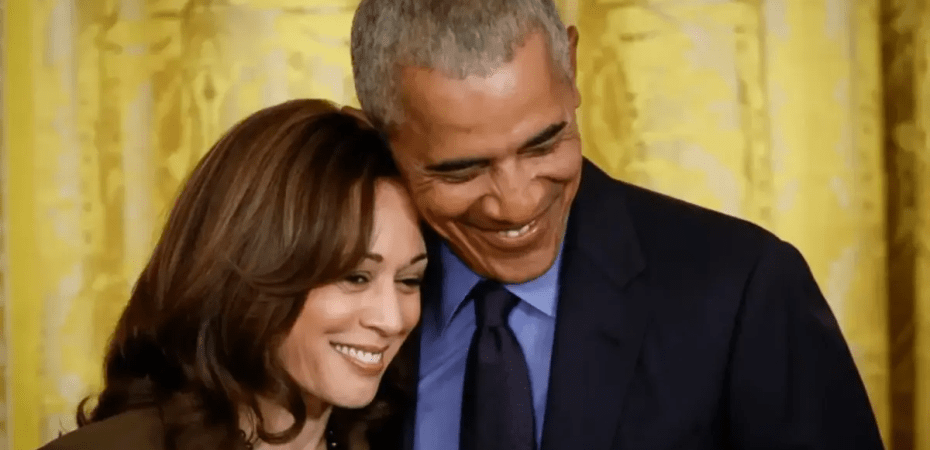
Like Bill Clinton before him, Barack Obama’s presidency was ultimately a failure and Kamala Harris’s keenness to have him as part of her campaign was poor politics, argues Mike Phipps.
In the many post-mortems into the US presidential election, the numerous weaknesses of Kamala Harris’s campaign have inevitably been highlighted. These included her inability to challenge Trump on his actual record in office, her refusal to offer anything of substance to working class people on the economic front, her reluctance to differentiate herself from Joe Biden and her willingness to allow the parameters of her campaign to be defined by her opponents.
Harris surrounded herself with ‘Democrat royalty’ – not least Barack and Michelle Obama, widely thought to have a Midas touch at electioneering in the US. In fact, while Barack Obama is frequently hailed as a great orator and campaigner, which may still be very much the way he is appreciated in the UK, in the US itself his presidential achievements are widely regarded as, at best, mixed. If Kamala Harris was trying to place herself in a line of continuity with Obama, it may be one of the reasons her campaign failed so spectacularly.
Looked at more closely, Obama’s record in office stands in a long line of Democrat presidential failure. Associating oneself with it was bad politics on the part of Harris.
The economy
There is no doubt that Obama notched up some significant achievements in his first two years in office, when his party also controlled both houses of Congress. Most notable among these were Obamacare and his fiscal stimulus to kickstart the ailing economy.
But even these had major drawbacks. The Affordable Care Act significantly expanded the number of Americans with health cover, but kept the focus on for-profit provision and fell a long way short of universal healthcare.
The stimulus was simply too little, with Obama acquiescing to a far smaller amount of expenditure than was needed, as proposed by former Clinton Treasury Secretary and hedge fund manager Larry Summers. The result was a slow recovery: the package, good for Wall Street, was poor at job creation. This was a key reason the Democrats lost their House majority two years into Obama’s presidency.
A major feature of the economic crisis was the huge wave of home foreclosures, something Obama promised to fix on the campaign trail in 2008. In fact, the number of homes in foreclosure or with delinquent mortgages rose steadily through Obama’s first year in office to nearly 9 million in early 2010, and critics took the view that his efforts to solve the problem had been insufficiently resolute at forcing institutions to stop the process.
Even before the Democrats lost control of Congress, Obama was notoriously aloof from his legislature, unwilling to engage with its power-brokers, even those within his own party. This was perhaps a feature of his inexperience – just three years in the US Senate before reaching the Oval Office. This problem worsened once he lost his majority, not least because of increasing Republican extremism, although in 2010, when the Republicans took control of the House, the Tea Party hardliners were just a vocal minority.
The less Obama got through Congress, the more he relied on executive actions which bypassed it. That’s fine as far as it goes, but such directives are easy to overturn once a president leaves office – and overturn them is exactly what Donald Trump did.
Foreign policy
Obama’s foreign policy is often hailed as being less confrontational and war-oriented than his predecessor’s, but one should be cautious about this judgment. He may have presided over the withdrawal of much of the US troop presence in Iraq but the commitment to exit was largely settled in the last days of the Bush Administration in November 2008.
The US presence continued in Afghanistan, with the number of troops there peaking at 100,000 in 2010. Obama’s occupation of the White House saw a big increase in the deployment of drone strikes – ten times more than his predecessor – particularly in Pakistan. He failed to close the Guantánamo Bay detention camp, caving in quickly when Congressional opposition surfaced. American Civil Liberties Union Executive Director Anthony Romero accused Obama of deprioritising the issue because it did not resonate enough with the electorate, saying “Vote counting dumped this at the bottom of the pile.”
Obama initiated a NATO-led invasion of Libya, which may have removed its dictator Gaddafi – and killed scores of civilians – but left that country war-torn and unstable to this day, with the whole region becoming a breeding ground for Islamist extremism.
Re-elected with fewer votes than in 2008, Obama became increasingly authoritarian. His National Defense Authorization Act allowed the indefinite detention of US citizens by the US military on grounds of alleged terrorism; and his use of the National Security Agency to carry out covert surveillance of reporters’ phones drew comparisons with his disgraced predecessor Richard Nixon.
Broken promises – electoral disaster
At the start of Obama’s last year in the White House, the Guardian estimated that fewer than half of the biggest promises he had made as President had been kept. Progress was slowest on gun control, tax, overseas troop withdrawals and immigration, although more people were deported under his presidency than under Trump who succeeded him – not that this is a particularly creditable achievement when considered from a humanitarian standpoint. Obama also made fewer reductions to America’s nuclear stockpile than any incumbent president since the end of the Cold War.
Even while Barack Obama enjoyed strong personal ratings, voters were abandoning the Democratic Party in droves. “Democrats lost more than one thousand seats in state legislatures, governors’ mansions, and Congress during his time in office,” Julian Zelizer points out in his book The Presidency of Barack Obama.In fact, more Democratic state legislature seats were lost under Obama than under any president in modern history.
One analyst noted: “In the end there are only two ways a president can forge a legacy in U.S. politics: accomplish things with bipartisan support, or nurture his political party so that people are elected who will carry on and protect his accomplishments. Obama’s legacy is in trouble because he did neither.”
Obama’s key legacy, his Affordable Care Act, just survived Trump’s first presidency. With a potentially more extreme Republican majority in both houses of Congress, it’s now questionable whether it will last the next two years.
Obama’s failure in office to deliver on the promises of his soaring electioneering rhetoric paved the way for Donald Trump’s win in 2016. And it should be remembered: it was not just Hillary Clinton who scorned many Trump voters when she referred to them as a “basket of deplorables”. Obama, even before becoming president, showed his contempt for – or at least, complete misunderstanding of – working class voters in old industrial towns wrecked by job losses (partly resulting from his predecessor Bill Clinton’s championing of the North American Free trade Agreement), when he said: “They get bitter, they cling to guns or religion or antipathy to people who aren’t like them.”
Such attitudes surfaced again in this year’s election campaign with President Biden’s disputed reference to Trump supporters as “garbage”. These views help explain Trump’s re-election despite his dismal four-year record and utter unfitness for office on multiple grounds. They expose an intolerant elitism within the upper echelons of the Democratic Party, which, until they are repudiated, are likely to prevent it from connecting with many working class voters for some time.
Mike Phipps’ book Don’t Stop Thinking About Tomorrow: The Labour Party after Jeremy Corbyn (OR Books, 2022) can be ordered here.
Image: https://www.freemalaysiatoday.com/category/world/2024/08/21/obama-to-anoint-harris-as-democrats-best-hope-at-convention/ (AFP pic) Attribution 4.0 International CC BY 4.0 Deed
 Labour Hub