

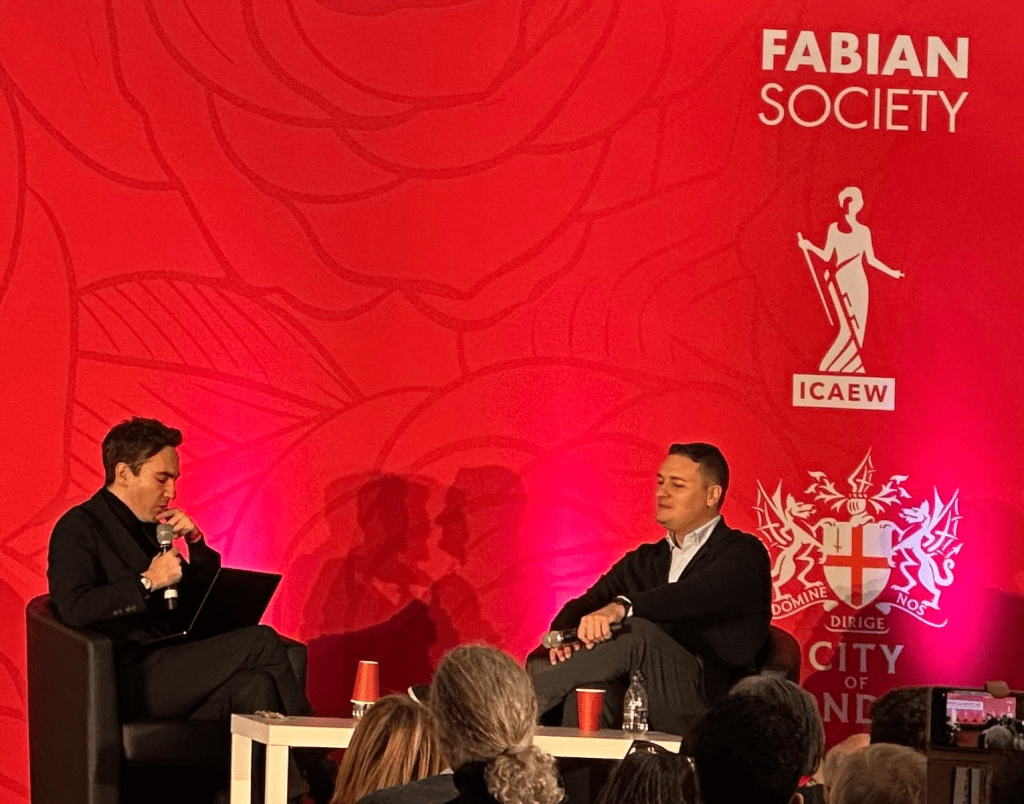
Wes Streeting, Labour’s Secretary for Health and Social Care, addressed the Fabian Society Conference on Saturday, 25th January 2025, followed by an on-stage interview with Lewis Goodall. Rathi Guhadasan was there.
Following over a decade of managed decline of health care, the state of the NHS and social care is one of the biggest and most urgent challenges facing the Labour government. Yet on Saturday, Streeting preferred to focus on other topics, ranging from the rise of the far right in the UK and US to culture politics and conspiracy theorists.
The address began by predictably extolling the achievements of the new Labour government. In health this included ending junior doctors’ strikes, hiring more GPs, increased funding for home adaptations for disabled people, 17 new surgical hubs “running like Formula 1 pitstops”, patients able to book their own tests and scans on high streets, and working towards the 2 million appointments promised in the Labour manifesto. He didn’t mention the recently announced review into social care, which is not set to report until 2028, despite criticisms from the Kings Fund and others, who point to the several reviews and reports already conducted and the urgent and overdue need for reform.
We are in the middle of yet another terrible NHS winter, with recent ONS statistics revealing a doubling in mortality risk for patients spending over 12 hours in A&E, versus those treated and discharged or admitted in under two hours, yet Streeting offered no hope for staff or patients. Later in conversation with Goodall, he admitted that we may well see corridor care next winter as well. While he acknowledged that this was not good, no strategy to solve this perpetual crisis was forthcoming.

“Are you winning the battle of ideas?”
Goodall’s opening question may give the clue to where Streeting’s focus is these days. Earlier, Streeting had said that delivery was essential but that we also needed to “take on populist arguments and defeat them with ideas” – just not ideas about the various urgent crises in health and social care today, apparently.
Instead, a large part of the session focused on culture politics, with Streeting attacking “anti-whiteness” in the NHS and refusing, despite being asked multiple times, to say whether the NHS under him would always recognise more than two genders. He did express his desire for an inclusive service where everyone could get the care they need and acknowledged the contribution that black and Asian health workers have made to the NHS since its inception, and the structural and overt racism which they still face today. These are issues which the SHA raised last year, calling for:
- definitive measures to reduce inequalities for staff in the NHS and allied institutions, such as Royal Colleges and medical schools,
- definitive measures to reduce ethnic disparities in health and in health care,
- robust reporting structures where staff can feel safe to report concerns and confident that these will be acted upon,
- COVID justice for all – but in particular, we need to ensure that no minoritised staff groups or individuals take on a disproportionate burden of risk ever again.
This structural racism extends to patients and it was right that the Health Secretary highlighted the ethnic disparities in maternal mortality seen in the UK, echoing the SHA’s 2024 article, “In Place of Trauma”, which stated, “Maternal mortality in the United Kingdom has risen to rates not seen for over twenty years, with women from black ethnic backgrounds almost three times more likely to die during birth or postnatally, and Asian women almost twice as likely to die, than white women. The apparent decrease in black maternal mortality risk is largely due to the rising background maternal mortality rate among white women, rather than any specific improvements for black communities – the next Labour government will need to bear this in mind when implementing its promise to “set an explicit target to close the Black and Asian maternal mortality gap.”
The article also highlighted the needs of women in the most socioeconomically deprived areas and those described as marginalised or “exceptionally vulnerable” in the All-Party Parliamentary Group 2024 Birth Trauma Report.
“The left is quick to point out market failure but finds it difficult to acknowledge state failure.”
Streeting’s love affair with the independent sector is well known and it was disappointing to see this go unchallenged on Saturday. The continued marketisation of health care is costly and does not provide a good return on investment for the taxpayer. The current emphasis on technology risks widening inequalities and alienating some of the very people we want to reassure. The shift to community-based care is a good long-term strategy but should not be at the expense of hospital services, such as emergency, intensive care and oncology, which also need massive reinvestment if we want to see improvements in health outcomes within this parliamentary term.
Delivering for health vs engaging in culture wars?
Streeting is right to say that people need to be able to feel improvements in their lives, and to recognise that both Farage and Badenoch seek to prey on growing public disenchantment with the NHS. Addressing the social determinants of health – for example by lifting children out of poverty, ending food insecurity and damp housing and allowing pensioners to heat their homes – and providing good and timely health care for those that need it would go a long way towards keeping Reform at bay.
Dr Rathi Guhadasan is Vice Chair of the Socialist Health Association. The Socialist Health Association was founded in 1930 as the Socialist Medical Association and has been affiliated to the Labour Party since 1931. It promotes health and well-being and the eradication of inequalities through the application of socialist principles to society and government.
Images: c/o author.
 Labour Hub