
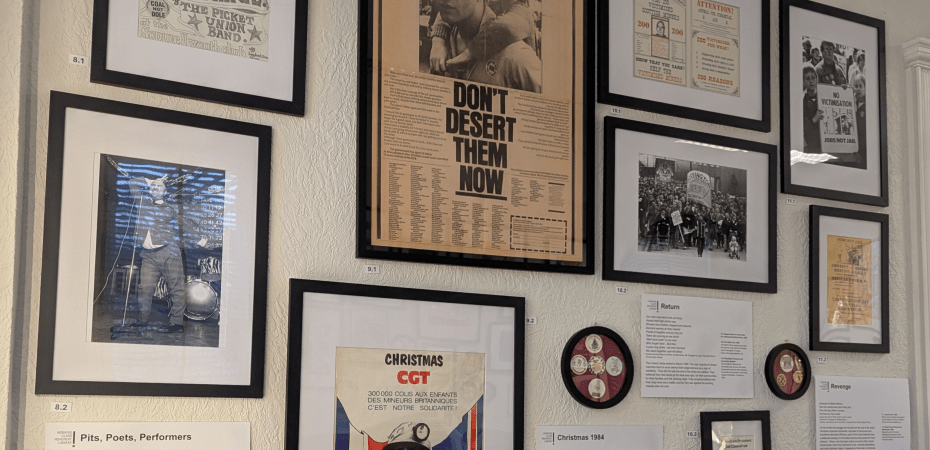
Andy Pearce introduces the lessons to be learned in the Miners’ Strike 40th anniversary exhibition at the Working Class Movement Library, Salford.
Forty years ago this month, Britain’s miners had been on strike for almost a year. They faced a bleak time, unable to heat their homes or even buy food for their children. Their plight had sparked a wave of support from working class people during the festive season. Despite the immense pressure from the Tory government and the media to return to work, the vast majority of miners would stay out long into the new year.

Opened to coincide with this anniversary, this unique and fascinating exhibition explores the Miners’ Strike 1984/85 using contemporary artefacts, photographs and poetry. The artefacts are all from the library’s own collections – many acquired by the library’s original founders Eddie Frow (1906-1997) and Ruth Frow (1922 -2008). The photographs were taken by John Harris, who operated ‘behind the lines’ during the dispute, capturing events from the strikers’ viewpoint. Almost all the poems were written by women during the strike, many of the them miner’s wives, and published in works now in the library’s archive. Together they provide a powerful insight into the strike from the perspective of those who were there.
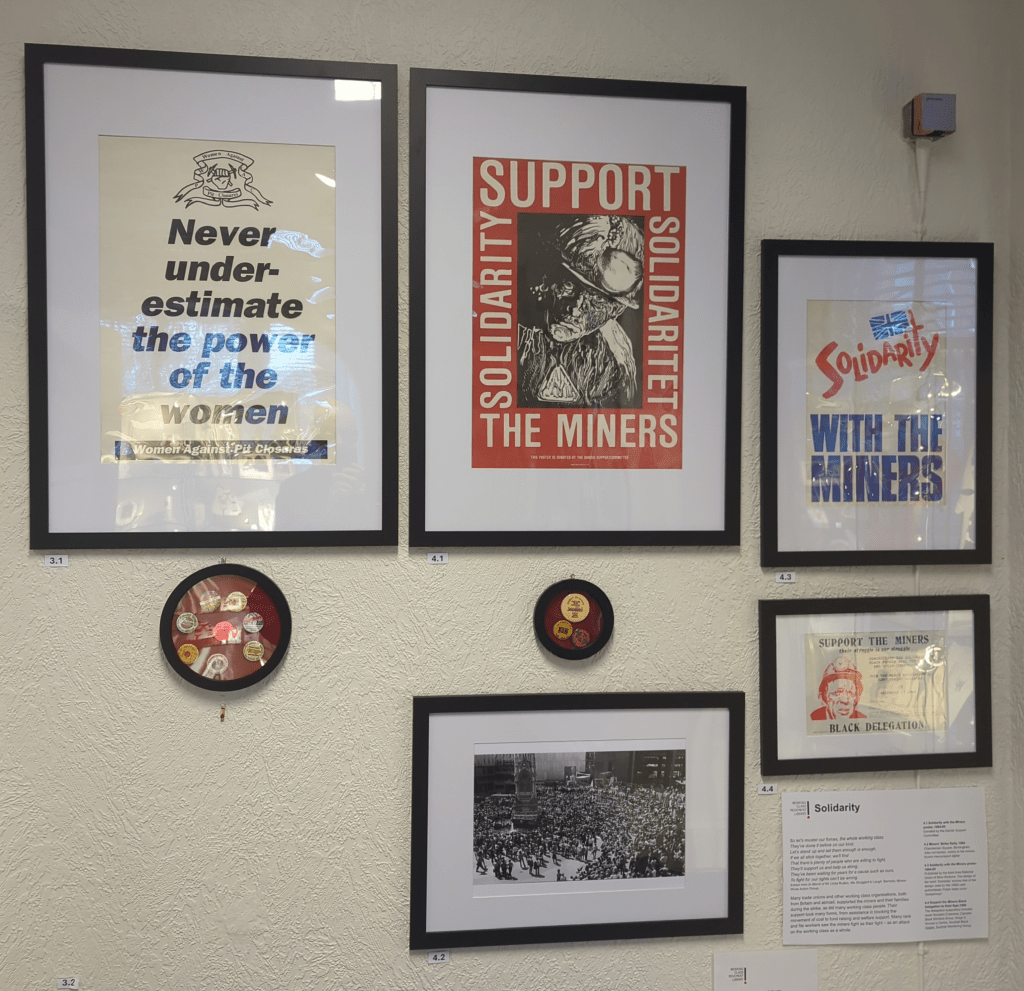
As you walk around the exhibition, each section introduced by an extract of poetry and one of Harris’s iconic photographs, it can seem that the events portrayed are a long time ago, with little relevance to today. The sense of ‘being in the past’ is highlighted by the photography being almost exclusively in black and white, by the long outdated 1970s fashion and hairstyles on show, the posters and flyers cranked out cheaply on long obsolete linotypes and photocopiers, and the badges and stickers, often handmade and hand drawn. All are a far cry from our era of social media and desk top publishing.

But look a little closer and the continuing legacy of this bitterest of strikes resonates to this day. The Coal Not Dole section reminds us that the dispute was not about pay or conditions, but an attempt to save working class jobs. The badges in Miners’ Wives (and other women) illustrate how the support and efforts of women during the dispute would have lasting consequences. The posters in Solidarity show many trade unions and other working class organisations, both from Britain and abroad, supported the miners and their families during the strike. The central zones of the exhibition – Pickets, Police and Scabs, Orgreave and They Shall Not Starve reveal how, as the strike progressed, the tactics used by the government against the miners became increasingly violent and aggressive.

Surprisingly, there is also humour and optimism – from badges that invite you to ‘Help the police – beat yourself up’ or proclaim ‘Police Intelligence – is a contradiction in terms’ – to an Orgreave veterans’ t-shirt, complete with fake hoof prints applied to the reverse! The exhibition concludes with a section on Remembrance, where posters, flyers and photographs show how mining communities and organisations have continued to commemorate the strike, campaigning for justice for those involved, and highlighting the lessons to be learnt by working class people. They remain determined that the events of forty years ago should never be forgotten.
The final poem in the exhibition is not actually one written during the strike itself, and the only one not written by a woman. It is an extract from Ian McMillan’s Strike, written to commemorate the 20th anniversary of the end of the strike in 2005, but it perfectly captures the spirit of this exhibition:
It feels like a hundred years ago, or it could just be last week
When they stood on a freezing picket line and history took a turn
When communities refused to die or turn the other cheek
And what did we learn, eh? What did we learn?
Andy Pearce is the Exhibition Curator and a trustee, Working Class Movement Library. The Collectors, The Cameraman, The Poets and the Pits runs until July and is open Wednesday, Thursday and Friday afternoons from 1.00pm to 4.30pm. There is a tour of the library every Friday at 2pm. More information here.
Images: c/o Working Class Movement Library, Salford.
 Labour Hub