
By Michael Calderbank
In last week’s Spring Statement, Rachel Reeves made a clear political choice to embrace a second round of austerity. She aims to balance the books on the backs of the sick and disabled, by cutting benefit entitlements to levels which even the Government’s own impact assessment indicates will push a further 250,000 (including 50,000 children) into poverty.
It wasn’t the only choice she could have made. Few would dispute the difficulty of the inheritance Labour received following the disastrous Tory years of austerity, the challenges posed by the US’s withdrawal of military support for Ukraine and the impact of Trump’s damaging tariffs on trade. But given that the ‘world has changed’ since Reeves set her own self-imposed fiscal rules, it would only have been prudent to revisit these strictures to allow for greater levels of borrowing in the short term. Even a moderately social democratic Chancellor would surely have taken the opportunity to raise taxes on the super-rich. Oxfam and Tax Justice UK calculate that a 2% wealth tax on assets exceeding £10 million in the UK could potentially raise around £24 billion annually.
Reeves and Welfare Secretary Liz Kendall present further welfare reform as some kind of liberation for people trapped by a ‘broken system’ into subsisting on state handouts rather than enjoying the benefits of a fulfilling career. It’s basically the same ‘workers versus shirkers’ rhetoric we saw from George Osborne and Iain Duncan-Smith under the Tories. It ignores the reality of people’s lives, the spiralling mental health crisis amid inadequately funded mental-health services and the profoundly depressing, stressful and exhausting reality of trying to eke out a living on low paid, insecure jobs. Coercing sick people back into the labour market by slashing their minimal support payments is cruel and callous. It’s not exactly the change people voted Labour for.
But if the Government thinks it can implement these attacks without paying the political price, it is surely delusional. Activists from Disabled People against the Cuts (DPAC) have already proved themselves a formidable fighting force, ending ATOS’s contract for delivering the Work Capability Assessment. Just months ago, DPAC member Ellen Clifford won a judicial review against the Department for Work and Pensions’ attempt to cut nearly £5,000 a year from almost half a million disabled people. And while disabled people and their organisations will be at the forefront of the fightback, they won’t be alone.
“Labour is the party of work…the clue is in the name,” ministers argue, as though workers don’t have sick and disabled family members or neighbours. Or as though workers don’t value security in the event that we fall sick ourselves or become disabled? The campaign against benefit cuts is a class issue. Eleven trade union General Secretaries from the Trade Union Coordinating Group – the vast majority of which are affiliated to no political party – have written an open letter to Starmer and Reeves to commit their support to the campaign to reverse the cuts. Significantly, this includes the PCS union – whose members work for the Department for Work and Pensions, including in the job centres. They know all too well what distress results from such policies.
Nor are campaigners without allies inside the Labour Party, whatever the leadership might say. Already at least 25 MPs have said they will rebel rather than back the Government’s plan, with more speaking out by the day. With many areas facing local elections in May, reports are feeding back that the mood on the doorstep towards Labour is becoming utterly toxic. Angry local councillors will be pressuring MPs, many of whom – even at this early stage in the Parliament – will be starting to worry about their own future electability. A serious coalition of resistance is building, outside and inside the Labour Party, and now is the time to build maximum pressure on MPs to defy the whips and force through a change of direction.
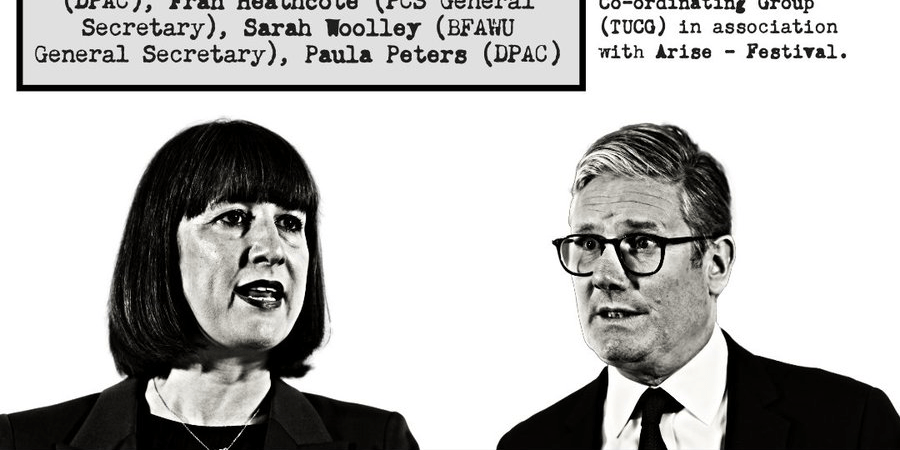
The Trade Union Coordinating Group is holding an online discussion with Arise tomorrow (Wednesday April 2nd from 6.30pm) to review the Spring Statement and discuss building a coalition against the next wave of austerity cuts – with John McDonnell MP, Ellen Clifford and Paula Peters from DPAC and Fran Heathcote (PCS General Secretary), chaired by Sarah Woolley (BFAWU General Secretary).
Michael Calderbank is Political Education Officer of Tottenham CLP.

 Labour Hub