
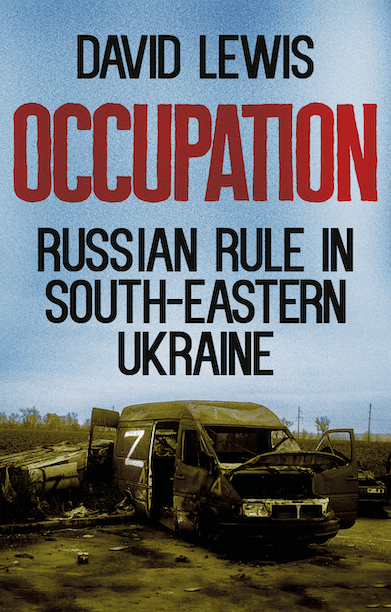
Mike Phipps reviews Occupation: Russian Rule in South-Eastern Ukraine, by David Lewis, published by Hurst.
In September 2022, President Putin announced the incorporation into the Russian Federation of four provinces in southern and eastern Ukraine. “It was the biggest land grab in Europe since World War II,” writes David Lewis. “On these occupied lands, Russian forces and their proxies kidnapped, tortured and killed civilians and officials, seized businesses and properties from their Ukrainian owners, erased any evidence of Ukrainian culture, rewrote Ukrainian history and subjected the population to a barrage of constant propaganda.” How it happened is the subject of his book.
Russia claimed to be the ‘liberator’ of the lands it seized. The hollowness of this boast was underlined by drone footage of the towns captured, for example, Artemovsk, as the Russians called it – Bakhmut, to Ukrainians – where every building was destroyed as far as the eye could see and only a few dozen people remained.
Putin’s justifications for occupation go beyond the desire to recreate a Russian empire. They overlap with arguments often heard on the so-called left here and internationally, for example, how a strong Russia with its own sphere of influence acts as a counterweight to the dominant western imperialisms – however the citizens of that sphere may feel about being under Russian control. Equally parroted is the Kremlin line that Russian speakers in eastern Ukraine have a ‘Russian identity’, which means they ‘belong’ in Putin’s dictatorship. The reality, as Lewis explains, is far more complex.
It was this erroneous belief that led forces to think they would be welcomed with open arms by the people they had come to ‘liberate’. Instead, they met intransigence and resistance. In Kherson, Russian troops opened fire on protesters and began to systematically detain them. Mariupol was besieged, pounded with artillery and indiscriminate bombing and battled street by street. People burned furniture to cook food; bodies lay in the streets.
In the newly occupied lands, the Russian authorities held referendums to secure popular consent for incorporating their newly acquired territories into Russia. “Even by Moscow’s standards of election fixing, the process was farcical,” reports Lewis. “Electioneers went round houses in person to gather votes, accompanied by the Russian military.” The same approach would later be used for ‘elections’, in which in some cases not even the candidates’ names were available to the voters who were corralled to vote for them.
The referendum process was overwhelmingly condemned by the UN General Assembly, with just five votes against. Undaunted, newly-appointed officials were enlisted to run the new territories: they quickly saw the opportunities for corruption.
Citizens in the occupied territories were forced to accept Russian identification documents and swear loyalty to the occupier. Without the new passport, it proved difficult to access welfare payments or even healthcare – “measures almost certainly illegal under international law.”
“Russian governance in the occupation was heavily reliant on shocking levels of violence and repression.” Besides the persecution of opponents, potential oppositionists, including journalists, local officials and religious leaders, in short anyone with authority, were also targeted. Over 80% of survivors of Russian detention said they had been tortured: a UN analysis put the figure even higher. The most common method was electrocution.
The population was forced to undergo “filtration”, where each individual was checked for potential disloyalty. Sometimes the queues for this process lasted several days. Those detained faced torture, sexual violence and sometimes execution. Millions also faced forced migration, including the forcible deportation of hundreds of thousands of Ukrainian children, separated from their families.
A rapid process of Russification of culture and education was also undertaken: from place names and monuments to school curricula, libraries, TV and cinema. Cultural institutions were deliberately destroyed or looted. When the Russian occupiers withdrew from Kherson, they took with them 10,000 artefacts from its regional museum. Propaganda aimed at young people was particularly relentless. The whole programme constituted a concerted attempt to erase Ukrainian identity.
Control of the economy was also a key lever of power. Russian soldiers looted and stole on a huge scale, but much of the specialised plunder could have been undertaken only with the involvement of senior Russian officials.
A mass programme of expropriation of Ukrainian assets was undertaken. By the end of 2022, more than 30,000 Ukrainian companies had been re-registered in the Russian corporate register. ‘Ownerless’ or ‘abandoned’ properties were confiscated – owners had only three days to claim ownership. In Zaporizhzhia alone, some 4,000 assets were seized on this pretext. Prime agricultural land was confiscated in order to control grain exports.
Despite the fierce repression, acts of Ukrainian resistance, both violent and non-violent, went on throughout the occupation. It would have interesting to read more on this, but material is available elsewhere, as it is on Russia’s war on Ukrainian museums, libraries, cultural destruction, use of forced deportations and much else. To stay up to date with latest developments in the conflict, readers should subscribe to the weekly Ukraine Information Group bulletin, here.
Mike Phipps’ book Don’t Stop Thinking About Tomorrow: The Labour Party after Jeremy Corbyn (OR Books, 2022) can be ordered here.
 Labour Hub
[…] Russia imposed its control over a hostile population (Labour Hub, April […]