
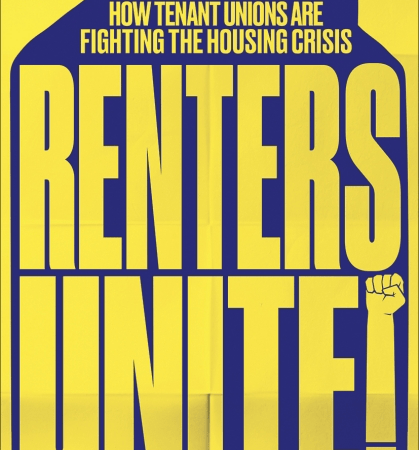
Mike Phipps reviews Renters Unite: How Tenant Unions are Fighting the Housing Crisis, by Jacob Stringer, and Solidarity betrayed: How Unions Enable Sexual Harassment – And How They Can Do Better, by Ana Avendaño, both published by Pluto.
“Homelessness in the UK often doesn’t manifest as street homelessness,” says London Renters Union activist Jacob Stringer, “It manifests as overcrowding, unsuitable housing, sofa surfing, emergency accommodation and above all ‘temporary accommodation’ which people can be in for years while they wait for public housing that may never be offered.”
A lot of people in this position are privately miserable. But this misery becomes fully visible only through organising, when it turns to anger and action. It’s helpful that most tenant unions have a number of members with cultural and social capital, who are also being impoverished not so much by workplace exploitation – although in many jobs, that too – but through rent.
Across the Global North, housing precarity has become normalised. Rents rise and standards fall. What’s the point of asking for repairs if the landlord evicts you in revenge, or raises the rent on the improved property? In England alone, 900,000 households suffer from the effects of serious damp and mould – sometimes with deadly consequences, as the recent death of a two-year old child in Rochdale underlines.
In London, in 2022, the average price of a one-bed flat was 44% of median pay before tax. In areas that attract tourists, tenants are evicted to make way for holiday lets.

One reason for this state of affairs is that housing is a lucrative investment. The more important the market, the more politicians are persuaded not to intervene. But it’s a very discriminating market: “The effects of housing crisis are always unevenly distributed along lines of class and race and gender.”
The ‘market solution’ is invariably to build more. But no country has built its way out of a housing crisis. The problem is less one of supply than of affordability. As previously reported on Labour Hub, Manchester is a classic example of this. “There is now an acute shortage of social housing, because new developments include fewer social housing units than they destroy and because social housing providers are selling stock on the private market… Tenants complain that their areas are deliberately neglected, then blighted as run-down and requiring new development, which invariably displaces them.”
As Isaac Rose points out in his recent book, “The rent burden is so high in Manchester that it outstrips London for unaffordability, due to the city’s lower wages.” Stringer’s account of the ‘transformation’ of South East London’s Heygate Estate into the privatised ‘Elephant Park’ tells a similar story.
Government intervention is often unhelpful. The UK’s ‘Help to Buy’ scheme has done little but drive up housing prices: “Government funds that once went to building public housing get redirected to subsidise landlords.”
Tenant unions show individuals who are being victimised by landlords that they are not alone. More importantly, as he shows here with examples from the UK and beyond, tenant unions achieve victories – for individuals and whole communities.
The author includes useful practical information about setting up a tenant union: the need for radical direct action, a comprehensive set of demands and cross-tenure organising. Regarding the latter, he points out that some of the worst contempt directed at tenants comes from housing department council officers and housing association property managers. Local councils move people into badly maintained temporary accommodation blocks run by private landlords who are under little pressure to do repairs and at the same time often get more rent from the council than they could on the open market. It’s a racket, says Stringer, and it allows the worst slumlords to be funded by the public purse.
Stringer believes every tenant should join a union “because as we build solidarity within and between communities, we can all offer each other a chance of a different and better way of organising the world. Renters of the world unite!”
*
Ana Avendaño describes her book as a “tough love” letter to the labour movement. Unions, she contends, “have failed to address one of the most harmful, dehumanizing aspects of the workplace: sexual harassment.” Worse, they deploy “mechanisms of protection to defend harassers, leaving the victims feeling betrayed and marginalized.”

Even after the #MeToo movement, sexual harassment remains a serious problem in American workplaces. The author herself was fired for exposing it in 2019 when working for a large labour movement charity and learning that union leaders were harassing its female staff. She sued and won a substantial settlement.
At the time she still believed any problem in the broader trade union movement was confined to a few “old-school bad apples”. As she investigated, she found a largely male bureaucracy closing ranks to protect its own, while accusing her of disloyalty and freezing her out.
US unions have a history of discrimination against women, for example, arguing in the post-war era that married women in the workforce should make way for returning ex-servicemen. In the sixties, some union leaders fought to lessen liability for themselves under the 1964 Civil Rights Act, which made workplace discrimination illegal.
By the 1970s, women were entering the workforce and joining unions in record numbers. In manual jobs, sexual harassment was endemic – and unrestrained. Unions did little.
Once #MeToo took off, union leaders were quick to claim that unionisation was key to preventing workplace harassment, “typically by a male manager against female subordinates”. In fact, research shows that 60% of women who experience harassment on the job are harassed by their peers – more than twice the proportion who report being harassed by their manager – and it’s these cases which unions have a poor record of taking up.
But the greatest problem the author highlights is where union leaders themselves are the harassers. Several cases are documented here and a pattern emerges of a refusal to take seriously, or even covering up, such instances when they are raised within the union concerned.
Avendaño believes there has to be a culture change. Globally, women make up only 28% of the membership of the highest decision-making bodies of trade unions. “To put it simply, when women don’t have a voice in leadership, patriarchal practices persist.” Gender parity, however, is only part of the solution.
There are some notable exceptions. The union that represents Californian janitors, which has a large number of immigrant women among its members, has taken important steps to confront sexual harassment, which are explored here in detail. It’s an “essential reminder,” says Avendaño, “that institutional change requires multiple levels of intervention.”
Sexual harassment is a global problem. Within ten days of the #MeToo hashtag going viral in the US, it was trending in 85 countries. Britain has had some high-profile cases involving senior union officials which are documented here. In South Africa, COSATU’s 2022 National Congress was rocked by an allegation of rape and sexual harassment, with women delegates rising from the floor to demand action. Emerging unions in non-traditional sectors which lack an established masculinist culture, on the other hand, are doing some inspiring work.
The author concludes by suggesting some basic solutions to the problem. First, start recognising sexual harassment as a core union issue. Second, unions need to focus on the nature of workplace culture (“how we behave when no one’s watching”). Third, they should build new paradigms into their education and training. Fourth, they must change how they discharge their collective bargaining duties and stop unquestioningly defending harassers at the expense of survivors. Fifth, they need to develop a broader and more inclusive labour movement feminism, which may mean looking for inspiration beyond the movement itself. And above all, unions themselves need to be model employers and stop using non-disclosure agreements as a way of silencing their own victims.
Mike Phipps’ book Don’t Stop Thinking About Tomorrow: The Labour Party after Jeremy Corbyn (OR Books, 2022) can be ordered here.
 Labour Hub
[…] reviewed quite a few books on housing on this site in recent years, I would say that Bricking It is one of the best – […]