
Maybe by saying we need it for bombs! wonders Councillor Steve Battlemuch.
On 11th June, Chancellor Rachel Reeves will announce the results of the spending review. Millions of words have already been written lobbying for this and that cause, none more so than the defence industry who tell us the world isn’t a safe place (was it ever?) and we need to spend more and more on bombs, drones, guns and weapons of mass destruction to ‘keep us safe’.
For years the argument on nuclear weapons was that they were a deterrent against attacks by others. However, attacks and wars come in difference guises now and our ownership of nuclear weapons hasn’t exactly kept us safe from various attacks. The second biggest owner of nuclear weapons – Russia – has been in a war with Ukraine for three years and the deterrent theory has been tested there and proven to be (thankfully) unworkable – for the avoidance of any doubt I’m not advocating that Russia nuke Ukraine! Quite the opposite – both sides have spent billions fighting a war for land and the fact that Russia was a nuclear power didn’t stop Ukraine fighting back.
What does all this geo-politics have to do with Local Government I hear at least one of you ask? Well I’m fairly sure that the Ministry of Defence and the cheerleaders for defence spending will win the argument with the Treasury on increasing defence spending. When Labour put it up to what the Tories and Reform have called for, they will then change the goalposts and call for more.
If Reeves does not radically alter the ‘fiscal rules’ set by backroom blokes in the city, then the funds allocated to the issues that affect our day-to-day lives will be smaller: less money for the NHS, for Local Government, for Transport, for infrastructure projects, for housing, etc.
Local Government had its money cut by the Tory/Lib Dem government in 2011 and this continued every year until last year’s general election. Not only did they cut the budget but they changed the formulas for working out the distribution of the money, meaning in reality that the poorer areas got poorer. Yes, that’s right – they took money from those councils with the greatest need and gave it to the wealthier areas. Sunak boasted about it to Tory members in Tunbridge Wells and thankfully it was caught on camera. Not that they tried to hide it. It was a planned policy of the Tories.
So government grants went down and to make up the shortfall came three things:
- Increases to Council Tax, so that people blame their local council for the increases, not the central government. In cities with tight boundaries like Nottingham where 80% of the Council Tax is band A or B, then this brought in very little revenue in comparison to areas where band D was the norm. Councils were also made to charge for social care funding via council tax too instead of this being picked up nationally.
- Increases in fees and charges – making all day-to-day issues more expensive, like car parking, swimming lessons, hiring community rooms, burials, paying for your garden waste to be collected and much more.
- Cuts to services – big cuts, especially in the inner city councils which suffered the highest losses. So we saw the end of Sure Start and Children Centres. Youth clubs became a fond memory. Local grants to the arts sector were decimated. Preventative work, which we all know saves money in the long term, was scrapped. Community centres closed in some areas and scaled back activities in others, surviving in the better-off areas by charging a lot more for local events.
So yes, 14 years of Tory government cuts brought councils to their knees. Over 30 of them now survive only by a crazy system of ‘exceptional financial support’ (ESF) which is no longer exceptional given how many councils have applied for it. Why is it crazy? Well, to pay it back, you have to sell off council assets to find the money. It’s like selling your cooker and sofa to pay your rent or mortgage.
So Labour has been in power for almost a year – are things better? Well, the jury is very much still out. The eyes will be on the spending review to see if any increase is meaningful and can stop the rot. There is talk of a three-year settlement making planning easier – it seems so obvious but it’s not happened before.
Changing the formula back to recognising deprivation and poverty in the allocations would also help. Allowing councils to borrow more cheaply for infrastructure projects would help too. Councils that have had to use EFS need to be treated better by the push to sell everything being scrapped and a new approach to getting these councils back on an even keel. However councils need an above-inflation real-terms increase to fix the mess our local communities are in.
Finally, Labour needs to hold its nerve with its push for local government reorganisation. The principle of having fewer tiers of local government is a good one. Having District and County Councils overlapping the same areas is a waste of precious resources. Redrawing the map of local government with smaller unitary councils like Nottingham and Derby being linked to their natural neighbours will bring stability and make for better planning in areas which naturally go together.
So I will watch the Chancellor’s spending review with my fingers crossed in the hope that councils start to get a better deal, but I suspect the multinational defence industry will be the ones popping the champagne corks when she sits down. They have more lobbyists than children and councils have and they have the fear factor. In a world where fear beats hope, we have an uphill battle to get money allocated to making things better locally.
Maybe if we ask the Defence Industry nicely they might sponsor a children’s centre? The Lockheed Martin Tiny Tots group or the Boeing Youth Club could well be where we fundraise next to keep essential services going.
Steve Battlemuch is a labour Councillor for the city of Nottingham. He writes in a personal capacity. This post originally appeared here.
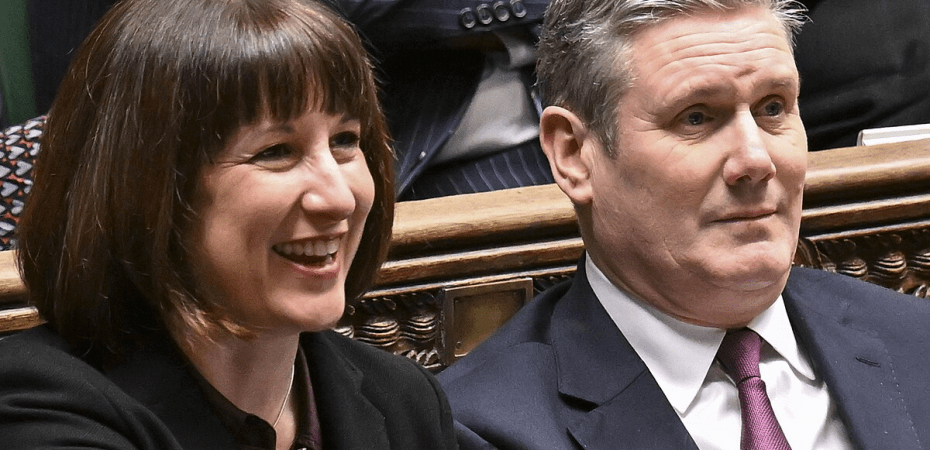
Image: Rachel Reeves and Keir Starmer. Source: UK Parliament. Author: © UK Parliament / Maria Unger, extracted from another file : Prime Minister’s Questions, 7 February 2024 02.jpg, licensed under the Creative Commons Attribution 3.0 Unported license.
 Labour Hub

[…] the money available for issues that affect our day-to-day lives would be smaller, pointing out that local government had its money cut by the Tory/Lib Dem government in 2011 and this continued every year until last […]