
Despite the winter fuel payment climbdown, the Chancellor unveiled a modest package that missed the opportunity to lift people out of poverty.
The Chancellor’s Spending Review had to do several things. It needed to address the vast and numerous problems facing Britian after years of neglect, under-investment and privatisation. It had to overcome the deep sense of disillusionment that had developed during Labour’s first year in office, reflected in last month’s poor local election results.
Ahead of those elections, people who voted Labour in the 2024 general election and planned not to in the locals gave their reasons to pollsters. The removal of the Winter Fuel Allowance, the failure to reduce the cost of living or improve public services, broken promises and a failure to stand up to the rich and powerful were the key factors determining their alienation from the Labour Party.
The Chancellor also had to restore her own reputation. In polls of Party members regarding which Cabinet members are most favoured, she consistently comes last, behind Work and Pensions Secretary Liz Kendall and Keir Starmer. Angela Rayner and Ed Miliband come top.
Over two-thirds of members want a change of course – and, failing that, a change of leader. These are not primarily diehard Corbyn supporters, many of whom are no longer in the Party: they are mainly people who bought into Keir Starmer’s promise of continuity embodied in his ‘ten pledges’, most of which have long been discarded.
In a recent Survation poll for Labour List, over a quarter of Labour members polled want to see the Government make savings from defence spending – but this is being increased. Only one in five said international aid and development should be targeted for savings – but the Government is planning heavy cuts. Only 3% favoured any cuts to the government’s environmental policies. But the Environment Department is seeing its budget cut.
Winter fuel U-turn
Ahead of the Review, the Chancellor had already been forced by mounting pressure from within the Party and among voters into a major U-turn on winter fuel payments, which were restored earlier this month to some 9 million pensioners.
Jan Shortt, General Secretary of the National Pensioners Convention welcomed the climbdown as a “victory for common sense” but added: “However, there is still no recognition of the devastating impact the withdrawal of the winter fuel payment had on older people over December 2024 to February 2025. Statistics show that older people were switching off appliances, rationing the use of energy, cutting down on food and other household bills after losing the payment. Many will now be in debt to their energy provider, with some taking out loans to pay bills at enormous interest. We believe it is only fair that the government pay compensation.”
Simon Francis, coordinator of the End Fuel Poverty Coalition, also gave the change of heart a cautious welcome, adding “there will still be pensioners unable to afford the high cost of energy and living in cold damp homes. So now the Government must focus on how it supports all households in fuel poverty and implements the long term measures needed to bring down the cost of energy for good.”
Following today’s Review, the organisation welcomed the Government’s decision to honour its manifesto pledge to fully fund the Warm Homes Plan, but warned more still needs to be done to end the high cost of energy for all.
Simon Francis said: “This is not the end of the crisis as energy bills are still too high – hundreds of pounds a year more than in 2020. The Government must now act to support all homes in fuel poverty through a ‘social tariff’ and to bring down the cost of electricity in a fair way for everybody.”
Women’s Budget Group perspective
Other groups tempered a cautious welcome for the Spending Review with broader concerns. The Women’s Budget Group hailed “the scale of public investment in housing and public transport” as “a significant and much needed change in direction.” But Director Dr Mary-Ann Stephenson said: “The Chancellor’s previous decision to hold the overall Government budget for ‘day to day spending’ to 1.2% in real terms, however, left her little room for her to match her ambition for renewal in physical infrastructure with the same in social infrastructure.”
She added: “The Chancellor could look to make taxation more progressive to increase revenue to the public purse, from which we all benefit and which would contribute to gender equality. Taxing income from wealth at the same rate as taxing income from work, and taxing wealth directly could tackle inequality twice over by funding the services and social security women and other disadvantaged groups rely on. Millionaires themselves want to be taxed more and the public agrees.
“The Chancellor should also look again at her fiscal rules. The economy is built not just on roads and railways, but also on unpaid and underpaid care. Some level of borrowing for social infrastructure should be enabled and classified as investment in the same way as for capital projects and be allowed for in the Government’s fiscal rules. Mental health, public health, social care and prevention measures all need serious investment if we want people to live healthy lives and enable them to contribute to society and the economy in a way that is fulfilling.”
Local government and housing
Dr Stephenson also expressed concern about the small increase in local government funding saying it would “not meet the challenge councils are facing or undo the damage of huge cuts under austerity. This is one of the key departments that impacts women’s lives, from social care to specialist services for victim survivors of domestic abuse and sexual violence.”
Writing on this site ahead of the Review, Nottingham Councillor Steve Battlemuch also warned that if Reeves did not radically rethink her fiscal rules, then the money available for issues that affect our day-to-day lives would be smaller, pointing out that local government had its money cut by the Tory/Lib Dem government in 2011 and this continued every year until last year’s general election.
And this looks set to continue. Andrew Fisher, the former Labour head of policy who wrote the ground-breaking 2017 Party Manifesto, said of the budget allocation to the Ministry of Housing, Communities and Local Government: “Looks like a sleight of hand masking real terms cuts on local government finance.”
He noted that the apparent 3.1% increase in the Spending Review document appeared to include the assumption of a 5% increase in council tax, which itself will have political repercussions. This would mean a core funding cut from central Government of 1.4% annually from 2025/6 to 2028/29.
Overall, the allocation for local government will still leave funding around 10% below 2010 levels, while demands on councils for social care and special educational needs have soared.
There are also fears that not nearly enough has been allocated to housing. Many councils’ housebuilding programmes are at a standstill, given the escalating costs of building materials. Reeves’ announcement of £39 billion to be spent on building affordable homes is important, but it should be borne in mind that the definition of affordable remains at 80% of market value – which for many is far from affordable.
The Treasury said the £39bn represented “the biggest boost to social and affordable housing investment in a generation.” Annually, that means the Treasury could spend around £4 billion on affordable housing a year, which might amount to 16,000 houses a year – totally insufficient to deal with the 1.3 million people on council housing waiting lists at present. That said, building alone will not solve the crisis of affordability and the money could be used to make existing stock more cheaply available.
Health and environment
The NHS was widely hailed as a winner in the Chancellor’s departmental allocations. But Andrew Fisher questioned this, pointing out that in 2023 the Government published the NHS Workforce Plan, with cross-party support, which the Institute for Fiscal Studies estimated would require annual increases of 3.6% to be delivered. Yet Reeves allocated only a 3% increase to the NHS in her Review.
Environmentalists also had mixed feelings about the Chancellor’s Review. Friends of the Earth’s head of policy, Mike Childs, said: “While we welcome investment into warm homes, buses and trains, the government must go further and faster. New taxes in the Autumn Budget that make polluters pay for the damage they have caused could better fund the vital investments needed to build a greener, fairer future for us all.
“Ministers must publish a new climate plan later this year to deliver on legally-binding targets and international commitments, but it risks being undermined by spending on new roads and airports while climate solutions face under-investment.
He added: “Planning reforms that strip away wildlife protections will accelerate nature’s decline. Britain’s natural world deserves better – and so do we.”
Overall, modest
Overall, despite the hype, a 2.3% increase in expenditure in real terms is quite modest. Even the fiscally prudent Gordon Brown managed more than twice that level in the New Labour years.
London Mayor Sadiq Khan was so unimpressed with the level of infrastructural support for the capital – no funding for the extension of the Dockland Light Railway, too little on affordable housing – that he refused to give media interviews after the announcement. But in a statement, he expressed disappointment at the lack of infrastructural spending for London. Transport nationally was also hit with a 5% cut, despite some eye-catching local projects.
Much of the Chancellor’s capital spending, noted Richard Murphy of Tax Research LLP, “is going to take place in the dim and distant future when she will be long gone from the Treasury.” He added: “Elsewhere, the reality is that there will be cuts in real government spending. Austerity is, in other words, continuing despite what Reeves had to say.”
The anti-austerity group People’s Assembly believed that “the big winners were arms’ manufacturers and the builders of nuclear power stations, both of which specialise in cost overruns. But the economy will not get the public investment it needs, and once again, the most vulnerable are being attacked.”
It’s certainly the case that the £30 billion earmarked for nuclear power stations will prove to be a huge underestimate. The costs of decommissioning Sellafield alone now amount to £136 billion. On renewable energy, Reeves said virtually nothing in her statement.
In Tribune, economist James Meadway said the Review “will not feel like an end to austerity and does not address the underlying economic problems we face.”
“The most immediate culprit for this miserliness is the huge increase in defence spending,” he added. “Keir Starmer and Reeves have both tried to contend that defence spending creates jobs and growth, but this is an exceedingly thin argument. Defence spending today is technologically advanced, equipment heavy, and creates very few manufacturing jobs — as analysis of the government’s own figures for its employment impact shows.”
The biggest concern, expressed by anti-poverty campaigners, was the Government’s continued commitment to widely unpopular disability benefit cuts and the two-child benefit cap. Paul Kissack, Chief Executive of the Joseph Rowntree Foundation, warned that the benefit cuts could push 300,000 to 400,000 people into poverty, including 50,000 children. Chief executive of the Child Poverty Action Group, Alison Garnham, pointed out that the two-child limit pushes 109 children into poverty every day.
Momentum’s overall assessment was that the Review “falls far short of what’s needed. Extra spending on the NHS and housing is a necessary step, but millions will continue to bear the brunt of austerity unless the Government invests more heavily in our public services. What’s more, the Labour leadership are poised to push ahead with a vote on welfare cuts, despitewidespread opposition from across the labour movement. Already we’ve seen a U-turn on Winter Fuel Payments, which would not have happened without pressure from socialist Labour MPs. Now the Government must go further by scrapping the two-child benefit cap and reversing all planned cuts to disability benefits.” It urged members to write to their MP, using their lobbying tool.
Former Shadow Chancellor John McDonnell MP tweeted: “Of course investment in housing and infrastructure is welcome but many departmental budgets at near standstill won’t solve the crisis in public services, and threatened cuts in disability benefits and the failure to tackle child poverty by scrapping the two-child limit loom over like a dark cloud.”
Former Shadow Justice Secretary Richard Burgon MP lamented the Government’s determination to push ahead with cuts to disability benefits next year, tweeting: “Instead of allowing time for proper scrutiny and meaningful dialogue with disabled people, the Government has simply brushed aside so many MPs’ genuine concerns. These planned disability cuts should be scrapped – not rushed through without proper scrutiny.”
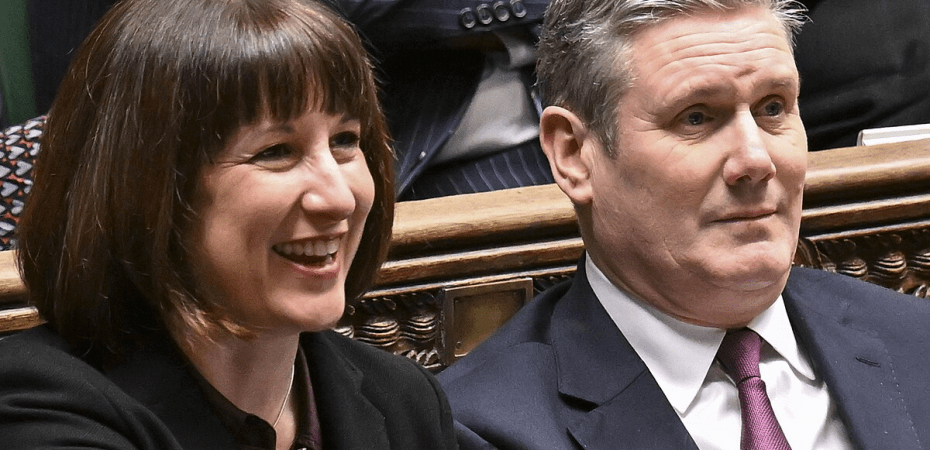
Image: Rachel Reeves and Keir Starmer. Source: UK Parliament. Author: © UK Parliament / Maria Unger, licensed under the Creative Commons Attribution 3.0 Unported license.
 Labour Hub