
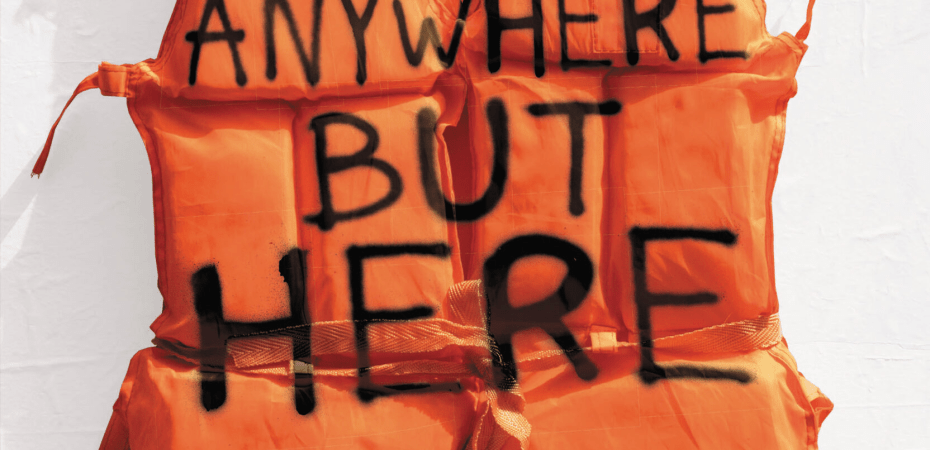
Mike Phipps reviews Anywhere But Here: How Britain’s Broken Asylum System Fails Us All, by Nicola Kelly, published by Elliott & Thompson.
You might expect such behaviour from Tory and Reform UK propagandists, but many would have been shocked in recent weeks at the sight of reporters from the mainstream media standing on French beaches, expressing their exasperation at French police for ‘allowing’ dinghies loaded with desperate migrants to set sail for the shores of Kent. How cheered they were as they captured on camera the police slashing at the rubber vessels with knives, forcing those on board into the water.
Government rhetoric versus popular tolerance
You would not guess from these scenes that most people in Britain are pretty tolerant of migration, with 68% saying we should allow new arrivals to settle here. Perhaps they have a more humanitarian understanding of the plight of the refugees who are forced to embark on such hazardous journeys. They may also have some idea of what those trying to cross the Channel are desperate to leave – makeshift camps with no mains water or sanitation, regularly bulldozed by the French riot police – despite much less media coverage of these conditions.
Perhaps they also have a clearer grasp of what does and does not constitute value for money: in March 2023, then Prime Minister Sunak signed off a £500 million package to increase the number of police officers stationed on beaches along the coast of northern France, the sixth deal of its kind in under four years.
“The way a Government treats refugees is very instructive because it shows you how they would treat the rest of us if they thought they could get away with it, “Tony Benn once said. Journalist and former Government employee Nicola Kelly agrees: she joined the Home Office in 2014 at the height of the “hostile environment” policy, when immigration enforcement teams stepped up their targeting of multi-ethnic communities. As she says, “Blameless, decent, hard-working people who had lived and worked in the UK for decades were being rounded up during dawn raids, detained and deported.” The Department, however, was more interested in how ‘soft’ or ‘hard’ it looked to right wing tabloids.
That obsession peaked with the Government’s plan to deport asylum seekers to Rwanda. Individuals, sometimes unconscious or coerced through “pain-inducing restraint” were trussed in harnesses and put on an aeroplane. They were released only following a late-night injunction from the European Court of Human Rights. “Scandalous!” complained then Home Secretary Priti Patel. One Home Office official took a different view: “It feels like working in Germany in 1937.”
Kelly’s book is passionate. It focuses on the human side of migration, recounting some of the shocking journeys that many people made to get to the UK, and the persecution in their home country that drove them on.
On arrival, their ordeal is far from over. Children are accused of lying about their age. By January 2024, one report showed that over 1,300 child asylum seekers might have been wrongly identified as adults and placed in unsupervised accommodation.
The Home Office’s cavalier attitude to protecting child migrants was underlined by its admission in 2022 that it had no idea of the whereabouts of 222 children it was meant to be protecting. It later emerged that dozens of asylum-seeking children had been kidnapped from a single hotel in Brighton and exploited by criminal gangs.
Some of those seeking asylum could be housed for weeks at Manston processing centre in overcrowded marquees into which portaloos overflowed, where inmates attempted suicide and staff were reported to be selling drugs on the site.
Others might be sent to Napier barracks, where “beyond the barbed wire fencing they found residents on hunger strike, sleeping outdoors on the basketball court to protest against the conditions.” Over two-thirds of Napier’s residents had a diagnosed psychological condition and 40% reported having suicidal thoughts or having made actual attempts.
Kelly focuses on Afghans, who worked for the British and were promised support, but were abandoned when the Taliban seized control of the country four years ago. With few safe asylum pathways provided, many were forced to make the perilous journey culminating in a small boat crossing of the Channel.
In July 2025, the Labour Government announced the immediate closure of its Afghan resettlement schemes, despite having resettled fewer than two-thirds of the number of Afghans originally promised. The Executive Director of International Rescue Committee UK, said: “The sudden closure represents a concerning abandonment of the UK’s commitments to the people of Afghanistan. With thousands of Afghans still facing persecution or forced into hiding, and a backlog of 22,000 applications still pending, this abrupt closure leaves vulnerable people – including children and families – in dangerous situations with no clear pathway to safety.”
Days later, it emerged that the details of some 19,000 Afghan asylum seekers who had applied to move to the UK had been accidentally leaked and the entire blunder had been hushed up by a Government super-injunction for two years.
Government policy encourages the far right
By summer 2024, nearly 120,000 people were awaiting an initial decision on their asylum application. Average waiting times stood at around 18 months, while hotel costs had risen to more than £8 million a day. And this was despite – or perhaps because of – the Home Office using high street recruitment agencies to hire utterly inexperienced staff to make decisions on asylum cases.
Last year’s fascist-led riots against asylum seekers have been well covered. Less well known, however, is the routine racism and hostile, persecuting behaviour of staff at one of the hotels targeted. Serco, the Home Office contractor with a ten-year $1.9 billion contract to manage asylum accommodation and support across Britian, not only refuted all the allegations but even threatened legal action when this scandal surfaced. Later they sacked the perpetrators.
It should be emphasised that Serco and other companies involved in the subcontracting process are making vast profits out of the work, although the service provided – food and housing especially – are often deplorable.
As part of the far right violence, the author herself was targeted on social media. One email “told me they knew where I lived and where my son went to nursery and would harm him.”
Integrating asylum seekers into the community is one way of puncturing the ability of the far right to target them in the way they did a year ago. Allowing them to work, as 80% of the British people believe they should, is another – especially in post-Brexit Britain, which is short of an estimated 2 million workers. It would also have enormous mental health benefits and free asylum seekers from the dangers of being exploited in a black market, where violence and abuse are rife.
Current Government policy seems firmly fixed in the opposite direction. Asylum seekers are dispersed to some of the most deprived and isolated parts of the country, in a move almost calculated to provoke local resentment.
Those who risk taking casual work, as well as being at the mercy of unscrupulous employers, may be subjected to immigration raids, often following an anonymous tip-off, sometimes from a rival employer. The authorities get 150 of these a day; most are bogus. More shocking is the involvement of charities , like St Mungo’s, which have cooperated with, and even been paid by, the Home Office to help remove individuals.
The ‘lucky ‘ ones
Those lucky enough to be granted leave to remain face short-notice eviction from their asylum accommodation and are often forced into rough sleeping, described by former Home Secretary Suella Braverman as a “lifestyle choice”.
For the less fortunate, detention awaits, prior to removal. “The decision to detain is made by an individual Home Office immigration officer rather than a judge, and is not subject to review at any stage of the process,” reports Kelly. No reason need be given and no timeline set. Smartphones are not allowed and health care and food are notoriously poor-quality. It’s effectively a prison.
The Inquiry into Brook House removal centre revealed staff using strangulation and humiliation to subdue detainees. ‘Never again,’ declared the Home Office, but a fortnight after the Inquiry reported, two Albanian men attempted suicide – one later died in hospital – and clinical evidence showed little had changed.
The final resort is deportation. In 2022, the Government spent £3.6 billion in just three months chartering deportation flights. The airlines of course make tidy profits.
The number of enforced removals of people arriving by small boats is small – just 1.3% between 2018 and 2023. It’s a lot easier for the Government to target people who have been in the UK for many years, a policy which led directly to the Windrush scandal.
The great merit of Nicola Kelly’s book is its focus on the human beings caught up in this nightmarish labyrinth. It’s a welcome antidote to the dehumanising rhetoric of successive Governments which fuelled the far right riots last summer and which continues to poison public debate.

Mike Phipps’ book Don’t Stop Thinking About Tomorrow: The Labour Party after Jeremy Corbyn (OR Books, 2022) can be ordered here.
 Labour Hub