
By George Binette
Some 10,000 members of the Canadian Union of Public Employees (CUPE), employed as flight attendants by flagship carrier Air Canada and its subsidiary Air Canada Rouge, walked off the job in the early hours of Saturday 16th August. The strike action came after the breakdown the previous day of long-running negotiations on a new contract to replace a 10-year-old agreement.
The dispute centres around basic pay, work rules and the levels of unpaid work at the airline, which Brian Mulroney’s Conservative government privatised in 1989. Flight attendants are effectively unpaid when performing safety checks, attending to onboard medical and safety emergencies when planes are on the runway, and assisting passengers during boarding and deplaning.
CUPE officials insist that many of its Air Canada members endure poverty pay with average base salaries of $(Can)28,000 – just under £15,000. They also point to the 46% rise secured by the airline’s largely male pilots over the course of a four-year deal that averted a threatened strike in 2024. Nearly 70% of flight attendants are women.
Within 12 hours of the walkout Patty Hadju, the Jobs Minister in Mark Carney’s recently elected Liberal government, invoked Section 107 of Canada’s federal Labour Code. This imposed binding arbitration on the union and airline management, while also instructing CUPE members to return to work. Over the ensuing 48 hours the flight attendants continued their strike before the Canadian Industrial Relations Board issued a return-to-work order on Monday morning (18th August), declaring the strike “unlawful” despite 99.7% of union members backing the action on a turnout of 94.6%.
Thus far, CUPE officials have indicated a willingness to defy the Board’s order despite the risk of heavy fines and even criminal prosecutions. Individual strikers could also face summary dismissal. At a press conference on Monday CUPE’s national president Mark Hancock said, “We will not be returning to the skies. If it means folks like me going to jail, so be it.”
The previous Liberal government under Justin Trudeau forced Canadian postal and rail workers off picket lines under Section 107 powers. But against the background of the Covid pandemic in 2022, Ontario’s Tory premier, Doug Ford, blinked first when unions across Canada’s most populous province threatened to mount solidarity action with striking education support workers.
Barry Eidlin, an associate professor of sociology at Montreal’s McGill University, told CBC News that the Government’s intervention “really is a troubling development. Section 107 basically just allows the labour minister this unilateral power to intervene to order workers back to work against their will.” In a separate interview with CTV News, Eidlin added that the increasing use of Section 107 meant that there was effectively no right to strike in Canada, despite a 2015 Supreme Court ruling.
Whether the Canadian Labour Congress will rally to offer meaningful support to the CUPE flight attendants remains to be seen. There seems little prospect of Air Canada resuming operations any time soon, leaving some 500,000 travellers in search of alternatives. And Mark Carney’s Liberal government has clearly sided with capital against organised labour and issued a stark challenge to Canada’s whole union movement.
George Binette, a Massachusetts native, is a retired union activist, vice-chair of Camden Trades Council and former Trade Union Liaison Officer of Hackney North & Stoke Newington CLP.
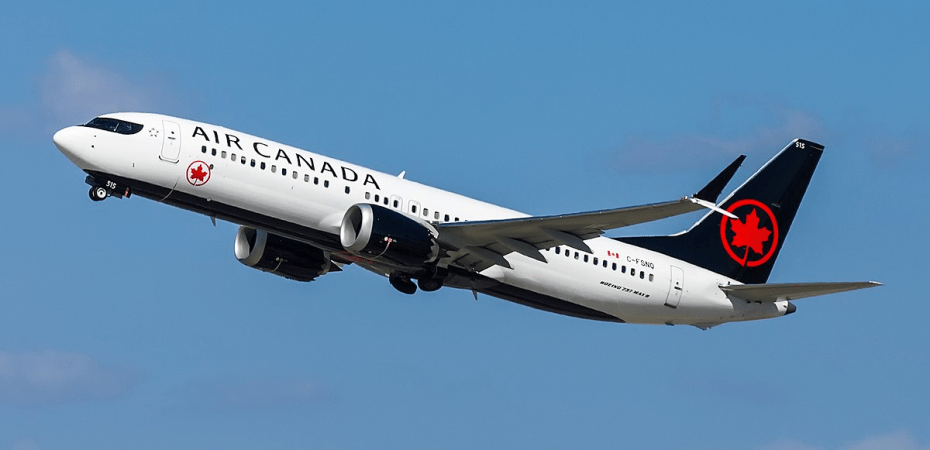
Image: https://commons.wikimedia.org/wiki/File:C-FSNQ_-_Boeing_737_MAX-8_-_Air_Canada.jpg Source: https://www.flickr.com/photos/cb-aviation-photography/44669135765/. Author: Colin Brown Photography, licensed under the Creative Commons Attribution 2.0 Generic license.
 Labour Hub
