

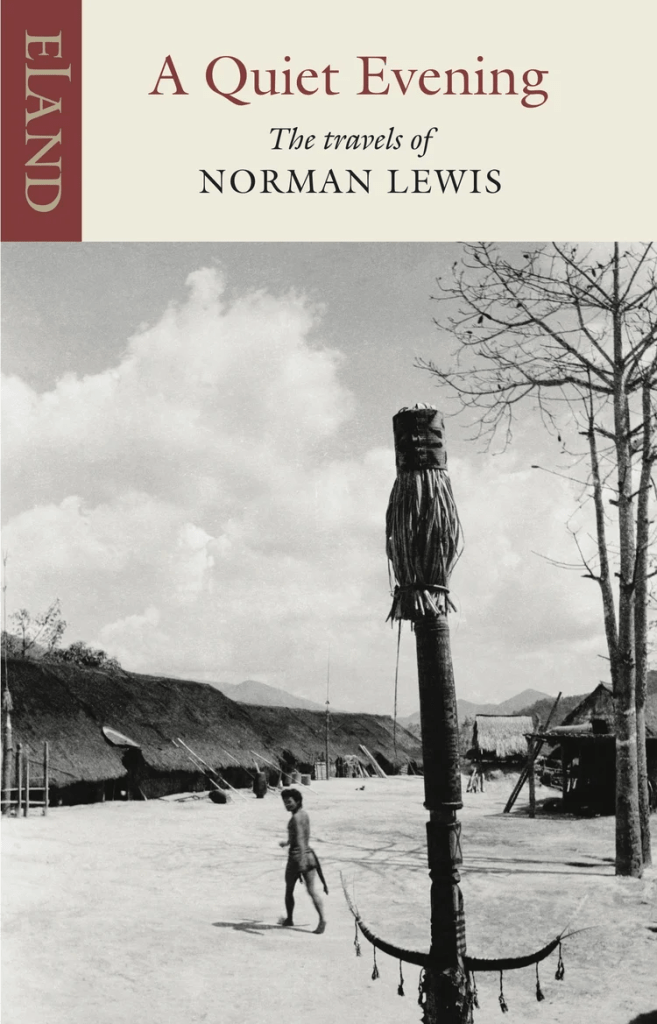
Mike Phipps reviews A Quiet Evening: The Travels of Norman Lewis, selected and introduced by John Hatt, published by Eland.
Travel writing has fallen out of fashion in recent years. That’s partly because the war on terror at the start of this century turned a lot of interesting places into no-go areas for curious westerners. The genre also became a victim of its own success, with more writers going down well-trodden paths, often with little fresh to say. Furthermore, it can be argued that increasingly we live in a monoculture where everywhere is a variation of everywhere else.
Others see travel literature as “hopelessly entangled into the history of European colonialism”, inherently conservative and privileged. Too often, travel writing has been the preserve of white middle class men.
Moreover, in a post-colonial world, the idea that Western writers need to interpret ‘exotic’ lands and cultures is rightly called into question and viewed as exploitative. It’s also much easier to travel the world these days, which makes the quest for new adventures more extreme, but also more self-indulgent, even if they might be justified by a nod towards environmental principles. Alongside these endeavours are travel books which are “On a ”, where “a writer chooses a deliberately impractical mode of transport, thereby inviting the calamities that will inevitably befall him or her,” as one writer put it.
Yet amid this steady decline there have been famous exceptions, such as Dervla Murphy, whose work strove to break down barriers across polarised societies and find a common humanity, nowhere more so than in her journey through the Balkans in the aftermath of the wars that tore part former Yugoslavia.
Travel writing still remains overwhelmingly a male genre, however, with the ring of boys’ adventures and male bonding across cultures. Even the press release for this new collection has endorsements – nine in total – exclusively from male writers.
But in other respects, Norman Lewis, probably the greatest travel writer of the 20th century, is untouched by these problems. For one reason, he is not afraid of tackling big issues, including war and genocide. His output underlines that the best travel writing is seldom a contrived trip, but undertaken by someone willing to immerse themselves for a considerable time in unfamiliar cultures for real-life reasons.
Admirers of Lewis’s writings emphasise his powers of observation and understanding, seen particularly in what he wrote about his wartime experiences in Italy and Austria. But there is also a profound sympathy for humanity running through his work.
In an article on Ghanaian independence republished here from 1957, when white supremacist narratives were the norm, he contrasts the humanity of the African population with the racialist and exploitative character of the imperialist colonisers.
But his most significant political piece of writing was his 1969 12,000-word article, reproduced here. It was the longest article that the Sunday Times magazine had ever printed, on Brazil’s Indian Protection Service’s involvement in the murderous destruction of Amazonian indigenous communities. “The tragedy of the Indian in the United States in the last century was being repeated, but it was being compressed into a shorter time,” wrote Lewis.
The extermination of so many native people – whole tribes were wiped out – led even Brazil’s military government to dissolve the public agency responsible. The Indian Protection Service had used bacteriological warfare – the impregnation of clothes with the smallpox virus, or even directly injecting people with the same – and poisoned the food supply to carry through its campaign. In addition to mass murder, which included aerial bombardment, property worth an estimated $62 million was stolen from the Indians in just ten years. One Indian girl testified how the landowners prostituted Indian girls and had children as young as two working “under the whip”.
The article was entitled simply “Genocide” and its publication led to the foundation of the pressure group Survival International. Lewis also wrote about the enslavement, torture and killing of indigenous people in Paraguay, where he travelled across water-logged mud roads to see for himself the abject conditions in which people were forced to live and work. He was also the first non-specialist writer to suggest that Amazonian deforestation cold lead to a global environmental disaster.
Lewis’s articles also highlight the role of religious missionaries in destroying the way of life of indigenous peoples. In Bolivia, he interviewed a leader of the Summer Institute of Linguistics, an evangelical mission now expelled from some Latin American countries, but still with staff in other eighty others worldwide, who detailed how they induce native people away from their homelands into low-paid wage slavery. Other evangelicals operate in a similar way: another article investigates the New Tribes Mission which worked in Venezuela to wipe out the traditional cultures of native peoples – “ethnocide was precisely its goal,” concludes Lewis. It was eventually kicked out of the country by the government of Hugo Chávez in 2005.
Another gem here is Lewis’s 1970 piece about the California grape-pickers’ strike, organised by Cesar Chavez and in its fifth year when the article was written. Chavez, a trade union and civil rights leader campaigned especially among Hispanic workers and co-founded the National Farm Workers Association. He also coined the campaigning slogan “Si Se Puede” (Yes We Can) which was used by President Obama in his first presidential campaign.
Lewis visits a town on the Mexican border, where at 3am day labourers begin their daily commute in dilapidated buses to California’s vineyards, from “an enormous sunken carpark, softly fogged with exhaust smoke, smelling of urine, and surely one of the last places in the world… where you can see one man feel another man’s muscles before employing him.” He compares the back-breaking work under a raging sun to conditions in 19th century England, except that the pickers also face the added danger of being sprayed from the air with dangerous chemicals. Child labour is also exploited: one local paper reported the case of a girl of eight who worked a seventy-hour week on a grape ranch.
When the strike began, strikers were physically attacked, run over by trucks and shot at, actions often condoned by the local police. Meanwhile, a striker who started a slow handclap at a meeting at which a politician was denouncing the strike got six months in jail, where he died. Yet, thanks to public support, the growers were gradually forced to negotiate, raise wages and adopt new safety measures.
One of the more bizarre missions related here is when Lewis was asked in 1957 by James Bond creator Ian Fleming to go to Cuba to find out what Ernest Hemingway’s view was of the rebels organising in the mountains against the Batista regime. Hemingway declined to offer much of an opinion but Lewis’s relentless inquiries – talking to everyone from waiters to bishops – built up a detailed picture of the revolutionaries who would take power in the country just over a year later.
It’s a chapter that underlines the fact that, in this genre, the best listeners and observers make the greatest writers. Lewis wrote a score of so-called ‘travel books’, many more articles and fifteen novels. The selection here brings together some of his finest work.
Mike Phipps’ book Don’t Stop Thinking About Tomorrow: The Labour Party after Jeremy Corbyn (OR Books, 2022) can be ordered here.
 Labour Hub