

Dr Rathi Guhadasan previews an important fringe meeting today at the TUC Conference in Brighton.
Last week 800 pathology workers across London, outsourced to the private companies Health Services Laboratory (HSL) and The Doctors’ Laboratory (TDL), went on strike.
These essential workers, represented by Unite, process blood and other tests for seven hospitals in London – across multiple clinical services, including A&E and surgery. As patients, we may not see them, but we rely on them as much as we do on nurses and doctors. The Royal College of Pathologists say that around 95% of clinical pathways include some type of pathology as an essential component.

Why did they strike?
Outsourcing NHS services to private providers is an expensive and pernicious practice and the Socialist Health Association and others have previously highlighted its horrifying impact on patient care. In the case of these pathology workers, it also puts them at a huge disadvantage compared to their NHS counterparts. Private providers to the NHS do not have to adhere to NHS pay scales and wages are up to 27% lower than they would be if workers were employed directly by the NHS.
A lack of transparency in grading means that many staff are doing the same work as more senior colleagues for lower pay or being paid different rates to do the same work. Workers have described a massive increase in workload in recent years, which as in other aspects of healthcare, can impact service quality. To make things worse, hundreds of these workers were transferred out of the NHS onto the payroll of these private companies when the partnership was set up in 2016.
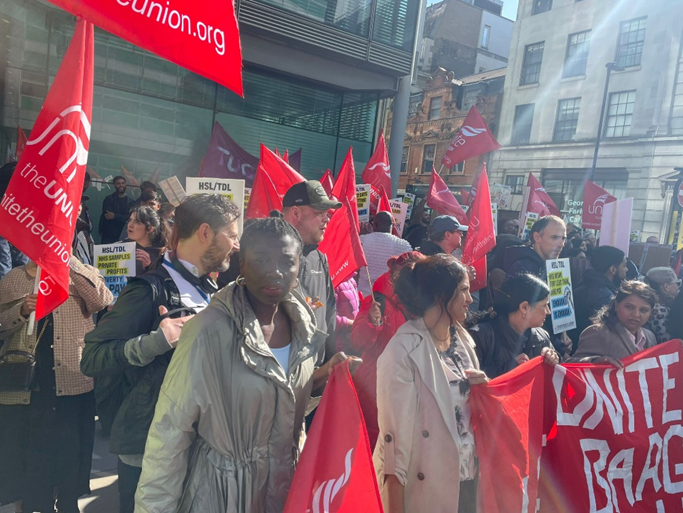
Unite general secretary Sharon Graham said: “This is yet another example of the failure of privatisation within the NHS. A service being run for profit, that cuts corners and puts both staff and patient safety at risk by focusing on volume rather than quality. Our members are being short changed and a byzantine grading system means HSL are trying to get away with a race to the bottom over pay. Unite simply won’t allow such practices to continue.”
Unite is also campaigning for the introduction of special leave for these workers, increasing annual leave with length of service and increased number of paid sick leave (currently 20 days).
Yet massive profits for shareholders and CEOs…
Last year, HSL, which along with TDL is owned by Australian firm Sonic Healthcare, paid £98.1 million to shareholders and its CEO David Byrne received a 40% pay rise, taking his annual earnings to £900,000 per year. HSL’s chair is Labour peer Lord Carter, author of a 2006 report into pathology services which recommended outsourcing to the private sector – another example of the unhealthy relationship between government and private healthcare which has fuelled the corporate capture of the NHS for over three decades, as described in the SHA’s “In Place of Profit”. Lord Carter, Wes Streeting and the Labour government all failed to respond to last week’s industrial action.
Pathology services under threat
Pathologists have long been raising the alarm on the decline in service capacity, and therefore quality. The 2018 Royal College of Pathology workforce census reported that only 3% of histopathology departments surveyed felt they had sufficient staff to meet the clinical demand. 50% reported using more expensive locums while 45% had resorted to outsourcing work.
Regional Unite officer Tabusam Ahmed will be outlining the issues facing these and other health sector workers in our fringe meeting, “Restore Our NHS!” at the TUC Congress today. She will be joined by representatives from UNISON, BMA and RMT.
Join us at the TUC! Fringe meeting, “Restore Our NHS” – Monday 8th September at 12:45-2pm, The Restaurant, Brighton Centre. Lunch provided – come early!
Visit us throughout the congress at stand 15.

Dr Rathi Guhadasan is Chair of the Socialist Health Association.
All images c/o the SHA.
 Labour Hub