
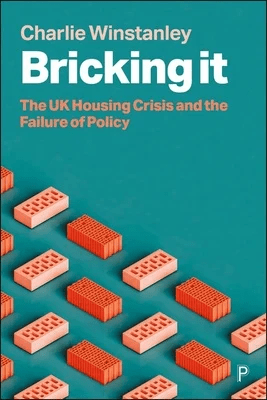
Charlie Winstanley’s book Bricking It: The UK Housing Crisis and the Failure of Policy is published today, Here the author introduces some its main themes.
The UKs housing crisis is perhaps the single largest failure of domestic policy in decades, and an increasing source of political malaise for any party in government. The average price of a house relative to earnings in the UK is higher than at almost any other time in the last 150 years. Home ownership is in freefall from 70% in 2003, to 53% today. Our hidden homelessness crisis costs us £2.8bn a year in Temporary Accommodation payments, and another £1bn in rough sleeping funding. Rents are increasing rapidly, beyond the means of UK residents to pay – with our housing benefits costing the Treasury a mammoth £23.4bn a year. The quality of British homes is trailing that of similarly developed countries, and in particular areas is in decline – and we have a shortage of every major type of specialist accommodation for those in need.
And yet, not so long ago things were very different. For much of the latter half of the 20th century, housing costs made up only around 10-15% of the average UK resident’s income. Home ownership consistently grew every decade from the 1920s onwards. A steady supply of social housing meant that in the late 70s, as much as 30% of UK households representing as much as 40% of the population resided in social housing. Housing quality improved drastically, decade upon decade, for most of the period from the 1890s through to the millennium.
Today, many people talk of a housing crisis – and in so doing, they are comparing the worsening affordability and conditions of the housing system today, to that of most of the 20th Century. In my new book Bricking it, I argue something different: that the conditions of the latter half of the 20th century were special, unique in all of history, for sustainably balancing improvements in quality of tenure, availability of housing and affordability of housing over the course of many generations. What many call a ‘housing crisis’ today is, more aptly, a reversion to historical norms – where housing was of poor quality, cost a relatively large sum of the average income, and was unavailable in a suitable format for large sections of the population.
Bricking it takes a long term view of what I have defined as the post-war consensus in housing, a series of policies which collectively represent the post-war housing system. In this era, a collection of policies and legislation combined to reduce and suppress house price inflation, to continually upgrade and replace old and decaying housing stock, and plan for the kinds of housing that were needed in particular areas, and for particular subsets of people. But these policies weren’t merely the invention of the post-war Labour government; they have their origins as far back as the Victorian social reformers, a road to improvement which began as a revulsion against the horrors of unplanned urbanism during the industrial revolution.
The benchmarks of this policy environment were a strong planning system and regulations on property quality, and access to amenities; capital controls on lending, rent controls on renting, and artificial barriers on mortgage finance which prevented inflationary speculation in property; and perhaps most significantly, a huge programme of subsidised council house building which both suppressed the value of homes as assets, and directly provided the kinds of accommodation required by people in different parts of the country.
The point is, this era of housing plenty did not happen by accident. Rather, it was the conscious byproduct of a combined societal attempt to relegate the horrors of the excesses of early laissez faire capitalist development. Some might have called it ‘socialism’!
By contrast, our present policy environment in housing is a patchwork quilt of policies, each focused on micro-manifestations of a much broader issue: whether it’s the labyrinthine collection of policies on responding to our homelessness crisis, schemes set to help first time buyers, which in fact push homeownership further out of reach, or an obsession with releasing developers from planning obligations which continues to fail to increase the numbers of units delivered – not only are our housing policies failing to deliver, in many cases they are worsening the core problem.
The unpicking of the post-war policy consensus on housing has been a conscious and ideologically motivated project. It has been the blind belief in markets, the distrust of planning on principle, and an active desire to unleash the speculatory investment potential of land which has driven these shifts. And now, towards the end of it, we find ourselves in a situation where millions of UK residents struggle to keep a roof over their heads.
It doesn’t have to be that way – our predecessors have proven that. But to get to grips with the problem in its entirety, policymakers must begin to think on an altogether different plane of scale. Post-war, housing policy was connected firmly to health – and both were integrated into a wider industrial strategy and economic vision for Britain and its inhabitants, in which everyone had a productive role to play and must have access to a suitable home. It will take no less of a grand ambition and aspiration to ‘fix’ our housing system again. But our continued failure to do so begs the question – have we even the imagination to think that big these days?
Charlie Winstanley is a former Political Advisor, and social and public policy specialist working in Asylum and Devolution. His book Bricking it can be purchased on the Bristol University Press website: Policy Press | Bricking It – The UK Housing Crisis and the Failure of Policy, By Charlie Winstanley
 Labour Hub
[…] book is based on nearly ten years of work on housing policy from the author’s perspective as a political advisor to the City of Salford’s elected Mayor, Paul Dennett. In three […]