
By Celeste Hicks
Around 9pm on a September Sunday evening, the Rt Hon Heidi Alexander MP, Secretary of State for Transport, slipped out the news that Gatwick Airport had been given the go ahead for a second runway. It was a low-key announcement for what may seem to be, at least in terms of construction, a modest plan: Gatwick already has an emergency runway for use when the main runway is unavailable. Moving it sideways by 12 metres is sufficient to allow regular operations at the same time as the main runway is in use, with the potential to handle around 190 extra flights a day.
The environmental consequences of the decision are significant and the technical evidence on these points was, among other factors, compelling enough for the Examining Authority to recommend refusal of the application to expand. Yet the Secretary of State overruled that advice, putting the Government’s legally binding climate goals at risk as well as bringing more noise and misery to local communities.
Figures presented to the Examining Authority show that carbon emissions from the project will increase significantly compared to a one-runway airport, at a time when all economic sectors are working hard to reduce emissions. That’s not to mention the non-CO2 impacts of the project, like contrails, which are thought to roughly double the warming impact of aviation’s CO2 emissions. Adding these extra flights to our congested skies will only increase emissions at a time when 2024 marked the highest ever level of international aviation emissions in the UK. It really is magical thinking to argue that Gatwick expansion will not hugely exacerbate this trend.
This puts the Government’s stance on airport capacity at odds with the recommendations of its statutory climate advisers, the Climate Change Committee (CCC). In its Seventh Carbon Budget advice, published in February, the CCC painted a clear picture for the future direction of air travel: demand for UK air travel will need to stay at around today’s level for the next decade to allow decarbonising technologies to develop and scale, with passenger numbers growing by no more than 2% by 2035.
The Gatwick decision, however, allows for potentially 29 million more passengers per year, vastly exceeding the CCC’s target level of growth. Taken together with April’s announcement that Luton can increase by 14 million passengers a year, and the August 2024 decision to allow 2.5 million more passengers at London City, this represents a 15% growth on 2024 passenger levels. And a decision on Heathrow’s third runway, with the potential to accommodate an addition 45 million passengers a year, still looms.
The decision comes ahead of the results of an Environmental Audit Committee cross-party investigation into whether airport expansion is compatible with the UK’s environmental goals, expected imminently. The Committee took evidence on the lack of demonstrable progress on decarbonisation, exposing the challenges in scaling ‘sustainable aviation fuels’ and other decarbonisation solutions such as greenhouse gas removals and zero emissions flight. Of course, the Government has a chance to respond, and in just a few weeks, it will be publishing its Carbon Budget Delivery Plan setting out revised proposals on how the Sixth Carbon Budget from 2033-37 can be delivered, including for the aviation sector. The Gatwick decision contains no hints on how the aviation emissions problem will be resolved, but the Climate Change Committee expects that by 2038, aviation will be the UK’s single highest emitting sector.
Some may argue that this is a risk worth taking if it brings economic benefits to the UK, but do such claims stand up to scrutiny? It may be good news for airlines, airports and their largely overseas-based investors, but there is little evidence to support the view that it will generate economic growth for the country. The New Economics Foundation has shown that the number of people flying for business purposes is lower today than it was 20 years ago, while Britain has a tourism deficit as Brits spend significantly more abroad compared to visitors to the UK. Gatwick is an airport that principally caters for the leisure market.
The Gatwick decision comes against the backdrop of the Government simultaneously encouraging developers to expand the UK’s biggest airport, Heathrow (proposals on how this can be done were submitted in July). The current planning guidance for airports, the Airports National Policy Statement published in 2018, endorsed a third runway at Heathrow Airport, but it didn’t identify a clear need for another runway elsewhere. This raises doubts about the “demonstration of need” case for Gatwick. Back in 2022, Department for Transport modelling estimated that today’s level of passenger demand is likely grow by a further 70% by 2050. A year later, largely due to changes in the outlook for GDP around the world, that figure had been reduced to 52%. An FOI request also revealed that the same modelling showed that if Heathrow Airport expansion goes ahead, the demand case for Gatwick’s new runway is likely to collapse.
Finally, a thought for overflown communities. There was little in the decision to reassure residents about the inevitable increase in noise and air pollution from more planes, nor the impact on already struggling public transport links to the airport. The Secretary of State asked Gatwick to provide more information on what it can do to ensure that at least 54% of passengers arrive at the airport by public transport, but the airport did not put forward any proposals for contributing to the cost of having to upgrade local road and rail links, leaving a question mark over whether the money will need to come from the public purse. Several community groups are expected to seek a judicial review, which may mean that the Gatwick, and Heathrow, expansion question is far from over.
Celeste Hicks is Policy Manager at the Aviation Environment Federation, an environmental NGO representing communities around airports and under flightpaths that is dedicated to reducing the environmental impacts of air travel.
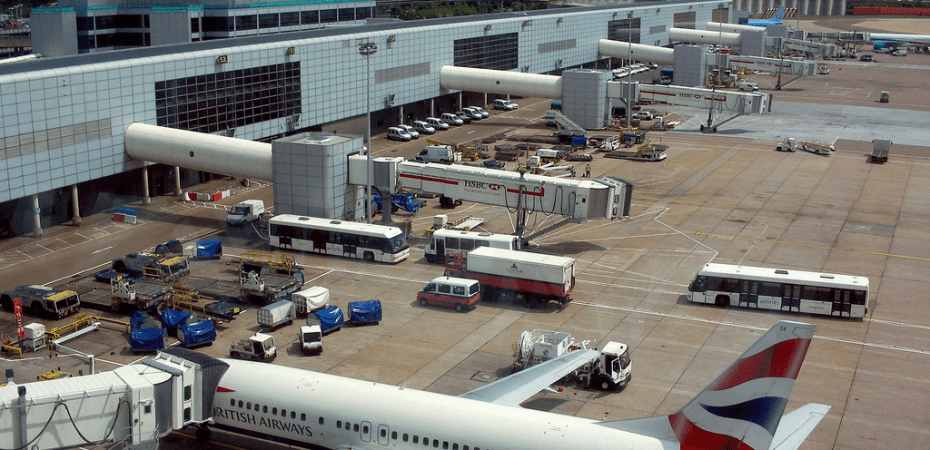
Image: Gatwick Airport, North Terminal. https://commons.wikimedia.org/wiki/File:Gatwick_Airport,_North_Terminal.jpg. Source: Gatwick Airport, North Terminal. Author; Martin Roell from Berlin, Germany, licensed under the Creative Commons Attribution-Share Alike 2.0 Generic license.
 Labour Hub
