
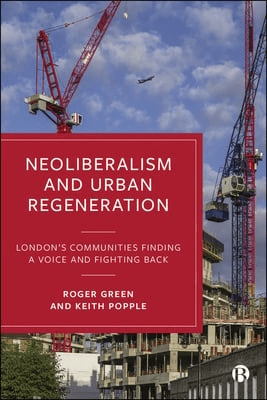
Mike Phipps reviews Neoliberalism and Urban Regeneration: London’s Communities Finding a Voice and Fighting Back, by Roger Green and Keith Popple, published by Bristol University Press.
“For far too long urban communities and neighbourhoods have been reimagined by corporate power,” write the authors in the Introduction of this book. This has “brought into sharp relief the city as a commodity where class, power and politics are interwoven to dominate the urban landscape.”
The pattern is predictable: massive office blocks and high-density housing that is unaffordable to most people – lucrative for the developers, dismal for the community.
The impact of global neoliberalism on London has been to exile not just the poorest, but substantial sections of the middle class to the outer suburbs, while large swathes of inner London are increasingly the preserve of the super-wealthiest, with little evidence of any ‘trickle-down effect’. One third of Central London’s luxury flats are bought by overseas buyers.
The influence of foreign money is felt in other ways. Evgeny Lebedev, whose fortune derives from his father, a Russian banker and former senior KGB officer, used his London newspaper, the Evening Standard, to promote Boris Johnson’s bid to become Mayor in 2008. One of the Mayor’s powers is to override local authorities who are holding up planning applications, often on grounds that they don’t serve local interests.
The alliance between local politicians and corporate developers has seen the displacement of long-standing diverse communities and genuinely affordable rented social housing being absent from new developments. To minimise local opposition, running down housing estates is often the precursor to their destruction: tens of thousands of council homes have been lost in the name of regeneration. The needs of children in particular are being sidelined in the quest for profitable development.
This key case study of this book is Deptford, a diverse working class area of Southeast London, where most people live in rented accommodation, with nearly 50% in council housing. Despite local misgivings, Mayor Boris Johnson approved a commercial development of luxury flats. It was the start of an aggressive period of gentrification, which began squeezing out the local community.
Resisting this was the Voice4Deptford campaign, the central case study of the book. The group mobilised in the local community to push for an alternative vision to that of the developers. After eleven years of campaigning, it has had a significant impact, while also exposing the limitations of local democracy in the face of global capitalism.
There is a long history of local resistance to corporate development in poorer parts of London. One of the better known is the Coin Street Action Group in Waterloo, which successfully fought off plans to build to build hotels and office blocks on a Thames-side site over a number of years. In the 1980s, the Group bought and redeveloped a 13-acre site as a community amenity, with a housing cooperative and a range of facilities. But there have been many other campaigns, discussed here, united by their common goals of resisting social cleansing and corporate takeover.
There are a lot of suggestions here about how to organise in your community against the anti-social side of capitalism. You might be left wondering, however, what local government is for. All over London – and beyond – Labour councils, elected with the votes of working class communities they are supposed to serve, collude with developers to displace them. This contempt for democratic accountability has to be challenged inside the Party at all levels.

Mike Phipps’ book Don’t Stop Thinking About Tomorrow: The Labour Party after Jeremy Corbyn (OR Books, 2022) can be ordered here.
 Labour Hub
[…] reviewed quite a few books on housing on this site in recent years, I would say that Bricking It is one of […]