

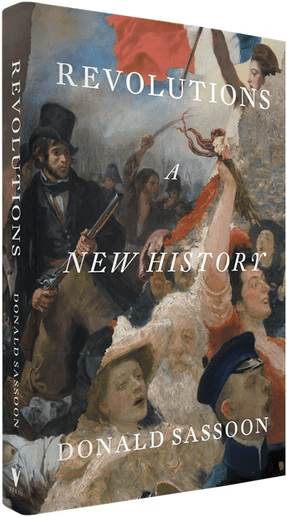
Ahead of a talk at Bookmarks on November 7th and the publication of his new book Revolutions: A New History later this month, Donald Sassoon considers the nature of revolutions – and how they often take revolutionaries themselves by surprise.
A revolution, in common usage, is an event which overturns the structure, the politics, or the constitution of a particular state. It is, like most complex phenomena, virtually impossible to define.
Revolutions usually start with the breakdown of the state: finance, law and order, etc. A period of crisis ensues and then, either the state is reorganized in a modified form – or a new state emerges. But was fascist Italy or Nazi Germany the result of revolutions – as some of their supporters claim?
Similarly, the fall of communism in Eastern Europe and in the Soviet Union, which did involve the breakdown of the existing states, was not called a ‘revolution’.
How about the anti-colonial revolutions? These involve the destruction of the colonial state apparatus and its replacement with a state run either by settlers (as in the revolutions in the Americas) or by the indigenous population (as in most of Africa).
As Montesquieu explained, any revolution which can be foreseen will never take place, for if foreseen it will be pre-empted by any intelligent politician.
Had not the American Revolution taken place, slavery might have been abolished sooner, since it was abolished in the British empire in 1833. So, if America had remained part of the British Empire, slavery might have been abolished some thirty years earlier than the actual abolition in 1865.
In real history matters are never clear. Even Karl Marx, who was supposed to know a thing or two about revolutions, is never precise over the use of the term. He never used the word consistently nor did he ever produce a general theory of revolutions. He seldom used the term ‘bourgeois revolution’.
In recent times we have increasingly used the term loosely: we write about the Neolithic revolution, the technological revolution, the digital revolution. We talk about the sexual revolution, the feminist revolution, the social media revolution – all processes that have changed behaviour and mentalities. But we have also used the term for ‘revolutionary’ rock bands and the rock bands themselves talked of revolution from the Rolling Stones’ Street Fighting Man (1968) to the Beatles’ more moderate Revolution (1968).
By the turn of the twenty-first century, the word revolution had become trivialized. A beautifying face cream was called the ‘Revolution Pro Miracle Cream’. Emmanuel Macron, a banal centrist politician, published in 2016 a book called Révolution where he talks about his life, his wife and the great changes he had in mind (none of which he even attempted to implement) – and plenty of other clichés. It was advertised by its British publishers as “The visionary memoir of a rising global leader.” No vision and no rise followed.
In July 2020, during the Covid-19 pandemic, Boris Johnson announced an instantly forgotten “cycling and walking revolution” while, in the same month, -on the 14th of July! – the Guardian discussed the “Nespresso coffee revolution”. By then the term had lost any meaning.
It is often said that revolutions go bad, that they betray their original high-minded principles (when they have them), and that, in what has now become a cliché, they ‘devour their children’. But, during the so-called ‘Terror’ in revolutionary France ‘only’ 2,639 people were guillotined. Many more died in the civil war in the Vendée and elsewhere.
As the leading American abolitionist and women rights’ upholder Wendell Phillips famously declared, “revolutions are not made, they come,” though he made it clear that one also needed a group of people pledged to new ideas.
What happens depends on a multiplicity of factors and not just on revolutionaries and counterrevolutionaries. Revolutions are usually initiated by a minority taking advantage of an exceptional conjuncture which they had not created. Those who stormed the Bastille could not possibly know that this would be the first step towards a republic Revolutions that would follow an unpredictable course. The women who demonstrated on 8th March 1917 in Petrograd did not know it would lead to the end of the Romanov dynasty and eventually to the Russian revolution.
Until the English ‘Glorious Revolution’ of 1688 (hardly a revolution in the modern sense), historiography seldom uses the term ‘revolution’. Montesquieu used the term révolution frequently in his De l’Esprit des Lois (1758) but he usually meant a change of regime.
The American Revolution was not called a revolution from the outset, though Thomas Paine used the term in 1777.
By 1789 it was widely used by the French revolutionaries as well as by their opponents. The word, and the event, for long caused consternation and not just in the West: in 1908 the Qing ministry of education demanded that all references to the French revolution in Chinese schools to be deleted and the word ‘revolution’ replaced with the word ‘chaos’. All to no avail: a few years later a revolution wiped away the Qing and nearly forty years of real chaos ensued.
Modern revolutions are often connected to the issue of finance and taxation. The seizure of power, as opposed to rebellions and protests, matters when the state matters, when government is for real, when the state imposes taxes. As David Hume explained, governments are “one of the finest and most subtle inventions imaginable” for, thanks to government (and the finances it raises) “bridges are built; harbours opened; ramparts raised; canals formed; fleet equipped; and armies disciplined.”
This is why the history of revolutions begins in earnest with the history of the state and the history of the national economy – what we call capitalism – and why revolutions should not be seen as sudden, short-lived events which are resolved in a few years. The purported original spark launches a process with new demands and grievances even when the original ones have been resolved. This is why the revolutions I deal with, the English Civil War, the American War of Independence and the French, Russian and Chinese revolutions are seen as long-term processes. There is no date set for the beginning of the Middle Ages, or their end, or the beginning of the Renaissance or the start of capitalism. Processes, almost by definition, do not have clear beginnings, let alone clear ends.
One should also avoid the temptation to treat the period preceding each revolution as the period which ‘prepares’ the revolution. It usually arrives unexpectedly catching the revolutionary themselves by surprise even though they spent years or even decades preparing for the great moment.
Donald Sassoon is Emeritus Professor of Comparative European History at Queen Mary, University of London. He will be spealing at Bookmarks, 1 Bloomsbury Street, London WC1B 3QE on Friday 7th November at 6.30pm about his new book Revolutions: A New History, published by Verso on November 18th.
 Labour Hub