
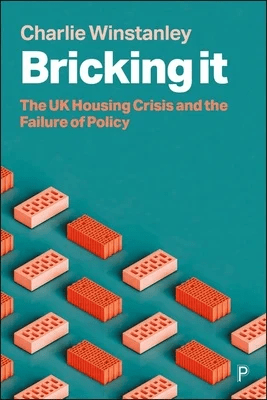
Mike Phipps reviews Bricking It: The UK Housing Crisis and the Failure of Policy, by Charlie Winstanley, published by Policy Press.
This book is based on nearly ten years of work on housing policy from the author’s perspective as a political advisor to the City of Salford’s elected Mayor, Paul Dennett. In three separate parts, it defines the nature of Britain’s housing crisis, explains the policy failings that led to it and proposes some solutions to fix it.
In the past seventy years, house prices have risen in real times by 365%. The average house in 1955 cost 4.5 times the average salary – now it is nearly double that. Yet, on reflection this ‘golden age’ looks like an anomaly: even then, the private rented sector made up 30% of the housing market and in earlier times it was even greater and people could expect to pay a much higher proportion of their income on rent.
Today’s ‘crisis’ has been the norm for most of the last 150 years. Perhaps one difference is that, even before the post-war era, there was a real determination to solve the problem, which is manifestly lacking today. Those years do at least show, however, that the current crisis is fixable – given the political will.
The nature of the crisis
The present crisis can be broken down into three components: availability, affordability and quality. The availability crisis is based not just on Britain’s rising population but also the changing nature of households and the lack of supported housing, care facilities and adapted accommodation for people with disabilities and mobility issues. Alongside that, the number of second homes in England has increased by 170,000 since 2010.
Social and council housing, in 1979 a readily available option housing for over 40% of the population, is now a much-sought rarity, housing just 16%. The National Housing Federation believes that 90,000 new social or local authority homes should be built every year to keep pace with demand. In 2022, just 6,554 were built.
Affordability is a central concern, given how housing costs have outpaced wage growth. As home ownership becomes increasingly unattainable, the private rented sector has more than doubled in size this century, becoming highly lucrative and crowding out other forms of accommodation. High levels of tenant insecurity due to the threat of sudden rent rises or eviction have created an epidemic of homelessness – particularly since 2010. Yet rough sleeping, which has almost tripled since 2010, is also an eminently fixable problem as Government efforts during the pandemic showed.
As for quality, four million homes are classified as endangering the health of their occupants – Britain has the oldest housing stock in the entire world. Its housing is the least energy-efficient in Europe, with over 13% of households living in fuel poverty. Over five million properties are at risk from flooding and more than half of home buyers of new-build homes report “major problems” with fittings and construction, according to Shelter.
Policy failure
Behind the crisis, argues Winstanley, lies a structural failure by governments to maintain the foundational principles that once ensured widespread housing availability, affordability and improving quality – replaced by a conscious attack on these principles.
Delivery of new homes has consistently fallen short. Governments have repeatedly blamed the planning system which ‘slows down’ development. Keir Starmer promises to “bulldoze through” this. Yet the planning system has remained broadly unchanged since 1947 and did not stop the post-war building of record numbers of new homes at the time.
Research by the Local Government Association in 2020 showed that the planning system was not the problem: the number of homes granted planning permission has outpaced the number actually being built. The private sector will not build if the opportunity is not profitable: too much supply lowers prices.
A 2019 report found that fewer than half the homes given planning permission in London were ever built. But such is the financialisaton of land that the mere granting of planning permission can drive up the value of agricultural land from £21,000 per hectare to £1.95 million per hectare. Hence the pressure from developers to build on the Green Belt.
For similar reasons, developers have little interest in affordability. This is where local authorities need to step up – as they did in the post-war years. Yet government policy consistently restricts their ability to borrow and continues to subsidise Right to Buy, which blocks the viability of new council developments and ring-fences the revenue made on asset sales. Shelter estimate that of all the houses sold under Right to Buy since 1980, fewer than 5% have ever been replaced.
Without a fundamental change to this approach, the problem of delivery cannot be solved. Worse, government policy has been slanted towards encouraging the displacement of council tenants, via private development gentrification schemes.
Meanwhile, little has been done to rein in the unregulated private rented sector. Labour’s Renters’ Rights Bill may finally get rid of no-fault evictions, but does little on other pressing issues facing renters, such as length of tenancy, rent increases and effective regulation of standards.
Successive governments’ welfare reforms – punitive benefit sanctions, the Bedroom Tax, Universal Credit, for example – have fuelled rather than alleviated homelessness. Government efforts to tackle this have frequently fallen short, focusing too little on needs and too much on ‘character deficiencies’.
Yet if government policy has been focused more on increasing home ownership, it has failed even by this yardstick. Home ownership has dropped from a peak of 71% in 2003 to 62.5% in 2021 – but for adults aged 25 to 34, it has plummeted from 59% to 41%. Spiralling costs are the main reason for this – and government subsidies for first-time buyers may actually be reducing affordability. Other factors behind house price inflation include the corporate investment in housing as financial assets, the rise of short-term lets and second homes.
As housing becomes increasingly unaffordable and wages stagnate, the government spends staggeringly huge sums on housing benefit – over £23 billion in 2022 – a doubling in real terms since the 1990s. As rents rise, this becomes an inflationary investment into the private rental market, sustaining what would otherwise become unviable. Higher wages could help tackle this – but that means seeing the solution of the housing crisis as part of a much wider programme to remodel the economy.
Fixing it
“The single most important policy towards resolving this country’s housing crisis would be unlocking the power of councils (and housing associations) to build council houses at scale once more,” argues Winstanley. That means removing one of the central obstacles to building: Right to Buy: “Councils cannot invest in building assets which may be sold under their noses at a substantial loss.”
Central government investment will also be necessary to build on the scale needed. But widespread council house provision at controlled sub-market rents would also play a key role in reducing house price inflation, as well as excessive rents in the private sector, which in turn would bring down the cost of housing benefit. Curbs on international investors, buy-to-let purchasers and short-term lets would also tackle the affordability crisis.
Urban regeneration will need a rethink. “The model of deliberately fostering areas of high value as a honeypot for investment, usually within urban cores, is contributing hugely to the commodification of housing and property.” A more holistic approach to development needs to be embraced with affordable, accessible housing at its heart.
The private rented sector needs more reform than is currently on offer. It’s currently perfectly legal to be an unregistered slum landlord. Local authorities need greater licensing powers in this field, including the power to acquire non-compliant properties.
To address Britain’s dire housing standards, not only is a major programme of upgrading and retrofitting needed: the entire construction industry, rife with sub-contracting and buck-passing over poor quality, needs reform. Winstanley offers a number of concrete ideas.
To what extent will Keir Starmer’s Labour government fix these problems? Despite some positive steps in their Renters’ Rights Bill, the signs are not good. Nothing in the current strategy shows that they have learned any of the key the lessons from decades of relying on the market to meet Britain’s housing needs. Their recent plan to reduce the percentage of affordable housing in new developments from 35% to 20% may well see more housing built – but not for people who need it and on a basis that will fuel further financialisaton of the sector and increase inflationary pressures.
Having reviewed quite a few books on housing on this site in recent years, I would say that Bricking It is one of the best – brilliant at explaining the crisis, what caused it and some of the policies needed to overcome it.
Mike Phipps’ book Don’t Stop Thinking About Tomorrow: The Labour Party after Jeremy Corbyn (OR Books, 2022) can be ordered here.
 Labour Hub