
By Russell Fraser
On 2nd December 2025 the Justice Secretary, David Lammy, finally made a statement in the House of Commons on ‘criminal court reform’. As with most ministerial statements much had been briefed to the press in advance, despite the Ministerial Code requiring announcements of policy be made in the House before anywhere else. Perhaps Lammy considers such things quaint, as with his newfound view of the place of juries in our criminal justice system. He was setting out the Government’s response to the ‘Independent Review of the Criminal Courts’ authored by the retired senior judge Sir Brian Leveson. Sir Brian had been tasked with finding the solutions to the crisis in the criminal justice system, represented most starkly by a backlog of 78,000 cases awaiting resolution.
The central proposal Lammy set out was that of removing the right to a jury trial from a raft of offences. These reforms he described as “bold” but necessary. Instead he will introduce “Swift Courts” dealing with cases where the sentence on conviction would “likely” be three years or less. He also proposes judge-alone trials for particularly complicated fraud trials and handing magistrates’ courts greater sentencing powers. Lastly, he wants to hand courts “the power to decide where cases are heard, no longer allowing criminals to game the system and torment their victims.” He is pinning his hopes on all this reducing the backlog by a mere 20%. There is little evidence to support that and nor does he propose to pilot any of the changes. However, the details of how all this will work remain scant, reduced to a few bullet points on the Ministry of Justice website.
Lammy himself has reviewed the operation of our criminal courts. In 2017 he looked at “the treatment of, and outcomes for, Black Asian and Minority Ethnic (BAME) individuals in the Criminal Justice System.” In that review he concluded that “juries deliver equitable results, regardless of the ethnic make-up of the jury, or of the defendant in question.” He said that BAME defendants often distrusted the advice of lawyers and did not believe they would receive a fair hearing in the magistrates’ court. In 2025, instead of recognising those complexities and questioning the structural problems in the system he dismisses such people as “gaming the system”.
The language is redolent of how some politicians speak of those who claim state benefits. Those in need and those who find themselves before the courts are viewed with suspicion despite the lack of evidence for doubting their motives. The language in his statement contrasts negatively with that of his review. The unconvicted defendants (the correct term) of his review become criminals in his statement. In my experience, most people I represent, on hearing their trial date will be more than a year in the future, do not leave court skipping care-free towards the horizon.
Juries are not the reason the courts are backlogged. The real causes are obvious and stem from the austerity years when the Ministry of Justice saw cuts to its budget of between 25% and 40%. The decade from 2010 saw 162 magistrates’ courts close and eight crown courts. But queues of cases exist in other areas of law too where juries are not a feature: in September the Public Accounts Committee criticised the Government’s failure to deal with family court backlogs; and in the summer the Law Society expressed its concern about the “spiralling” backlog in the employment tribunal.
Those of us working in the crown courts every day know the true reasons for delays and lost sitting days are systemic. The regularity with which defendants in custody are brought to court late is such that it no longer surprises anyone. Judges in open court express denunciation and dismay at the failures but their powers stop at the door of the dock. The same mumbled excuses issue from whichever jailer is unfortunate enough to be expected to explain. On top of that we have a neglected court estate where boilers break down, plumbing fails, dousing courtrooms in effluent, and yards of buildings are fenced off with black and yellow tape as if resembling a crime scene. None of this will be remedied without reversing the damage of the 2010s.
The Crown Prosecution Service too ought to take a hard look at its caseload and decide whether the public interest in fact demands cases are dropped, exceptionally because of the ‘emergency’. On social media in recent days I have seen colleagues recite countless examples of cases which are surely no longer in the public interest. On my own desk is a case dating to 2020 concerning a violent disturbance involving a number of men in a custodial setting. The result was that another man was injured but he has never supported the case. The staff who witnessed the incident and brought it to an end were unharmed. Some have since moved on in their careers and none of those involved remain at the facility. There was once a public interest in demonstrating that anyone criminally involved in such disorder should face punishment but that public interest has waned as the years have passed. Twice the case was listed for trial and twice the court could not accommodate it. A third attempt is still scheduled for 2026.
This is a time and opportunity for criminal justice to be reimagined in ways which will not only reduce the cases but make society better. We need to think more seriously about who we prosecute and why. The Government should begin by repealing offences targeted at protesters and migrants while trying to remove drug users from criminal sanction altogether. Bold reform, indeed.
Russell Fraser is a criminal barrister at Garden Court Chambers and an executive committee member of the Haldane Society of Socialist Lawyers. He writes in a personal capacity.
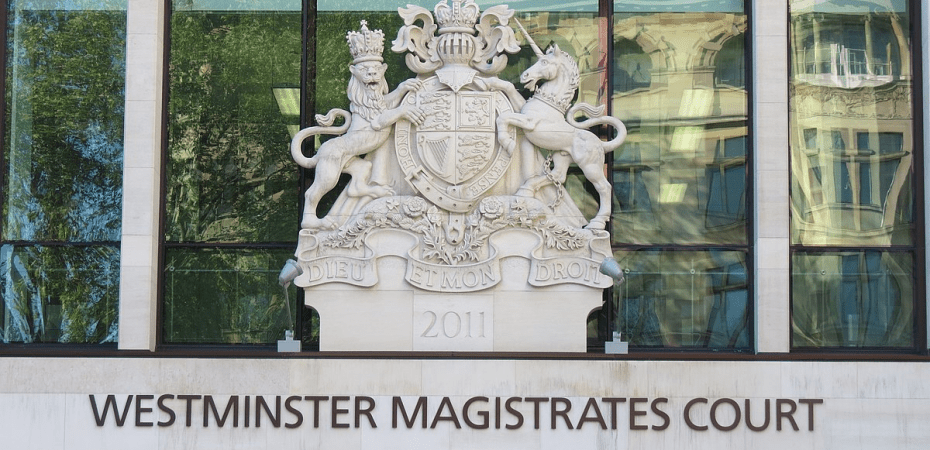
Image: Westminster Magistrates’ Court https://commons.wikimedia.org/wiki/File:Westminster_Magistrates%27_Court_-_Crest.JPG Author: GrimsbyT ,licensed under the Creative Commons Attribution-Share Alike 3.0 Unported license.
 Labour Hub

[…] yet another unpopular erosion of basic civil liberties, Labour announces a reduction in trial by jury in December. But in perhaps the best news for the left all year, Andrea Egan beats the incumbent to […]