
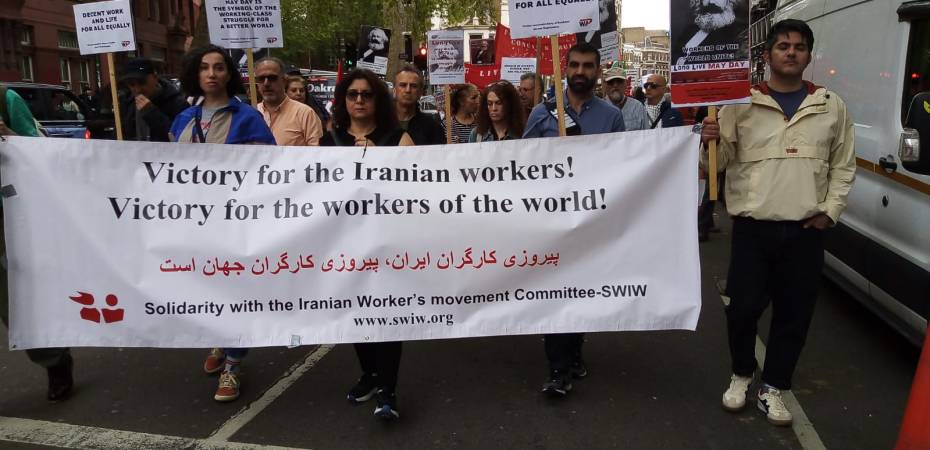
A report from the Solidarity with the Iranian Workers’ Movement Committee.
The 12-day war between Iran and Israel, far beyond a mere military confrontation, has imposed a chain of economic and social crises upon Iranian society, targeting the livelihood infrastructure of the people, particularly the working class. While the eyes of the world were fixed on the violence of the battlefield, this silent yet deep war exacerbated structural fissures in the lives of workers, fissures already formed by relentless inflation, widespread unemployment, delayed wage payments and a severe decline in purchasing power.
The heavy burden of this crisis fell on the shoulders of the workforce, demonstrating that the economic security of the working class is fragile and vulnerable. In the shadow of this crisis, many small and medium-sized enterprises (SMEs) resorted to layoffs under pretexts such as market recession, reduced investment, and ‘war conditions’. Informal and contract workers, lacking insurance and adequate legal protection, suffered the most damage; these are the very people who form the backbone of the country’s workforce.
Somayeh Golpour, representative of the High Council of Trade Associations, warns that employers are exploiting the critical atmosphere to fire workers without adhering to labour laws. This flagrant aggression is a violation of legal articles accepted by the Islamic Republic itself, such as Articles 21, 24, 27, and 30 of the Labour Law, which are meant to prevent unjust dismissal and non-payment of wages, and to ensure the reinstatement of workers following a crisis. Ali Aslani, a labour relations expert, pointing to the experience of the eight-year Iran Iraq war, notes that even during that era, employers did not assault the workforce on such a massive scale.
The tangible examples of these aggressions are clear and shocking: the Serjin Baft factory in Zanjan fired a large portion of its experienced workers after reopening; companies active in the digital economy, such as Alibaba and Karnameh, faced downsizing; and internet blackouts confronted micro-businesses with compounded difficulties. Under these conditions, wages have not only failed to increase but are paid with multi-month delays, while additional hardships such as soaring housing rents and the non-payment of the employer’s share of insurance have added to the workers’ livelihood burdens.
The government and employers have utilized the post-war security and militarized atmosphere to undermine the achievements of the working class and suppress any protest with the label of “weakening the homeland in war conditions.” However, the working class and other deprived sectors have not left this aggression unanswered. Over 150 strikes and 20,000 gatherings in various sectors from oil and petrochemicals to mines, municipalities, nurses, teachers, retirees, and farmers demonstrate that society’s protest movement is alive and ready. The workers’ demands are not merely economic, but legal and human: wage increases, the elimination of the contractor system, timely payment of wages, the reinstatement of fired workers, and the freedom of labour activists.
Alongside these demands, the urgent need for internationalist support for the Iranian working class has become more apparent than ever. Crises of this nature, especially within the deeply turbulent current global context, cannot be solved solely within national borders. Connecting Iranian labour activists with unions, syndicates, and anti-capitalist movements globally can serve several vital functions: preventing the isolation of Iranian workers’ struggles and amplifying their voices to international bodies; pressuring the government and employers through global labour solidarity; exchanging experiences; providing training in organizing and access to global support networks; and creating a political and ethical shield against repression. The Iranian working class, bearing the heavy weight of economic and security crises, requires this global solidarity.
Furthermore, to counter this deep livelihood crisis, we require urgent immediate and structural solutions: the creation of national crisis insurance and wage subsidies for workers in affected units; a temporary suspension of taxes and insurance premiums for damaged small businesses; the provision of emergency aid to households with no income; strengthening the Ministry of Labour’s oversight to prevent unjust dismissals and facilitating the formation of independent worker representation bodies; and the formulation of a national job rehabilitation plan with technical and skills training for those affected by layoffs.
The experience of this period has made it clear that security crises quickly transform into livelihood crises for low-income classes. Without strong support networks, effective oversight, genuine representative bodies, and internationalist backing, the heavy burden of this crisis will fall upon the majority of society. Guaranteeing job security, preserving the legal rights of workers, and creating social safety nets, not only reduce human suffering but are also necessary conditions for economic stability and social progress. Victory over these difficult conditions depends on unity, organization, and the persistent struggle of the working class, its connection with other justice-seeking and freedom loving movements, and global solidarity among all workers.
For more information about the Solidarity with the Iranian Workers’ Movement Committee, see https://www.swiw.org/about/
image: c/o Labour Hub.
 Labour Hub