
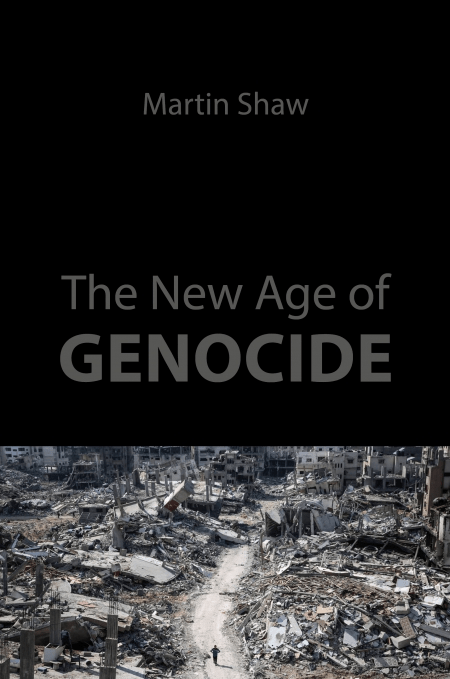
Mike Phipps reviews The New Age of Genocide, by Martin Shaw, published by Agenda.
This book addresses not only the concept of genocide but its return to a central place in world politics. It explores both the West’s failure to prevent genocide, and, in the case of Palestine, its active complicity in it.
But Shaw is no campist, blind to the genocidal aspects of other imperial wars. In fact, with the dominance of Trump in the US, Putin in Russia and Xi Jinping in China, “a veritable axis of genocide appeared to be emerging at the highest level of world politics.” Yet it is not accidental that this is happening at the same time as academic and media analysis increasingly shies away from using the term.
Gaza has brought the issue of genocide back into focus with some urgency. It underlines too how other powers fight wars as a way of obfuscating their genocides. Russia’s war on Ukraine was intended from the outset – Putin’s own words say this – to destroy the Ukrainian state and society. It targeted children’s hospitals and other civilian infrastructure, deployed ‘kill-or-capture’ missions against local officials, organised the torture, rape and execution of civilians as well as the forcible transfer of civilian populations, alongside the cultural destruction of museums, monuments and places of worship. It amounts to genocidal intent and action.
These same features – genocidal intent and action – are present in Israel’s destruction of Gaza. The intent, repeatedly voiced by many Israeli leaders, is to destroy Gaza and expel its people. Moshe Feiglin, for example, calls for the complete destruction of Gaza and said last year: “As Hitler … once said, ‘I cannot live in this world if there is one Jew left in it.’ We will not be able to live in this land if one Islamo-Nazi is left in Gaza.”
This is extreme, but it builds on earlier Zionist narratives that promote expansionism and population transfers over coexistence. The actions are indisputable: mass killings, the destruction of civilian infrastructure, including the health system, on a massive scale.
The character of Israel’s genocide is underlined by the fact that children make up nearly half of all verifiable Palestinian deaths, with 5-9 year olds the biggest category. Deliberate mass starvation – the worst since the siege of Leningrad in World War Two – has also disproportionately affected children.
How complicit is the UK in Israel’s genocide in Gaza? British military support given under the 2020 UK-Israel Military Cooperation Agreement has contributed significantly. Concretely, British reconnaissance flights, supply of weapons parts to F35 bombers, as well as legal and political support are all important. This is accompanied by the suppression of dissent: there is growing concern that the Labour Government’s ban on Palestine Action was the result of Israeli lobbying. Shaw concludes that by condoning and facilitating the perpetrators’ campaign, Britain failed to fulfil its anti-genocide responsibilities.
And not for the first time in my lifetime. The army of Republika Srpska’s genocide in 1995 against Bosnian Muslims in Srebrenica and beyond was minimised at the time under the euphemism “ethnic cleansing”, as Western leaders, Britain’s included, characterised the war as an inter-ethnic conflict in which all sides were more or less to blame. Such a narrative allowed Western peacekeepers to hand over a town of civilians to their enemies to be massacred. It took the International Court of Justice many years to rule that the slaughter of 8,000 men and boys in Srebrenica was indeed a genocide – while simultaneously denying the reality of a wider Bosnian genocide elsewhere.
Will it take as long for Israel’s genocide to be called by its right name? Current signs are not encouraging. While Srebrenica has been added to the UK’s 2025 Holocaust Memorial Day (HMD) commemorations to show concern for wider genocide, Gaza is still treated as a “catalyst for antisemitism.” The then Foreign Secretary David Lammy even joined Israel’s ambassador Tzipi Hotoveley, an outspoken apologist for its crimes in Gaza, in HMD celebrations.
Meanwhile UN Special Rapporteur on the occupied Palestinian territories Francesca Albanese, who has rightly called Israel’s action in Gaza a genocide, is the victim of punitive US sanctions which forbid all US persons and companies from doing business with her, affecting her bank accounts and many aspects of her personal and family life. Media complicity? The editorial board of the Wall Street Journal praised Washington’s move as overdue.
We truly are living in a new age of genocide, perpetrated by governments and facilitated by their supporters in the media. Russia’s ongoing genocide against Ukraine normalises Israel’s genocide against Gaza – and vice versa. Each reinforces the impunity of the other. To minimise one at the expense of the other – quite a widespread tendency on the ‘left’ – is a fool’s game that will degrade the human rights of everybody – at a time when authoritarian powers in all parts of the world are moving onto the offensive against their critics in civil society.
Mike Phipps’ book Don’t Stop Thinking About Tomorrow: The Labour Party after Jeremy Corbyn (OR Books, 2022) can be ordered here.
 Labour Hub