
Mark Farmaner reports on attempts to rebrand Burma’s genocidal military regime.
When western countries impose targeted sanctions or take other steps to promote human rights and democracy in Burma, China complains. Western countries are interfering in the internal affairs of another country, they say.
China interferes in the internal affairs of Burma more than any country since British colonial occupation. They arm the Burmese military and they fund the Burmese military. At the same time, China destabilises the Burmese military by selectively arming some ethnic armies on the China-Burma border which administer autonomous areas. They want a subservient ally, not an all-powerful one.
As part of their belt and road strategy and the strategic use of investment, China has cheap access to key natural resources in Burma and is economically binding Burma to China.
China was not pleased with Burma’s 2021 military coup; it interfered with business. They allowed ethnic armies on their border to join or otherwise support armed resistance to the coup, but the subsequent conflict and the growth of scam centres on the border with China created a level of instability and insecurity that they would no longer tolerate.
China decided that the Burmese military would be most subservient to their interests, and swung behind them, cutting off arms to the resistance and, of all things, telling the Burmese military they had to hold elections.
This Sunday a second round of elections will be held in Burma. The first was held on 28th December, with the main military-backed party winning around 90 percent of the seats. That was no surprise: more than 40 political parties have been banned, including the National League for Democracy, which has won every national election it competed in.
There isn’t even a semblance of these elections being free and fair, and more than 20,000 political prisoners remain in jail. The military is in full control of less than half the country. In areas where voting did take place, turnout was down by thirty percent, with reports of people only voting because they were forced to.
China has been openly boasting about its role in these elections. Mr Deng Xijun, Special Envoy for Asian Affairs of the Ministry of Foreign Affairs of China, attended the first round of elections as an observer. At a ceremony afterwards he stated:
“Notably, the successful conduct of these elections reflects the agreements and cooperative efforts between Myanmar’s Acting President Senior General Min Aung Hlaing and Chinese President Xi Jinping.”
Can there be any greater interference in a country’s internal affairs than choosing when and how ‘elections’ will take place.
The last round will be on 25th January, after which a new military-backed proxy ‘government’ will be installed.
This is the end goal of China and the Burmese military: installing a new regime with a new brand name, and claiming a process of democratisation is taking place.
China wants normalisation. The Burmese military are hoping that this superficial change will be enough to gain the international acceptance which they crave.
It’s a trick they played successfully in 2010, when they held similar rigged elections which were rejected internationally. The new military-backed regime portrayed itself as democratic reformers and modernisers. They released most political prisoners (in stages to maximise public relations benefits), relaxed censorship (while keeping censorship laws in place), launched a so-called peace process with ethnic armed organisations while breaking ceasefires in the north and west of the country, and made grand promises of reform, even as they began escalating the persecution of the Rohingya minority, beginning a process which led to genocide.
This fake reform process was enough to persuade western countries to lift sanctions and even offer assistance to the military-backed regime. Burmese human rights activists and politicians who warned the process was a sham were told to get on board, and those who didn’t were ostracised.
With sanctions lifted and investment flowing in, the Burmese military budget began increasing by one hundred million dollars a year, paying for the jets bombing homes, schools and hospitals today.
If the post-election military-backed regime plays this same game again, will it work? Burma is much further down international priorities than it was in 2010. Instability and crises all over the world take precedent, and aid budgets have been slashed.
The Burmese military may be calculating that they don’t even have to go as far as they did after 2010 to gain international acceptance. That regional and western countries distracted and tired of the situation in Burma will say something is better than nothing, and pressure the people of Burma to go along with whatever sham reforms the military-backed regime claim to be beginning.
This would be a betrayal and a tragedy, as since the 2021 coup the people of Burma have never been closer to freeing themselves of military rule. China wanted these elections because it feared what would happen to Burma if the military lost. Multiple local administrations and autonomous areas are being established in areas freed from Burmese military control and in many of these areas local people are being consulted for first time about how they will be governed. It’s a new bottom-up democracy and system of governance being created, and it terrifies regimes which want centralised control.
The British government must lead in not only rejecting these elections, but the Chinese-backed military-installed regime which will follow.
Mark Farmaner is Director of Burma Campaign UK.
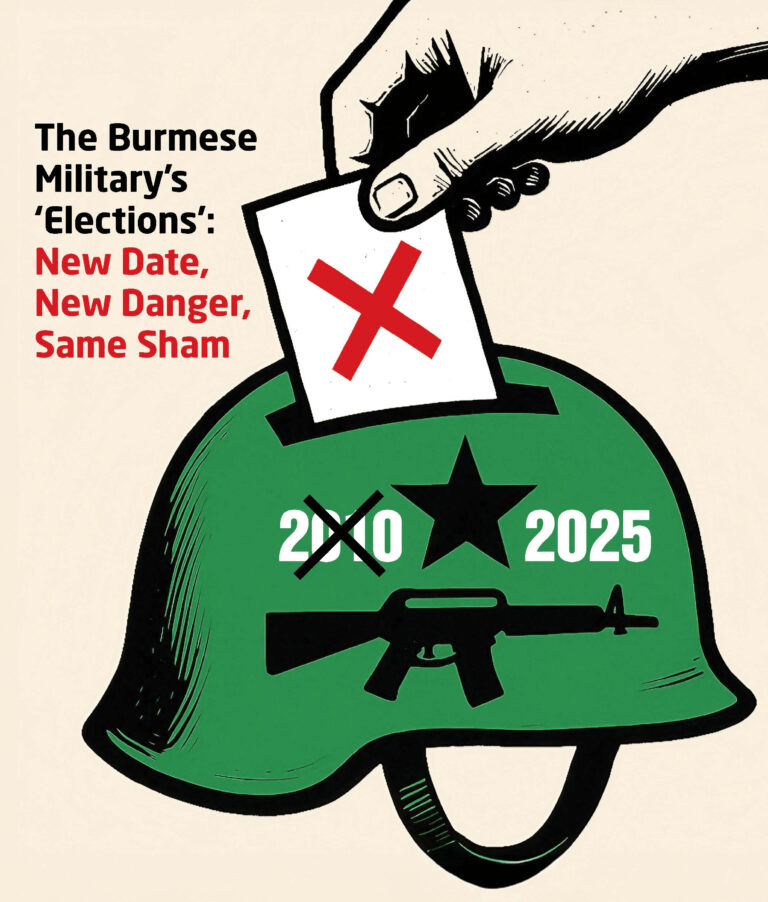
Image: https://burmacampaign.org.uk/burma_briefing/the-burmese-militarys-elections-new-date-new-danger-same-sham/ c’o Burma Campaign UK
 Labour Hub