
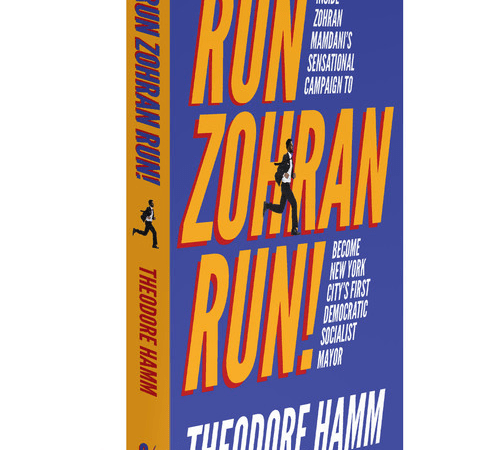
Mike Phipps reviews Run Zohran Run! by Theodore Hamm, published by OR Books.
Trump bombing Venezuela and kidnapping its President, Palestine Action hunger strikers close to death, ICE agents shooting dead an innocent woman in Minneapolis – it’s been a bleak start to 2026. Perhaps the only ray of hope was provided by the inauguration of Zohran Mamdani as the new Mayor of New York.
So the question arises: in the era of Trump, how did a 34-year old democratic socialist Muslim immigrant from Uganda win first the Democratic primary and then the general election to become Mayor of New York City?
Theodore Hamm’s book is the first comprehensive account of the origins of Zohran Mamdani’s victory and provides the key answers.
First, Mamdani was an inspiring candidate. A one-time rapper, he was charismatic and comfortable with a range of media, including Hindi commercials and Bollywood music, through which he engaged his diverse supporters. “His campaign’s always stylish, often humorous use of social media made him a star,” Hamm tells us. He is also a man of courage and integrity, underlined by his commitment to Palestinian rights, almost unique among New York politicians.
Palestine could not but be a feature of the campaign, given the way Mamdani’s opponents tried to weaponise the issue against him, in particular Andrew Coumo, who was a member of Israeli Prime Minister Netanyahu’s legal defence team. Determined to keep control of his own narrative, Mamdani spoke out against the Israeli occupation of Gaza and condemned the New York police’s storming of the Columbia University campus to break up a pro-Palestinian protest.
Secondly, Mamdani’s win was a collective effort. He had the support of not only the influential Democratic Socialists of America, but also a wide range of unaffiliated community organisations. By the time of the summer primary, 50,000 activists were working for his victory, including many Muslim and South Asian volunteers mobilising for the first time. Pro-Palestine activists, anti-poverty campaigners and tenants were also active in his campaign. By the end of his campaign, 100,000 volunteers had knocked on 3 million doors.
Third, programme. Socialist ideas have a considerable history in New York City but it was Bernie Sanders who brought them back into the national conversation and Alexandria Ocasio-Cortez who underlined their electoral potency. Mamdani focused laser-like on cost-of-living issues: a rent freeze, more affordable housing, fast, free transit, universal free childcare and higher taxes on millionaires to pay for this.
What was especially noteworthy about Mamdan’s campaign was his ability to connect every issue to affordability, for example linking the bribes received by his predecessor with the latter’s praise for New York police officers who opened fire at a subway station “over the crime of stealing £2.90 of a subway fare.”
Fourth, Mamdani faced a truly lacklustre opposition. The embattled incumbent, Eric Adams, dogged by corruption allegations, ducked out of the primary and attempted a failed independent run. Andrew Cuomo was also mired in scandal and ran as an independent after losing to Mamdani in the Democratic primary. In the final election, he was comprehensively defeated with just 41% to Mamdani’s 51%.
Hamm’s fast-paced account takes us up to Mamdani’s historic Democratic primary win in June, “one of the greatest accomplishments by the left and the socialist movement in the last century,” according to NYC-DSA co-chair Gustavo Gordillo. It contains a lot about the increasingly desperate antics of Mamdani’s opponents, but socialists elsewhere will perhaps be more interested in the organisation and tactics of his campaign, and the demographics who supported him. These included a majority of all18 to 50 year olds, people earning up to $300,000 a year, and a majority of homeowners and renters. It was this that helped Mamdani win four out of five of the City’s boroughs.
One important shift was in the Bronx, the City borough with the highest official poverty rate. It had backed Cuomo in June’s Democratic primary, but in the final election Mamdani scored 52% of the borough’s vote, with majority Black wards that had favoured Cuomo in the primary swinging decisively to Mamdani.
Overall, Mamdani won 64% of the vote in neighbourhoods with a plurality of Black residents — a 25 percentage point jump from the June primary. The leap attested to the work the campaign had put in to address scepticism about a political programme, as one analyst said, “intended to benefit working New Yorkers of all races whose message was often delivered by white canvassers perceived as transplants or gentrifiers before they were seen as neighbours.”
Holding together the electoral coalition that catapulted Mamdani into office will be, in the words of one of his campaigners, “a Herculean feat”. The key is “ensuring that the administration reflects the amazingly diverse tapestry of the city, so people can continue to see themselves.”
Mamdani himself understands this and the responsibility he now carries for the future of progressive politics in the US. In his victory speech on election night, he said: “We have bowed at the altar of caution, and we have paid a mighty price. Too many working people cannot recognize themselves in our party, and too many among us have turned to the right for answers.”
How far he will be allowed to deliver on his promises and maintain his popular support, in the context of a far right White House administration determined to thwart him, remains to be seen.
For more information, see Bryn Griffiths’ Labour Left Podcast interview with Professor Theodore Hamm about his book and the campaign here.
Mike Phipps’ book Don’t Stop Thinking About Tomorrow: The Labour Party after Jeremy Corbyn (OR Books, 2022) can be ordered here.
 Labour Hub