
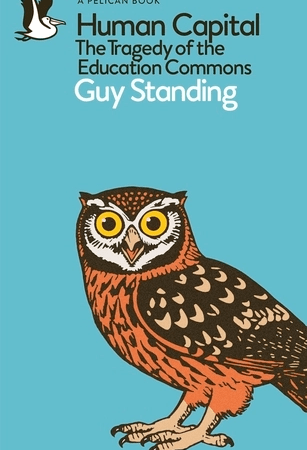
Guy Standing introduces some of the themes from his new book, which is published next week.
There is a famous aphorism, “Those whom the Gods wish to destroy, they first make mad.” The notion of madness comes to mind in reflecting on what governments over the past four decades have done to British education, or allowed to happen.
What progressives, inside and outside the Labour Party, must recognise before it is too late is that the ongoing changes represent an existential threat to emancipatory politics and Enlightenment values, making it increasingly likely that right-wing governments will be elected.
In ancient Athens, education was conceived as a commons, something to be shared in the open, with a dual focus, the pursuit of truth (paideia) and the refinement of virtue (arete). Key was the learning of empathy and compassion, and the values needed for healthy democracy. Although these principles have been abused throughout history, with schooling being dualistic, one stream for ruling elites, another for disciplining the working classes of the time, nevertheless the emancipatory flame has always been nurtured, by the likes of Rousseau, Jefferson, Hegel, Cardinal Newman, J.S. Mill and, in the 20th century, Tawney, Laski and G.D.H. Cole.
This influenced legislation in the 20th century, reaching pinnacles with the 1944 Education Act of R.A. Butler and the Robbins Report of 1963. The latter reiterated the classic rationale for universities as teaching people how to think and how to be good citizens. The emphasis was education as a public good, a sharing and competition of ideas and creative thinking.
A shift away from that began in the early 1970s, but is often traced to a speech given by Prime Minister Jim Callaghan in October 1976 suggesting schooling should serve the needs of industry. Then came the revolution orchestrated by Thatcher and Keith Joseph, her Education Secretary and mentor, leading to the 1988 Education Act, This imposed a narrow ideological curriculum on schools, while the decision in 1992 to merge polytechnics with universities turned the latter into engines for generating ‘human capital’.
All this was state enclosure, through rigid curricula and a marginalisation of the arts and humanities. Privatisation was then advanced by New Labour, notably by setting up the first quasi-private academies, and accelerated by Michael Gove after 2010.
Every aspect of education, from pre-school to higher education and ‘life-long learning’, has become part of a giant industry, with everything commodified. On some measures, education has become the biggest industry in the country after finance. This has opened the door to global finance, including private equity. How finance has plundered education, making handsome profits – often benefiting from government funding – of 20% or more, is described in detail in my new book.
The main point I want to make here is that unless the government can halt and reverse the ongoing financialisation and commodification of what purports to be education, two existential crises will make it difficult for any kind of progressive politics to thrive.
Global finance is not politically neutral. It operates to maximise short-term profits for its investors, and whatever rhetoric to the contrary, it is not answerable to society and has no intrinsic concern for emancipatory education. As the American founder of the for-profit University of Phoenix, which was for years the world’s biggest university with 600,000 students, said, “We are not trying to develop students’ ‘value systems’ or go in for that ‘expand their minds’ bullshit.”
Others have been more circumspect, but one of the mottos of the private equity concerns that are taking over education is ‘Buy, strip, flip!’ They want to maximise short-term profits, are answerable only to their investors and are quite prepared to jettison what is not profitable.
That is not the worst of it. A partnership has been established between the plutocrats in Silicon Valley, with their zealous worship of AI and related technologies, and Big Finance on Wall Street. Leading lights in that powerful circle openly talk about their goal of ‘revolutionising education’ and their grandiose plans to ‘disrupt traditional public schools’. And so far, politicians have either been complicit or passive in timidity. The education system does need revolutionising, but not in the way plutocrats like Elon Musk are promising to take it.
The rapidly growing threat is a double crisis, partly financial, partly ideological. If Britain allows foreign finance, in the form of venture capital and private equity, to dominate education, it will create for itself a financial dependency trap. In other words, if the state loses the ability and the desire to control its own education system, it will be forced to rely on those who do, and adapt policies to their whims, to attract and retain their good will and investment.
Who could forget how before the Budget of November 2025, the Chancellor, a Labour Chancellor, met the CEO of JP Morgan, Jamie Dimon, to solicit his approval. It followed a series of secretive meetings with him and his colleagues, indicative of who is in control.
A potential ideological crisis should be even more worrying. If a country allows global finance to control large parts of its education system, it would be naïve in the extreme to think or presume that finance would not set out to shape what was taught and what was not.
Fanciful? In 2025, a right-wing Bolivian-American billionaire was installed as chair of the board of Arden University after his Wall Street PE outfit bought 50% of the private institution, the fastest growing university in Britain, geared to producing professional degrees for over 40,000 students each year. Is it likely that social history, political science, philosophy or the arts will be taught in such a university? Or can we expect that those emancipatory subjects will be further marginalised? Such universities will drag others in the same direction, if only to remain ‘competitive’.
Once US-dominated finance becomes embedded in Britain’s education system, ideological baggage will follow. Perhaps those less worried than this writer should take warning from the rapidly growing Praeger University Foundation based in Texas. Headed by a CEO who previously worked for Mossad, it is ultra-conservative and is infamous for its so-called educational videos and other material that routinely disparage climate science and so much more. What is to stop it and bodies like it from permeating British colleges, schools and training institutions answerable to their financial and Edtech?
One stylised fact may indicate a wider danger. Studies show that children and students who learn the history of Empire and social history in general tend to develop politically progressive views more than those who do not, and this influences lifelong voting behaviour. If the Prime Minister’s stated desire to make the school curriculum even more oriented to preparing youth for the labour market continues, and if the government introduces financial literacy classes, as planned, one wonders what subjects will be more marginalised.
As finance deepens its control of British education, learning critical thinking will be enfeebled and then stifled, flagged as in the interest of ‘efficiency’, cost cutting and better preparation of students for the labour market. This is not a conspiracy theory. Allowing foreign finance to infiltrate the education system is to open it up to indirect control by the plutocracy, bent on achieving their own form of revolution, one to suit their oft-stated anti-democratic agenda.
There are many ways of combating the two related crises of finance dependency and ideological domination. But so far none have been at the fore of political debate. AI will make both crises infinitely more threatening. Those in control of AI are like evangelical zealots. Elon Musk has already set up his own university and wants to revolutionise all education.
In that context, the Government should set up a National Commission for Education to take stock and propose a brave, radical, transformative strategy, one designed to rescue and revive the education commons, in which the teaching of empathy, morality, respect for truth and democracy at least balances the pursuit of money-making skills and careerism.
One of the priorities of the Commission should be to curb the power of global finance and restore public democratic control over all aspects of education. It should strengthen what is vital for any commons, Gatekeepers, that is, bodies of commoners (stakeholders) capable of defending and reviving a system for producing healthy minds, empathy with our fellow humans and with nature, and a society celebrating creativity, truth and conviviality.
Anything less than a reset of the existing education industry would send a clear message to our children and grandchildren that today’s politicians were either oblivious to the dangers or did not care. And there is not much time. The core question is: ‘Does the Labour Government really want ‘change’?’
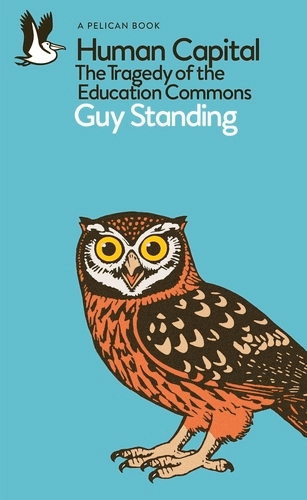
Guy Standing’s new book, Human Capital: The Tragedy of the Education Commons, is published by Pelican in January 2026. There will be a formal launch in the Brunel Gallery, SOAS University of London on February 17th. Anybody wishing to attend should contact Isabel Blake at IBlake@penguinrandomhouse.co.uk for an invitation.
 Labour Hub