
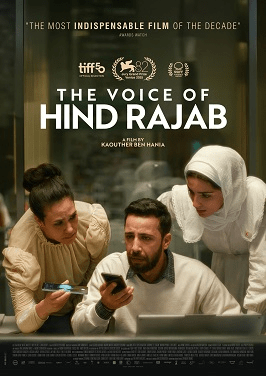
Ian Saville reviews The Voice of Hind Rajab.
This morning I watched The Voice of Hind Rajab, a new film by the Tunisian director Kaouther Ben Henia. It’s highly emotional and disturbing, as well as being an amazing piece of story-telling. It is told entirely within the setting of the Red Crescent Office in Ramallah, where the staff try desperately to be allowed to send an ambulance to a five-year old girl, Hind Rajab, trapped in Gaza in a car under attack by an Israeli tank, while six members of her family lie dead around her.
The ambulance is only eight minutes away, but in order to get the green light to proceed to the location, the call handlers and their worried boss have to ensure that they clear a passage with the layers of bureaucracy in charge – the Red Cross in Jerusalem, the Ministry of Health, and ultimately the IDF commanders. So the eight minute journey needs hours of coordination with these seemingly uncooperative agencies. And even when the green light arrives, after hours of begging and pleading, the tragedy continues.
The director decided to weave the film around the real-life soundtrack of the young girl’s call, rather than getting a child actor to speak the text, which she believes would have been disrespectful to Hind’s memory. This was done with the agreement of the girl’s mother, and the Red Crescent staff. It adds enormous power to the film, but also makes the experience harrowing.
This is much more than a documentary. It is a tragic drama. The scene in the office is tense and emotional, as conflict emerges between the call handler, who wants to just cut through the red tape and send the ambulance straight away, and his boss, who is determined not to lose more of his staff to Israeli murder. We also see the emotional toll on another, female, call handler, who tries desperately to reassure the girl, and establish an emotional connection with her. Those who followed the story on social media will know of the terrible outcome, and we see the arguments played out in the office over how useful it will be to broadcast the situation as it happens.
The tragedy is that even the caution of the boss doesn’t save his medics, as they also come under attack within metres of reaching their target.
Asked in an interview on BBC radio why she didn’t include the Israeli Government perspective in the film, the director said that the Israeli perspective is just one of denial, despite the undeniable research of investigative organisations Forensic Architecture, the Washington Post and Al-Jazeera. The film takes a position on the side of truth.
There has been some criticism of the film on the basis that using the real voice of Hind is somehow “in bad taste” in a drama which mixes the actuality with actors. But the mother of Hind, Wissam Hamada, who has since been evacuated from Gaza, has given her blessing to the film, though she can’t bring herself to watch it. She has expressed hope that it will raise awareness of the plight of children in Gaza, and some of the profits from the film will go to the Red Crescent and charitable organisations for Palestinian children.
This is a hard film to watch. But I hope it gets very widely distributed, so that more people begin to understand the senselessness of this war, and the reality of the living, and dying, people, like Hind, who are trapped in it.
Ian Saville is a socialist magician and an activist in Brent, northwest London.
Image: https://id.wikipedia.org/wiki/Berkas:The_Voice_of_Hind_Rajab_film_poster.jpg, licensed under a
Creative Commons Attribution-ShareAlike 4.0 License .
 Labour Hub
