
By Andy Bell
The death of Searchlight founder, publisher and sometimes editor Gerry Gable at 88 closes a chapter without which the story of British anti-fascism would look very different. For more than six decades he was a central, often controversial, but indispensable figure in the fight against fascism and the extreme right: an organiser, investigator and strategist who believed that understanding the enemy was the key to defeating it.
That belief found its clearest expression in Searchlight, the magazine to which he devoted much of his adult life. Under his stewardship, it became the most authoritative source of intelligence on Britain’s far right scene, remaining in print for half a century before moving fully online in 2025.
From the start, Gerry was driven by the belief that anti-fascism had to be intelligence-led.
That outlook was shaped early. In the early 1960s, as a young activist, Gerry confronted a far right that was openly neo-Nazi.
Street clashes with groups such as Colin Jordan’s National Socialist Movement were formative, but even more so was his involvement with the semi-clandestine 62 Group, a network of largely Jewish anti-fascist war veterans who brought military discipline and an acute understanding of intelligence work to the struggle against fascism.
These methods bore fruit repeatedly over the years. Intelligence gathered by Gerry and his collaborators helped disrupt violent plots, bring arsonists to justice and expose attempts to stockpile weapons. Informants and infiltrators – some motivated by conscience, others by more mercenary considerations – became a defining feature of Searchlight’s work.
Searchlight was launched by the leadership of the 62 group in 1964, as a short-lived tabloid newspaper. It appeared only four times.
Then, in the early 1970s, the electoral rise of the National Front led to a decision to re-establish it, this time as a magazine. It proved a hugely important decision.
As local anti-fascist groups sprang up, the magazine provided a trusted source of information and analysis about the far right. Its research fed directly into the Anti-Nazi League’s highly effective campaign to isolate and discredit the NF, helping to stem the advance of organised fascism at a critical moment.
Over the decades, that remained Gerry’s mission: to provide to the anti-fascist movement the intelligence and analysis it needed to make the fight against fascism effective.
It was a Searchlight ‘mole’, Ray Hill, who with Gerry managed to destroy two fascist organisations and thwart a plot to bomb the Notting Hill Carnival.
It was Searchlight ‘moles’ (three, no less!) who helped expose the activities and leadership of the proto-terrorist group Combat 18.
And it was a Searchlight mole, ‘Arthur’, who helped identify David Copeland as the London nail bomber.
Throughout, Gerry retained a deep faith in collective action, shaped by his background in the Communist Party, trade unionism and workplace organising. He believed unions were essential bulwarks against the far right, a conviction that remains embedded in Searchlight’s ethos.
His work came at a heavy personal cost. He faced threats, legal harassment and violent attacks, yet remained undeterred. The hostility shown by extremists after his death only underlines the impact he had. The far right in the UK has had markedly less success than its counterparts in Europe is establishing a foothold since the second world war and Gerry’s contribution to that was immeasurable.
Andy Bell was an investigative journalist with World in Action and former deputy editor of Panorama and a former editor of Searchlight. He is co-author with Ray Hill of The Other Face of Terror. He is on Twitter at @andybell2000.
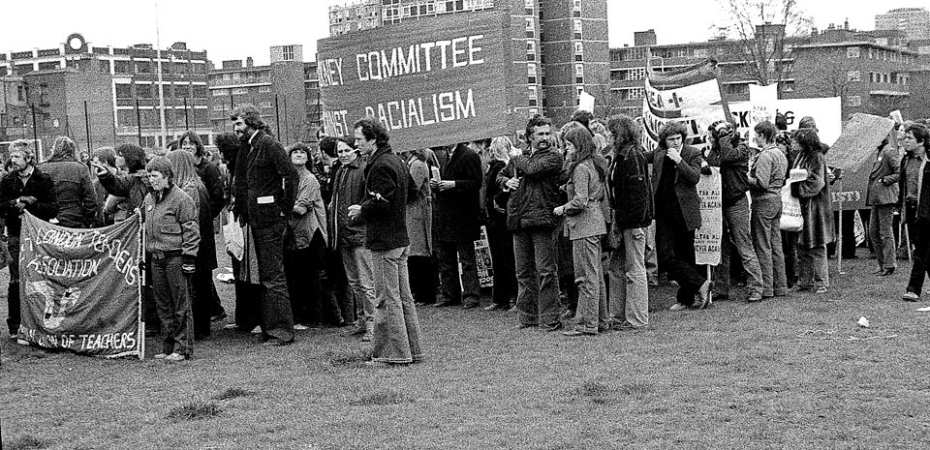
Image: Anti National Front demonstration. Shoreditch Park 1979. https://www.flickr.com/photos/alandenney/2449021440 Author: Alan Denney. Licence: Attribution-NonCommercial-ShareAlike 2.0 Generic CC BY-NC-SA 2.0 Deed
 Labour Hub