
The Syrian regime and Turkey are seeking the complete surrender of Kurdish autonomous areas, reports Sarah Glynn.
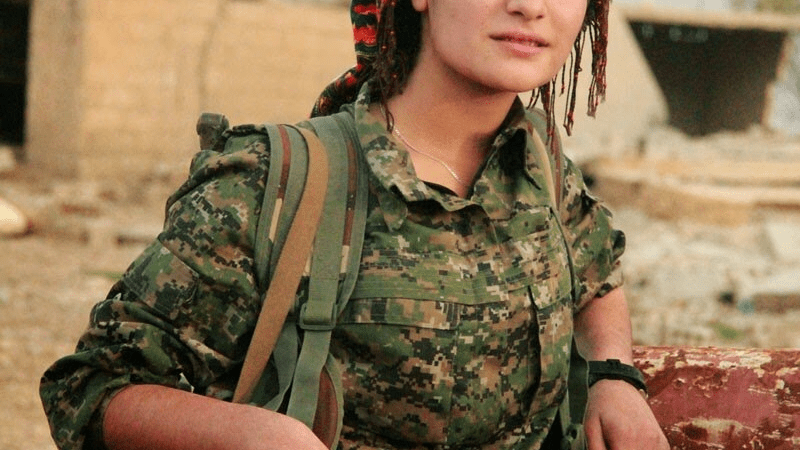
Like so many others, I first heard of the Kurds in Syria in 2014, when the news was full of images of women fighters defending their city and the world against ISIS. Alongside these images, the occasional reporter stopped to enquire not only what these women and their male comrades were fighting against, but also what they were fighting for. The answer was startling – inspiring. While we were arguing that another world was possible, far away, in the middle of a warzone, these people were actually building a different society: a society that, in accordance with the philosophy of imprisoned Kurdish leader, Abdullah Öcalan, prioritised community over the crude economic interests that we had been trained to regard as inescapable. That society is in mortal danger.
Hope and its enemies
I am not going to claim that Rojava achieved all that it set out to do, or that the liberating proposals for radical democracy were able to properly survive the pressures of war, and of interaction with a world of nation states; but the inclusive community mindset remains strong, and – against all the odds – the Kurdish areas were able to create an oasis of peaceful coexistence and women’s rights.
Rojava is living proof of two suppressed ideas – that Kurdish culture and society is strong and resilient, and that a society that prioritises social values really is possible.
But, even as people across the world found hope for their own struggles in Rojava, we knew that the powers that be would never allow such a radical approach to succeed and to provide an example for others. We could also see that Turkey would never allow such Kurdish autonomy – especially an autonomy inspired by Öcalan. Western powers have made no secret of their desire to appease Turkey, which is a geopolitically important member of Nato, and this sits easily with their distrust of Rojava’s politics.
In Rojava, the Kurds created an extraordinary gift of hope for humanity. The attacks of the Turkish-backed Syrian Government, supported by the United States, aim to destroy this hope and to extinguish the people who created it – to extinguish them both culturally and physically.
2014 and the fight against ISIS
In 2014, the Kurdish regions of Rojava, which had gained autonomy in the power vacuum of the Syrian civil war, came under existential attack from ISIS, whose forces were sweeping across Iraq and Syria. In the small Kurdish city of Kobanê, ISIS met their first defeat – at the hands of a rag-tag army of Kurdish women and men – while the Turkish government, which had facilitated the passage of international ISIS recruits, watched from across the border, hoping for Kobanê to fall.
It was at this time that the United States, realising the danger of the forces that had been unleashed by their Iraq war, began to provide air support for the Kurdish fighters on the ground, beginning a tactical partnership that, by 2019, had liberated the last part of ISIS held territory. The Kurds tried, with limited success, to bring their social ideas to the liberated areas, and continued to work with American troops in combatting ISIS sleeper cells and preventing further attacks.
In the fight against ISIS, around 12,000 Kurds lost their lives, and the Kurdish region was left to manage tens of thousands of ISIS prisoners for whom no one wanted to take responsibility. But, despite their reliance on the Kurdish forces, no foreign power would give official recognition to the Kurds’ Autonomous Administration, nor protect them from Turkish attacks and invasions.
Islamists and the West in partnership
From the early years of the Syrian civil war, when the CIA-led Operation Timber Sycamore provided weapons and training to Islamist groups fighting the Assad government, up to the grooming and official recognition of Syria’s Interim President Ahmed al-Sharaa – former wanted terrorist al-Jolani – the United States and other Western nations have always backed conservative Islamists, just as they did so disastrously in Afghanistan against the Russians. And they have always avoided upsetting Turkey.
2026
These first weeks of 2026 have demonstrated, yet again, the cruel reality of international self-interest – or perceived self-interest- as forces have been unleashed that are beyond the control of those causing this international disaster. For months, Turkey obstructed any agreement between the Kurds and al-Sharaa’s government short of complete Kurdish surrender; but military attack had been restrained by fear of Turkey’s rival for regional hegemony, Israel. On 6th January, in Paris, Israel and Syria signed an agreement that appears to have allowed Turkey to dominate the greater part of the country in exchange for leaving Israel free to dominate the south.
Supported by Turkish weaponry and intelligence, and spearheaded by Turkey’s mercenary militias – now officially part of the Syrian army – al-Sharaa has been able to take control of the greater part of the Kurdish-led Autonomous Administration, with Arab fighters switching loyalty to the winning side.
To achieve this, al-Sharaa’s government has not hesitated to break every agreement they have made, to target civilians, and to give leading roles to men notorious for their sadistic brutality. The Syrian army includes many men who have fought for ISIS or similar groups, and some who still wear ISIS patches. The militias have already released ISIS prisoners from captured prisons – prisoners whose nihilistic ideology has been reinforced by the desire for revenge. Videos shared by Syrian army fighters show them abusing captured Kurds in ways that have become only too familiar from the times of the ISIS ‘caliphate’ and from the many reports of human rights abuses in the Turkish-occupied areas.
America turns their back
The new American position has been starkly spelt out by their Ambassador to Turkey and Special Envoy to Syria, Tom Barrack, who had already announced his dismissal of democracy. In a long Twitter post, he stated that the US had no more need for the Kurds, and that the al-Sharaa government were their new partners in the fight against ISIS. It is clear that they don’t actually trust the al-Sharaa government in this role as they are transferring remaining ISIS prisoners to Iraq; but the fight against ISIS was never America’s primary reason for being in Syria. It was always about countering Iran.
Kobanê under siege
As I write, and despite another ‘ceasefire’, the Kurds remain under fire and have been pushed back to their core cities. Kobanê, the city that turned the tide against ISIS, is isolated and under siege. To its north, is the Turkish border, south, east and west, Syrian government forces are preparing to deal a final blow to freedom and hope. Electricity and water have been cut off, and fuel deliveries stopped. People are struggling to keep warm through freezing temperatures.
Despite internet disruption Commander Nisrin Abdullah of the Women’s Protection Units (YPJ) held a press conference today [Thursday] from Kobanê. In 2014, the battle of Kobanê was heralded as a modern Stalingrad – a vital victory against great odds. She was there in 2014 and later active in international diplomacy on behalf of Rojava, even visiting the Elysée Palace. Now, in her words, the Syrian Interim Government is “reestablishing the Islamic State”; and this time, international doors have been closed to the Kurds, so that “the siege today is even more dangerous’’ than it was eleven years ago.
While international leaders were reeling off sentences about integration, unity, and stability, Syria’s Ministry of Endowments issued a call for mosques to celebrate the army’s conquests and victories, headed with the same Quranic verse used by Saddam Hussein in his genocide of the Kurds of Iraq.
Sarah Glynn is a writer and activist – check her website and follow her on Twitter or bluesky. For four and a half years she wrote a weekly review of Kurdish news for Medya News. She blogs regularly on Kurdish affairs here. This article is drawn from the blog: it first appeared here.
Image: https://commons.wikimedia.org/wiki/File:YPJ_-_Rojava.jpg Kurdish female fighter of the Women’s Protection Units of Rojava, Syria, November 2014. Author: Denilaur, licensed under the Creative Commons Attribution-Share Alike 4.0 International license.
 Labour Hub

[…] elusive. This year’s attacks on Kurdish neighbourhoods in Aleppo, and more widely on the Kurdish Autonomous Administration areas, by the forces of the Syrian Transitional Government are an even greater cause for […]