
By George Binette
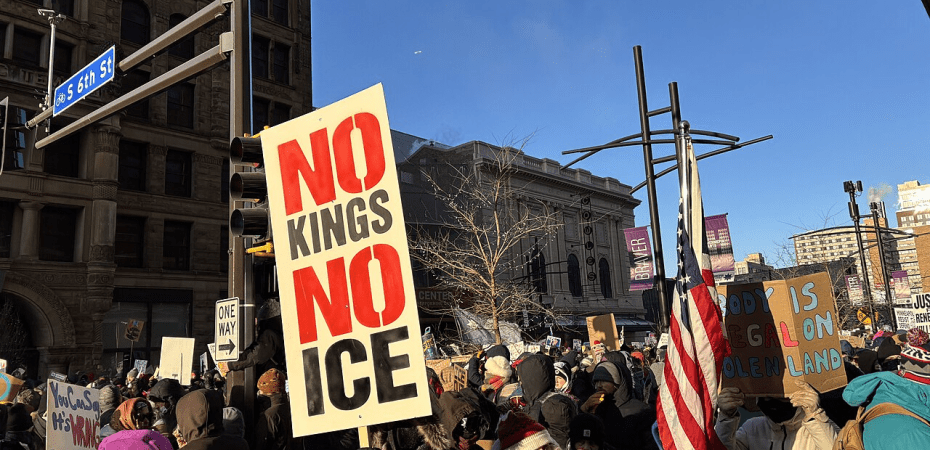
Some 50,000 demonstrators braved the streets of Minneapolis, Minnesota, amidst temperatures approaching -30 Celsius on Friday 23rd January. This was a mass display of opposition to the continued presence of nearly 3,000 Immigration and Customs Enforcement (ICE) agents in the city and its environs. Less than 24 hours later another US citizen, Alex J Pretti, lay dead on a south Minneapolis street, fatally shot by ICE officers, who may have fired up to 10 bullets at point-blank range.
The death of Pretti, a 37-year-old white male who worked as an intensive care nurse at a Veterans Administration hospital, marked the second time in January that Donald Trump’s agents of “reckoning and retribution” had killed a local resident and the third shooting by an ICE agent in the city. Preliminary analysis of a smartphone video contradicted the official account from the Department of Homeland Security, claiming that the victim was toting a nine millimetre semi-automatic. The White House’s Deputy Chief of Staff Stephen Miller – often seen as a key architect of Trump’s mass deportation programme – sought to brand the victim as an “assassin” and “domestic terrorist.”
Miller and co are following a familiar playbook: deny what the video evidence reveals and vilify the victim. As with the death of Renee Nicole Good – also white, also a born and bred US citizen – just 17 days before, federal government officials, not to mention Trump himself, wasted no time promoting fabrications about the shooting, which collapse under the slightest scrutiny. So far, the administration shows no signs of reining in its paramilitary police force, though to date Trump has not acted on his threat to deploy regular troops or invoke the 1807 Insurrection Act. Meanwhile, demonstrators who gathered near the site in the aftermath of the Pretti shooting faced a barrage of tear gas cannisters and stun grenades.
“Day of Truth and Freedom”
The day prior to the killing of Alex Pretti, Minneapolis and its twin city of St Paul had witnessed something approximating a local general strike, something not seen in the US since the mid-1940s. Scores of local businesses along with many local schools and the city’s museums shut for the so-called “day of truth and freedom”. According to a Reuters report, more than 10,000 rallied in the Target Centre, the city’s main professional sports arena.
Local religious leaders gathered for a symbolic protest at the Minneapolis-St Paul International Airport, currently a departure point for many flights to detention facilities and where ICE agents had reportedly arrested and detained at least a dozen workers. City police ultimately arrested more than 100 members of the clergy including a senior Methodist minister and a rabbi for apparently exceeding the number of participants agreed in previous negotiations. Later in the day, several thousand marched on the airport, leading to the main terminal’s temporary closure.
Though beyond living memory, Minneapolis was the site of one of the most effective general strikes in US history as a Teamster union battle to organise coal-delivery drivers sparked far wider action in 1934. Of course, the structure of capital nearly a century later is very different and the organised working class has shrunk as a social force in the United States, but unions certainly played a significant role in mobilising for last Friday’s “economic shutdown” with Minnesota’s state AFL-CIO along with locals of several unions calling for work stoppages, though most avoided use of the word “strike”. The 13-member city council, which includes four self-identified members of the Democratic Socialists of America, endorsed the day of action, as did the Democratic majority in the state legislature.
In sharp contrast, there has been nothing but silence from the offices of the 17 Fortune 500 corporations with headquarters in Minnesota. Among these major companies is the retail chain Target, with several of its stores subject to ICE raids. As a result, a Target store in St Paul became the focal point for Friday’s day of action.
“State of Siege”
Journalists on the ground in Minneapolis from a range of publications including the Guardian, New York Times and New Yorker have described the city as under siege or in the words of Charles Homans the site of the “great American unravelling”. Of course, the use of lethal violence by state forces has many precedents in US history.
Within my own memory are scenes of police unleashing Alsatians and hosing down Black children in Alabama in the early ‘60s, Chicago cops mercilessly battering demonstrators outside the Democratic convention in August 1968, the fatal shooting of unarmed anti-war protesters on the Kent State campus in Ohio, just 11 days later deaths at the hands of law enforcement of students at Jackson State university in Mississippi, the COINTELPRO operations, which led to the killings of prominent Black Panthers like Fred Hampton. What I have not seen prior to recent months is an ill-trained, undisciplined but heavily armed force roving residential streets in broad daylight, smashing car windows, dragging out drivers, breaking into homes without warrants, even taking five-year-old children into custody day after day.
These extraordinary sights, with few, if any, recent precedents help explain the strength of community reaction in Minneapolis and its twin city of St Paul as well as the comparatively strong rhetoric coming from Mayor Jacob Frey and Minnesota’s governor Tim Walz, Kamala Harris’ running-mate in the Democrats’ ill-fated 2024 presidential campaign. Minneapolis has a Democratic-led, relatively liberal administration, a characteristic shared with most of the other targets of ICE ‘surges’ launched since the start of Trump’s second term. Where the city differs is in the composition of its minority ethnic/global majority population.
Trump’s Somali Obsession
Minnesota is home to the largest Somali heritage population in the US, though the vast majority of Minneapolis’ Somali residents are already US citizens including Representative Ilhan Omar, a leading figure on the left of the Democratic Party ‘squad’ in Congress. Omar has frequently attracted Trump’s ire, while the President has repeatedly branded Somalis as “garbage”. This Trumpian fixation on a Black, predominantly Muslim population was doubtless a factor in making the city a focal point against the backdrop of the harsh mid-western winter with Republicans amplifying allegations of mass benefit fraud in the state involving Somali residents.
The largely rural and overwhelmingly white state of Maine in northern New England has also seen an ICE surge in January, evidently because thousands of Somali heritage people live in its two largest cities, Portland and Lewiston (with combined populations barely exceeding 100,000). To date, ICE has arrested over 100 people and has created an atmosphere of fear in neighbourhoods with significant numbers of migrant residents.
Maine is something of a swing state with one Republican senator in Susan Collins and another independent, Angus King, who caucuses with Senate Democrats. Harris won the state with more than 52% of the popular vote in 2024. Several senior state officials, who are Democrats, have echoed the demand for ICE out of Maine and the past weekend saw roughly 1,000 demonstrators on the streets of Lewiston in opposition to ICE’s increasing presence in the state with similar numbers rallying in Portland.
Another Shutdown?
With mid-term elections looming in November, Democratic politicians are feeling pressure from below amidst the revulsion and mounting anger at ICE’s brutality. Most major cities saw substantial demonstrations over the weekend in the wake of Alex Pretti’s murder, often in defiance of appalling winter weather. The images from Minneapolis have done nothing to boost Trump’s sagging opinion poll standing and some Republican politicians have begun to question the conduct of ICE agents, if not their supposed ‘mission’.
The previous front-runner for the Republican nomination for this year’s gubernatorial contest, Minneapolis lawyer Chris Madel, has now withdrawn and indicated his departure from Republican ranks. Madel, who only weeks before had backed the ICE surge, said in the video announcing his withdrawal, “United States citizens, particularly those of colour, live in fear. United States citizens are carrying papers to prove their citizenship. That’s wrong.”
Even the historically reactionary National Rifle Association, the most prominent organisation in the USA’s gun lobby, has queried the official account of Alex Pretti’s death and called for a “full investigation.”
Thus far, the most right-wing Democratic senators look set to vote against a budget measure that currently incorporates more than £11bn in ICE funding on top of the supplemental $75 bn already at the agency’s disposal over a four-year period. ICE already receives more money that any single ‘law enforcement’ agency in the nation, though that includes a large chunk set aside for detention facilities, generally run on outsourced contracts.
If Democrats like Senate minority leader Chuck Schumer and Virginia’s Mark Warner stick to their stated positions, votes from just four of the body’s 53 Republicans would be enough to halt the legislation that passed the House the previous week. This in turn could result in another shutdown of the federal government in the absence of a new agreement between the two chambers before this Saturday (31st January).
For the moment, Trump’s language seems to have softened slightly in the 48 hours since Alex Pretti’s murder. This might result in a temporary retreat from Minnesota in particular and even some restraints on ICE agents’ current operations, but in the short term there seems no realistic prospect of Trump abandoning what has effectively become the signature domestic policy of Trump’s second term: an ethno-nationalist war on migrants, particularly those from the Global South. Even so, the recent example of Minnesota demonstrates that Trump’s regime can ill afford to underestimate the willingness of a wide swathe of the population to resist.
George Binette, a Massachusetts native, is a retired union activist, co-chair of Camden Trades Council and former Trade Union Liaison Officer of Hackney North & Stoke Newington CLP.
Image: ICE protest in Minneapolis 23rd January 2026 https://commons.wikimedia.org/wiki/File:2026-01-23_ICE_protest_in_Minneapolis-11.jpg Author: Myotus, licensed under the Creative Commons Attribution 4.0 International license.
 Labour Hub
