
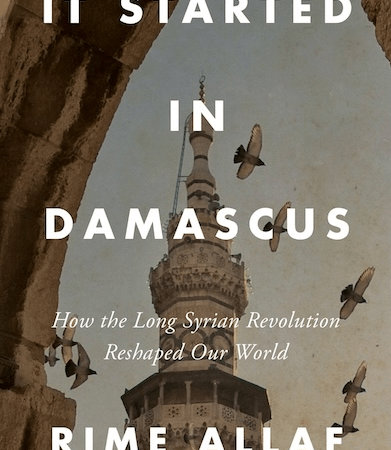
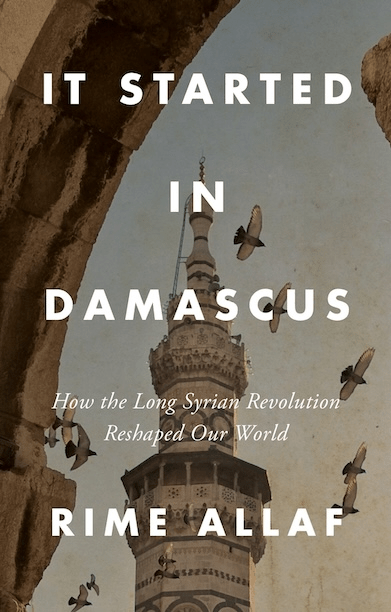
Mike Phipps reviews It Started in Damascus: How the Long Syrian Revolution Reshaped Our World, by Rime Allaf, published by Hurst.
When Syrian President Hafez al-Assad died in 2000, the constitution was amended to lower the age at which a president could take office from 40 to 34. This enabled his son Bashar to be confirmed as the new president after a referendum in which he was the sole candidate.
Anyone hoping for a relaxation in the fierce repression pursued by the regime against its domestic critics would see their expectations dashed. Less than a year into his presidency, Assad junior arrested and jailed several civil society leaders for up to ten years.
Rime Allaf’s book covers not just the scale of Assad’s repression but also the more day-to-day way that a kleptocratic regime, operating with complete impunity, could corrupt all aspects of society, with nearly every economic activity requiring a bribe paid to the regime. She herself was called in and warned by the security services about critical articles she had written, but was perhaps protected more than many by her privileged position and her family connections to the regime. She was subsequently banned from writing in Syria and later put on an arrest list.
The Syrian Revolution
Amid the corruption and repression, Syrians were being impoverished. In February 2011, hundreds protested in downtown Damascus after a young shopkeeper was beaten up by the security forces. The protest was filmed and shared online, stunning everybody, the regime included.
On March 6th, nineteen schoolboys were arrested for writing anti-regime graffiti in Daraa in southwest Syria. After days of searching, a group of fathers and elders from other well-known families went to see the head of Political Security. He contemptuously told them to forget they had ever had these children and to go home and make new ones with their wives, adding, “If you don’t manage, bring us your wives and we will do it for you.”
This level of contempt and impunity may have been the final straw. On March 18th, demonstrations erupted across Syria. The regime shot into the crowds, killing several. Trying to contain the uprising, the regime released the imprisoned children. If this was intended to pacify people, it had the opposite effect: they had broken limbs, fractured skulls and torture marks all over their bodies. Thousands now protested: the regime responded with live rounds, killing dozens.
Daraa was put under a full siege, with electricity and water cut off, aiming to starve its people into submission. This was just the start of a ferocious blitz of repression nationwide, using siege tactics and tanks against towns where protests erupted.
By the end of the year, the regime had killed an estimated 5,000 people, but the Syrian Revolution was in full swing. Idlib was the focus of armed insurrection. The Free Syrian Army, founded by defectors from the Syrian Armed Forces, took control of Homs, which had already been the scene of a massacre at the hands of the regime, and was now shelled mercilessly by government forces.
Allaf doesn’t give a detailed account of the Syrian civil war but is very clear about the “exponential increase of the regime’s violence.” International efforts by close allies to help Assad reform his way out of the crisis came to nothing. Arab League monitors who came to assess the situation were attacked in their cars by pro-Assad mobs. One ex-monitor accused the regime of war crimes: “The snipers are everywhere, shooting at civilians. People are being kidnapped, prisoners are being tortured, and none were released.”
Massacre followed massacre. In Houla, over 100 civilians, of which half were young children, were executed at close range. A week later, 87 were killed in Qubeir, some burned or slashed with knives. UN monitors trying to enter the town to report on the killings were shot at. Daraya was shelled and bombed from helicopters – then the army entered spraying bullets and a few days later 700 bodies, including 63 children, were found.
As the campaign wore on, the regime increasingly exploited sectarian tensions, using Alawi irregulars against primarily Sunni civilian villages. It also deployed chemical weapons to carry out mass slaughter in Ghouta. Over 2,400 Syrians were killed and 10,000 had to be treated for the after-effects.
The world watches
Allaf is scathing about the failure of the West to intervene at this point. But it should not be forgotten that the US-led coalition’s bombardment and invasion of Iraq a decade earlier – also spun as a humanitarian mission to punish an unpopular tyrant – turned into an absolute catastrophe for the Iraqi people, from which they are still struggling to recover. That said, as Leila al-Shami, co-author ofBurning Country(Pluto, 2016), has pointed out: “Sections of the left have done massive disservice to the Syrian revolution by framing the debate as a debate for an intervention or against it… There are plenty of other options.”
A principled opposition to military intervention that would escalate civilian casualties is one thing: minimising the crimes of Assad is another. Allaf has some sharp words – including for those in the peace movement – who did the latter, and even sharper ones for those who attributed to the opposition some of the killings perpetrated by the regime.
“Nobody marched for the Syrians,” notes Allaf. “No world capitals were brought to a standstill under the roar of chants for their freedom… No one tried to convince others that boycott, divestment, or sanctions on the Syrian, Iranian, and Russian state perpetrators of war crimes and crimes against humanity would help achieve justice.”
It is worth underlining the toxic presence of Russia in Syria and how the latter was used as a testing ground for Russia’s military, including phosphorus munitions, thermobaric bombs and cluster bombs – banned by international treaty – against civilian facilities, targeting hospitals, schools and markets. Allaf reports how the United Nations gave Russia the coordinates of medical facilities in the hope of sparing them: Russia converted them into a to-do list for their aerial destruction.
Russian and Syrian air forces bombarded Eastern Aleppo, where citizens were warned that if they did not leave, they would be “annihilated”. Aleppo was also tyrannised by Shia militias reporting to Iran, on whom the Syrian regime increasingly relied to repress its people.
The war left Syria in an unprecedented state of repression. Two years ago, Jaber Baker and Uğur Ümit Üngör’s Syrian Gulag: Inside Assad’s Prison System noted: “300,000 Syrians having been in prison at some point since 2011 (including those who died in prison), it amounts to about 1,200 prisoners per 100,000 of the population. This catastrophe is of an unprecedented scale in Syrian history: never before have so many people been arrested, imprisoned, tortured and killed in prison as in the past half century in general, and the past decade in particular.”
A Labour Hub review commented: “The security system’s pervasiveness is reinforced by the numbers involved. For every 150 Syrians over 15, there is an intelligence operative, one of the highest ratios in the world. The power of these agencies is exercised by unparalleled levels of repression, imprisonment and torture, often random, sectarian and extremely vicious.”
It’s worth remembering these words when one considers how large sections of the Western left have attempted to minimise the Assad regime’s crimes over the years in the hopelessly mistaken belief that the ostensible enemy of US imperialism must be somewhat progressive. George Galloway of course lamented the overthrow of Assad and his Workers Party comrade Craig Murray recently characterised the Syrian regime’s crimes as “alleged ‘misgovernance’” which he attributed to Western sanctions. Tariq Ali characterised Assad’s toppling as a huge defeat for the Arab world.
By 2018, over14 million Syrians – over half the population – were displaced from their homes. Nearly 7 million were refugees. In Europe, which had failed to stop the carnage, far right parties were now able to win votes by blaming domestic failings on the influx of refugees. Worse, the collective abdication of responsibility towards Syria, contends Allaf, has normalised a world where violent, authoritarian regimes can do what they want, from Russia to Israel.
The unexpected happens
In 2021, Assad was ‘elected’ to a fourth presidential term, with 14 million votes in an area of not even 10 million potential voters, notes Allaf. Three years later, he was overthrown in a revolution that, after all that had gone before, few saw coming. Yet both Russia and Iran, on whom Assad was now greatly reliant, were less willing or able to come to his rescue. With external air strikes not happening and the demoralised Syrian army in full retreat, the rebels made rapid progress, freeing political prisoners as they went. “Some women came out with children in tow, not knowing who the fathers were having been subjected to multiple rapes,” the author tells us.
On December 8th, it was announced that Assad had fled. “With Assad gone, the biggest violence Syria experienced was unexpected and of shocking intensity… Israel viciously pounded every remaining Syrian military and naval base.” It also seized even more of the illegally occupied Golan Heights.
Yet Syrians were elated. Many rushed home, jamming entry points. Teams of youngsters were seen sweeping and cleaning streets, reclaiming long-abandoned public spaces. Warehouses of illegal drugs that had enriched the Assad clan were discovered, as were well-lit underground tunnels “deep under the streets darkened by regime negligence, tunnels through which large trucks transported drugs, weapons, gold, or anything or anyone the Assads wanted.” But it was the state of the prisons – and the prisoners – that shocked people the most.
The Western media were more alarmed that the rebels were Islamists. The dominant force was Hayat Tahrir al Sham, which had for several years controlled Idlib, where services ran well but an Islamic interpretation of the law was strictly imposed. HTS leader Ahmad Sharaa seemed aware that what went for conservative Idlib might not work well elsewhere and announced that no dress codes would be imposed. Rebuilding a devastated nation seemed to be the priority.
One wants to feel positive about a new start for Syria, but the decades of collective trauma, the absence of democracy or any real political dialogue for over fifty years, the Israeli incursions, the terrorism of regime forces remnants scattered around the country, the predatory approach of Western powers, religious and ethnic divisions exploited by the Assad regime – all pose major challenges for the country. Last spring’s sectarian massacres suggest that peace, reconciliation and justice may prove elusive. This year’s attacks on Kurdish neighbourhoods in Aleppo, and more widely on the Kurdish Autonomous Administration areas, by the forces of the Syrian Transitional Government are an even greater cause for concern.
This book is a major contribution to our understanding of what Syrians have had to endure during these years. People who consider themselves to be on the left would do well to read it carefully.
Mike Phipps’ book Don’t Stop Thinking About Tomorrow: The Labour Party after Jeremy Corbyn (OR Books, 2022) can be ordered here.
 Labour Hub