
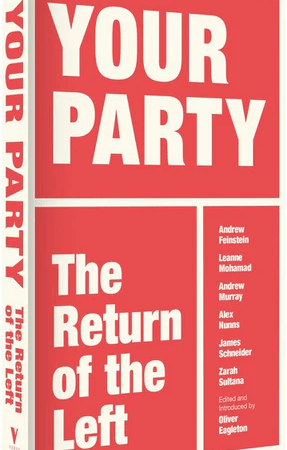
Mike Phipps reviews Your Party: The Return of the Left, edited by Oliver Eagleton, published by Verso.
Whatever you think of the Starmer Government’s record so far – and some might argue that Oliver Eagleton’s assessment in the introduction to his collection of interviews is a bit one-sided – the fact that last July 850,000 people expressed an interest in a new party to the left of Labour shows the huge potential for such a project.
Six months later fewer than a tenth of that number have actually signed up. It underlines the utter mess that the main personalities involved have made of the whole enterprise.
Eagleton hopes that the various contributions here will transcend “factionalism and infighting”; but it could just as well entrench them. The book was compiled before Your Party’s founding conference, the first day of which was boycotted by Zarah Sultana MP in response to individuals being barred from the room by security guards – apparently on the instruction of leading figures in the Jeremy Corbyn camp, although seemingly without his foreknowledge – because they were members of other groups.
This was a new nadir, on top of the very public slanging match between the two camps which saw nasty briefings to right wing media outlets from Corbyn’s team about Sultana followed by her retort that they were part of a “sexist boys’ club.”
On that basis, the real problem with this book might be that it is already out of date, superseded by yet more infighting, which the vast majority of its potential supporters find alienating and destructive.
The Sultana view
The problem is underlined by Eagleton’s first interview, with Sultana herself, who quit Labour last July to announce she was co-founding a new party with now-independent MP Jeremy Corbyn, although the latter appeared surprised by this and posted coolly a day later only that “discussions are ongoing”.
In her interview, Sultana says: “we have to hold on to the strengths of Corbynism – its energy, mass appeal and bold policy platform – and we also have to recognise its limitations.” These are then itemised in some detail over the next twenty lines: “it capitulated” on antisemitism, “triangulated” on Brexit, “abandoned” mandatory reselection of MPs, “didn’t make a real effort” to gets its members into the labour movement; it was “too conciliatory”, “dysfunctional”, “centralised”.
Quite a charge sheet! It’s clear from Sultana’s answers here that behind the organisational disagreements over when and how to launch the new party, there lie more significant political differences. She favours a more member-led organisation and is unimpressed by the all-male Independent Alliance MPs that the Corbyn wing installed at the helm of the new organisation, two of whom have now stepped away from the project. These MPs may hold principled positions on Gaza, which was central to their election to Parliament in 2024, but are less clearly socialist on issues such as education, housing and personal rights, to name a few areas of controversy.
Sultana also wants a more programmatic organisation than Jeremy Corbyn perhaps envisages, one that is consciously anti-Zionist and economically intransigent, captured in her response in interview that we should nationalise the economy.
Sultana’s ideological stance drew a lot of support from the many centralist left groups operating around Your Party, which the Corbyn wing sought to exclude at the founding conference on account of their divided loyalties. Now part of her voting base, Sultana championed their right to be inside the tent and appeared to have won. Yet the battle seems to be ongoing, with a recent attempt by the Corbyn apparatus to exclude several such individuals from running for the leadership body of Your Party being denounced by Sultana as a “witch-hunt.”
One former member of Your Party went further: “It’s as if the conference votes never happened. Exclusions of members of left groups still stand, and candidates for the Central Executive Committee have been barred if they are suspected of paying subs to another organisation.”
Long before these conflicts surfaced, Zarah Sultana was facing public factional attacks from some of the more divisive figures around Jeremy Corbyn, including anonymous briefings to the Murdoch press, “the very same people who tried to destroy Jeremy’s reputation.” Despite Sultana calling them out, these unattributable briefings have continued into 2026.
Other contributors
Eagleton’s interview with James Schneider reprises many of the themes in the latter’s Our Bloc. Schneider identifies the key sociological constituencies a new party needs to hegemonize and give political agency to – “the asset-poor working class, downwardly mobile graduates and racialised communities.” His approach repudiates the idea of perfect programmes and favours real steps forward in the mass movement. The problem is that, while this is something that a Corbyn-led Labour Party might have – should have – striven for, it’s much more difficult for a new, less known, smaller group to achieve. In Our Bloc, Schneider seemed to reject the idea that Labour could never be the vehicle for such a strategy: here the possibility of pursuing it independently of Labour – and the mass organisations affiliated to it – seems a bit unlikely.
Andrew Murray favours a more traditionally-defined working class party, based on the Marxist concept of a class that sells its labour power. But he dismisses the possibility, in the short term, of existing trade unions having a formal relationship with the new party, or even bringing together party members in a given union to pursue a common line. Yet, that being so, the unions will continue to see Labour as their political expression, and Labour’s ties to the unions are likely to go unchallenged.
That seems odd, given that Murray favours a party co-led by both Jeremy Corbyn and Zarah Sultana. The latter recently said: “The Labour Party is dead. It has destroyed its principles and its popularity. Some Labour MPs who consider themselves on the left are still clinging to its corpse.” Shouldn’t the unions be prised away from this corpse – or is this assessment simply premature?
Eagleton interviews Leanne Mohamad, who came within 500 votes of unseating Labour’s Wes Streeting MP in Ilford North, demonstrating the potential of a challenge to the left of Labour when the process is democratic, inclusive and united. Mohamad emerged as the candidate after an open selection process involving hundreds of activists, which laid the basis for an inspiring mass campaign. The challenge, she admits here, is to keep communities united and maintain the momentum beyond the electoral cycle.
Alex Nunns focuses more on Jeremy Corbyn’s leadership of the Labour Party, a subject about which he has written extensively. Avoiding simplistic narratives, he is keen to emphasise that Corbyn’s forces “didn’t surrender: they lost.”
He goes on: “I don’t think we should console ourselves with a false history that says that if only Corbyn had been more combative then things would have turned out well.” In particular, the fudge – some wrongly claim ‘betrayal’ – over Brexit in 2019 reflected a genuine difference in strategy within the Corbyn camp and was not the result, as Eagleton appears to believe, of a buckling to establishment pressure. We might add that it is a failure to see these developments clearly that has resulted in so few correct lessons being drawn from this rich experience – which might help explain the ongoing bunker mentality hampering the new project.
The last interview is with Andrew Feinstein, who ran against Keir Starmer in his London seat in 2024’s general election and came second. It was Feinstein who proposed the motion last July to invite Zarah Sultana to leave Labour and join the new party as an “interim co-leader” with Jeremy Corbyn at an online meeting where Corbyn and his team, who opposed it, refused to vote on the grounds that the meeting did not have the constitutional power to make such a decision. The victory claimed by Feinstein’s group led to Sultana’s public declaration of a new party and her claim to joint leadership on the same evening. His focus here is on how his experience in South African politics informs his approach to community organising in London.
Shedding socialists
What’s missing from this collection is the view of Jeremy Corbyn MP himself. Corbyn was invited to participate “but it was not possible.” One wonders why.
There are other leading figures who are not included here. Alongside Andrew Feinstein, former Labour MP Beth Winter and Jamie Driscoll, the highly respected former Mayor of North Tyne, have said they are “exasperated” with the way the internal dispute has developed. Jamie Driscoll, who said Your Party did not meet the high standards he believed were necessary for public life, subsequently abandoned the project and joined the Greens.
He told The House magazine: “I’m not a member of Your Party, and won’t be joining. I do feel sorry for their members, though, who joined on a prospectus of a new kind of politics, only to find people at the centre repeatedly issuing anonymous briefings that damage Your Party. You’ve really got to ask why their political leadership is allowing this to happen.”
Mish Rahman is another activist who has had enough of the factional paralysis. This year he gave up the fight within Your Party for a member-led organisation and joined the Greens. Referring this week to the “different sects” in Your Party, he said: “I’ve come to the realisation that they never might overcome the battle of the £1 newspapers before taking on the real challenges this country faces.”
Shedding such leading socialists constitutes a major loss of momentum which should ring alarm bells. Furthermore, if the Labour Party is now as degenerated as Oliver Eagleton believes it is, with its authoritarian suspension of backbench MPs and blocking of councillors seeking re-election, one might have expected many more of its representatives to come over to Your Party. In reality, those leaving Labour seem increasingly to be bypassing this proposition, many preferring the Greens, whose public profile seems to be unencumbered by the factional “antics” (Tariq Ali’s words) that have marred the launch of Your Party.
A left revival within Labour?
The fact is there may be life in the Labour Party yet. Jeremy Gilbert, Professor of Cultural and Political Theory at the University of East London, has written and broadcast extensively on the Labour Party. Here is his view:
“What one has to understand about an organisation like the Labour Party is that it is not one thing, with one identity or one locus of power and intention. It’s not an ideological membership-based party, as are most European political parties. It’s a vast, federated organisation the component parts of which include all of the largest trade unions in the country, 650 local constituency parties various affiliated societies and organisations, as well as the parliamentary leadership and local elected legislators. Within that federation, there are several very distinct ideological tendencies that have coexisted, while competing for control of the organisation, for decades.”
Is Labour irrevocably committed to a right wing agenda, whereby even if Starmer is forced to quit, he would inevitably be replaced by a leader with the same politics? For Gilbert, the answer is determined by an understanding of where the real power lies in the Labour Party. “In effect, the leadership of the three major trade unions decide the fate of the party and its leadership, partly through their control of delegations to the party’s National Executive Committee, but also because they have a capacity to contact and organise party members and their own members which is on a different scale to that of any other organisation or institution, inside or outside the labour movement. It was the unions who let Corbynism happen, and who have allowed Starmer’s faction to run the party for the past few years… If the union leaderships turn against Starmer and his right-wing faction, then there is a reasonable chance that something like Corbynism could happen again.”
Keir Starmer, it should be noted, needed the votes of affiliated trade union delegates to block Andy Burnham’s return to Parliament at Labour’s NEC last month. This battle, reaching right into the Cabinet, reflects a Party in turmoil. Despite the short-term victory for the leadership faction on this, Labour’s continued poor electoral performance can only increase levels of internal dissent against the line of the Starmer leadership.
These ongoing conflicts make it difficult to declare Labour definitively dead. Of course, it’s not beyond the bounds of possibility that a new party could establish itself and quickly attract mass support. UK politics has entered an unprecedently volatile phase, with Labour haemorrhaging votes and relatively new organisations gaining support. But even without the unnecessary and destructive factional warfare between the two leading camps of Your Party, the prospects for success would not be high. The strengths of both Corbyn and Sultana were as left wing champions of a broader mass movement; isolated from that, their individual weaknesses are far more exposed.
Long before Your Party, there was Arthur Scargill’s Socialist Labour Party, a particularly bureaucratic outfit which died under the weight of its own control-freakery. This sect seems to have been the formative organisation of Your Party Returning Officer Andrew Jordan, who has recently ruled several candidates ineligible for election to the leadership of Your Party. Then there was the Socialist Alliance and George Galloway’s Workers Party, neither of which made the promised breakthrough.
Over thirty years ago, Mike Marqusee identified the central difficulty facing all such formations in the UK context: “The chimera of an ’independent’ socialist party, to the left of Labour but somehow different from the democratic centralist sects, is resurrected every few years only to die an obscure death after a few more. Without a mass base in the working class, which in this society can only mean a base in the organised workforce, such an ’independent’ left party can only be a propaganda party – a talking shop which, in the absence of the discipline imposed by a mass base, will rapidly be torn apart by sectarianism, egotism and triviality.”
More questions than answers
For Your Party not to go down this road – and some might say it already has – it will have to set aside the personality clashes and face up to some big existential questions. What is its programme? Will it be ideologically clearcut or a broad church? Who is it going to represent? What is its relationship the existing organisations of the working class, in particular the trade unions? What is its electoral strategy? How will it relate to parties, like the Greens, who are trying to occupy the same space? And how will it relate socialists in the Labour Party, who, in Sultana’s view, are “clinging to its corpse”?
The fact is that many on the left who are not members of the new party want it to do well, if only to put greater pressure on the Labour Government from the left. Labour’s Director of Policy under Jeremy Corbyn’s leadership Andrew Fisher recently endorsed this approach. Many hoped the enthusiasm and energy of its grassroots members would thrust to the margins the posturing of the nascent bureaucracies emerging at the top of the project. As the weeks go by, even paid up members think this is looking increasingly unlikely.
Your Party could have made headlines with an inspiring socialist campaign in the upcoming Gorton and Denton byelection. Instead, it won’t even be fielding a candidate, because it’s has to elect its governing Central Executive Committee first. As one commentator noted, “The party cannot participate in an actual election because it is too busy electing itself.”
If Your Party fails because of these very avoidable and largely self-inflicted blows, it won’t just be an indictment on the inability of the left to come together and work collectively. It will be a betrayal of the hopes of millions of people who were willing to vote for popular socialist policies in 2017 and 2019 and who are hungry for the real change promised by Labour in 2024, but far from delivered.
Mike Phipps’ book Don’t Stop Thinking About Tomorrow: The Labour Party after Jeremy Corbyn (OR Books, 2022) can be ordered here.
 Labour Hub
[…] Phipps notes on Labour Hub, “Over thirty years ago, Mike Marqusee identified the central difficulty facing all such […]