
In May Scotland goes to the polls to elect its devolved parliament, using the Additional Member System, where voters get a constituency vote and a regional party list vote to make the overall result more proportional. The prospects are not looking good for Labour, reports Mike Cowley.
According to January You Gov polls, only 32% of Scottish Labour voters intend to give the Party their constituency vote in May. The SLP is sitting on 15% for both Constituency and List votes. If these figures are accurate, the Party should “prepare for its worse result in either a Westminster or Holyrood election in 116 years.”
Notwithstanding You Gov hyperbole, there is no doubt that since manoeuvring to oust Richard Leonard from office with the backing, and indeed assistance, of the UK leadership, Anas Sarwar and Jackie Baillie have provided further evidence that the ‘grown-ups’ we were told held a monopoly insight into how to win elections are in danger of leaving the Party at the abyss. Keir Hardie’s vision of a ‘Sunshine of Socialism’ appears not to have dawned on those handed the responsibility of leading the Party he founded.
Recent internal polling reveals a widening disconnect between the UK and Scottish leaderships and the Party’s rank and file. 64% of members want to see the party “moving to the left.’” A clear majority support redistributive wealth taxes, as well as public ownership of key utilities. More importantly, the Fairness Foundation recently published polling showing that two-thirds of Britons hold the opinion that “the super-rich have too much influence over UK politics.”
Peter Mandelson’s exposure as a self-serving bagman for global capital at the heart of the Labour government is hardly likely to disabuse anyone of that view. Reform UK sit in second place behind the SNP. A deepening of public disaffection runs the risk of further emboldening the far right. May’s elections threaten to bring to a close the previously stubborn narrative of Scottish progressive exceptionalism. Rather than that part of the electorate supportive of redistributive politics opting for the Green Party (who sit on 9% (Constituency) and 12% (List) votes respectively), many appear to have opted for a politics of nihilism depicted in Richard Seymour’s Disaster Nationalism.
Many Scottish CLPs fail to achieve quorate meetings, unable to table, discuss or vote on motions. My own experience is of CLP officers detached from either the causes or the implications of Reform’s advances. Despite Anas Sarwar’s strategic and limited distancing from the UK party on key issues like Gaza or support for trade union disputes, many activists have downed tools, refusing to work for candidates not explicitly committed to the socialist case.
More positively, Scottish Labour Campaign for Socialism (CfS) has, despite a landscape unforgiving of socialist organisation, achieved significant progress in recent months.
In February, we relaunch our quarterly journal, the Citizen. Late last year, we published Choose to Fight! a pamphlet restating the case for socialist intervention in the Labour Party. Our Young Socialists group is active, energised and creatively reimagining left political activism.
CfS has drawn up broad criteria for endorsing prospective Holyrood candidates. We look forward to comradely discussions in the coming weeks with prospective MSPs looking to align themselves with the Scottish Labour left. The loss of Mercedes Villalba, Alex Rowley and Richard Leonard will be keenly felt. Each of these comrades can look back on political records to be proud of. Katy Clark, Carol Mochan, Simon Watson, and, we hope, others, will represent the socialist case after May. Their presence will be all the more critical in reviving the party where racists have a platform in Scotland’s devolved parliament.
A post-May leadership election is increasingly likely. The SLP left is open to working alongside anyone who recognises the existential crisis the Party faces. The stakes are too high to forego alliances rooted in basic principle. CfS stands ready to talk with leadership candidates committed to Party democracy and redistributive principles in line with the Scottish TUC’s recent paper on wealth taxes.
Mike Cowleyi s Co-convenor of Campaign for Socialism and EIS-FELA National Executive Committee (personal capacity).
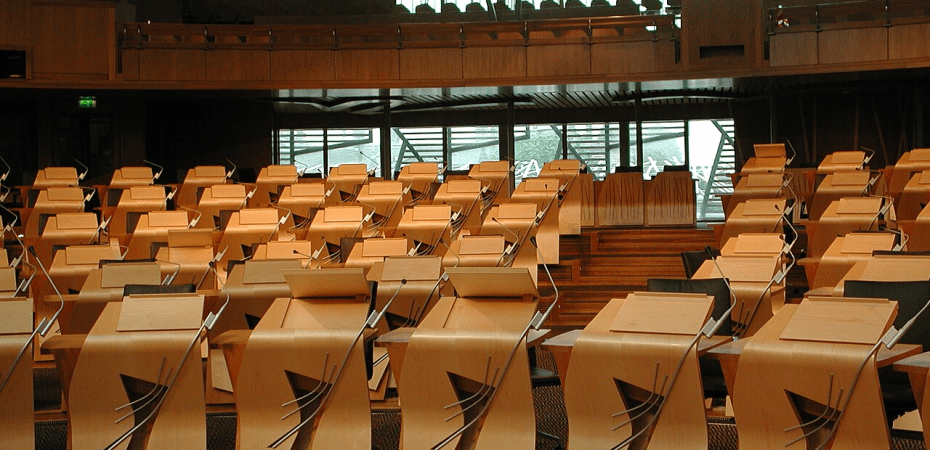
Image: https://commons.wikimedia.org/wiki/File:Scottish_Parliament_seating.JPG Author: Russ McGinn, licensed under the Creative Commons Attribution-Share Alike 2.5 Generic license.
 Labour Hub
