
Justice for Colombiapreview the upcoming elections in a country facing intense pressure from US President Trump.
As Colombians prepare to head to the polls for legislative elections in March and a presidential election in May, the choices they make will determine the country’s future far beyond the upcoming four-year electoral term.
In 2022, voters elected the country’s first ever progressive government, under the leadership of President Gustavo Petro, who campaigned on a platform of peacebuilding, social investment and national sovereignty.
With Petro unable to stand again due to the constitutional single-term limit, supporters of his Historic Pact government will give their votes to Senator Iván Cepeda, a longstanding advocate of peace and human rights who for decades has fought tirelessly to hold politicians to account for complicity in human rights violations. Confirmed as the Historic Pact’s presidential candidate, Cepeda currently tops polling with around 30 per cent of voter intention.
However, facing Cepeda are a multitude of right-wing candidates, with a definite challenger yet to emerge from the pack. The most prominent figure is the far-right independent Abelardo de la Aspriella, a media-savvy lawyer and politician who models himself on El Salvador’s Nayib Bukele. Other conservative challengers are journalist Vicky Dávila and Senator Paloma Valencia of the hard-right Democratic Centre party.
Were the right to win the presidential election, it would take immediate steps to reverse the progress made under Petro. This would mean ending current peace negotiations with armed groups, turning a blind eye towards state violence and ripping up social reform bills drafted to reduce gaping inequality and bringing Colombia firmly under the influence of the Trump White House. By contrast, a Cepeda win would continue the country’s journey along a pathway towards social, political and economic transformation that the country has urgently needed for so long.
Since entering office, the Petro government has made efforts to tackle deep-rooted problems of conflict and inequality. Decades of armed conflict were partially resolved through the 2016 peace agreement between the then-government and the FARC guerilla movement. However, the subsequent far-right government starved the agreement of funding, resources and the political will to implement it, as armed groups occupied power vacuums in regions formerly under FARC control. Consequently, conflict remains a daily reality for many communities.
The Petro government’s response to the instability it inherited has been a policy of ‘Total Peace’ whereby dialogue is prioritised to resolve conflict. This strategy has born mixed results, with some groups advancing in talks while others remain in armed confrontation with one another and with the state. The latter scenario has provided ammunition for Petro’s right-wing critics who argue he has been overly lenient on the groups.
Meanwhile, the government’s social reforms bills, which seek to ameliorate the disparities that make Colombia South America’s most unequal country, have also run up against right-wing opposition. While a pensions reform bill benefiting up to three million retirees was passed in congress, education and healthcare reforms seeking to expand access to essential services are deadlocked. While the passing of a labour rights bill provided important benefits to Colombian workers, proposed guarantees for trade union rights were removed under right-wing pressure.
The government’s electoral base recognises the challenges presented through the lack of a congressional majority that has therefore necessitated compromise with conservative sectors. This has preserved its support for the Historic Pact. However, will swing voters exhibit a similar degree of sympathy towards a government unable to fully implement its plans to address the material needs of so many?
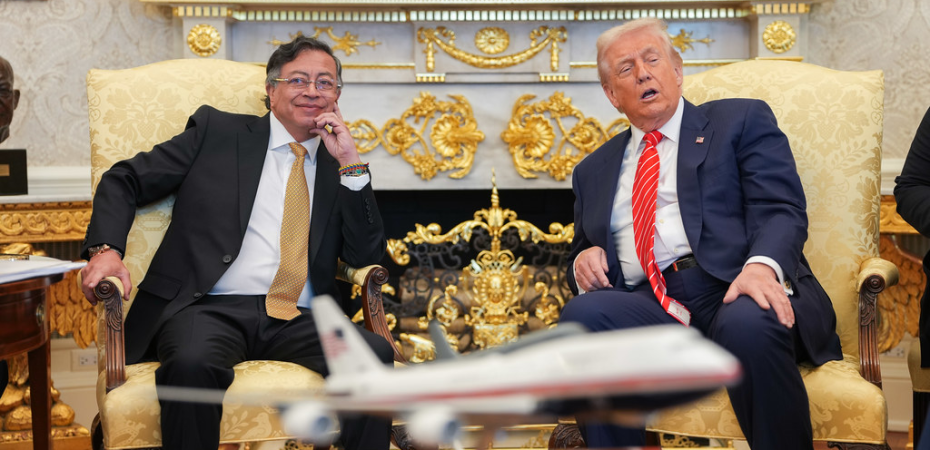
Overshadowing these important domestic issues is the looming presence of Donald Trump, who has repeatedly threatened President Petro and his government. This intensified following the 3rd January raid on Venezuela and abduction of President Nicolas Maduro and First Lady Cilia Flores. In the immediate aftermath, Trump implied that a similar action in neighbouring Colombia was on the table. This was the culmination of months of deteriorating relations over US support for Israel’s genocide in Gaza, drugs production and US attacks on small boats at sea, in which Colombian citizens have been killed extrajudicially. A White House meeting on 3rd February appears to have eased tensions, at least for the time being. As ever, one feels Trump’s renewed attacks may only be one perceived slight away.
As the far-right advances elsewhere in Latin America, the US has made no secret of its intentions to install subservient regimes across the region, even directly stating it would cut economic assistance to Argentina and Honduras if elections did not bring about the preferred result. If Cepeda emerges victorious in Colombia’s presidential contest, it is likely his government will come under intense pressure from Washington and its regional lackeys. With Colombia at the crossroads, the next few months could set the country’s course for decades to come.
Justice for Colombia was set up in 2002 by the British trade union movement to support Colombian civil society in its struggle for human rights, labour rights, peace and social justice.
Image: Gustavo Petro and Donald Trump https://www.flickr.com/photos/197399771@N06/55076622551/ Creator: Juan Diego Cano Copyright: Juan Diego Cano Licence: Public Domain Mark 1.0 Universal PDM 1.0 Deed
 Labour Hub