
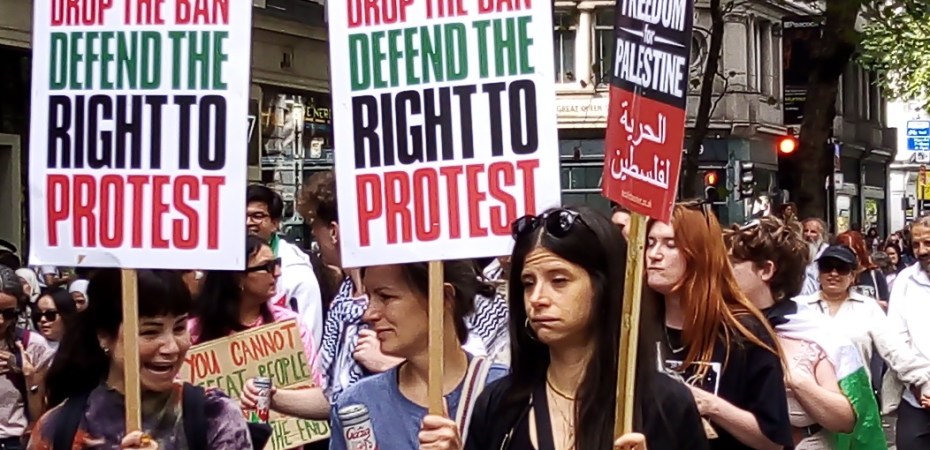
But it remains in force pending the government’s decision on whether to appeal. Liz Davies analyses the judgment.
The High Court’s unanimous decision that the 2025 proscription of Palestine Action (PA), was unlawful confirms what many have been saying all along: treating Palestine Action as a terrorist group when their actions amount to crimes – principally criminal damage – but not activities traditionally considered terrorism, such as large-scale assault on human life, is disproportionate.
The judgment follows a jury’s acquittal of the Filton 6 for aggravated burglary (entering a building as a trespasser and possessing a weapon with intention to commit theft, harm or unlawful damage). The jury could not decide on charges of criminal damage, violent disorder or grievous bodily harm.
Yvette Cooper MP, then Home Secretary, took the decision to proscribe PA on 30th June 2025. She said in a statement to the House of Commons seven days earlier than the decision had been following PA’s attack on Brize Norton in June, and the context of PA “having orchestrated a nationwide campaign of direct criminal action against businesses and institutions, including key national infrastructure and defence firms”, a campaign that had escalated since the start of 2024. Three specific actions were cited: attacking Thales defence factory in 2022, damaging submarine parts, attacking Intro Precision in Kent in 2024 and Elbit Systems in Bristol. The latter activity is that of the Filton 6.
Huda Ammori, a co-founder of PA, challenged the Home Secretary’s decision in a judicial review. For a judicial review to succeed, the Court must find that the decision was wrong in law. The Court’s own view of PA, and whether the Judges would have made the same decision, is not the issue. Ammori sought to argue that the decision was unlawful on eight grounds. She was given permission to argue four of those grounds.
The Divisional Court, comprising three High Court Judges including Dame Victoria Sharp, the most senior High Court Judge who is President of the King’s Bench Division, rejected two of Ammori’s grounds. They decided that the Home Secretary had not been required to give PA the opportunity to make representations before she made her decision, and that she had not failed to have regard to relevant considerations.
However, the Court found the Home Secretary’s decision-making was wrong in law. The Home Secretary had to make two decisions. The first was whether PA was “concerned in terrorism” as defined by Terrorism Act 2000. Proscription was not automatic if the PA was “concerned in terrorism”; the second question was whether to exercise her discretion to proscribe the organisation, or not. The Home Office had a policy, adopted in 2000 when the Terrorism Act 2000 was passed, setting out what factors the Home Secretary should consider when deciding that second question. The Home Secretary was required to weigh the “benefits” that would be achieved by proscription against its cost. The cost included the impact of the proscription decision on freedom of assembly and freedom of expression: an overall assessment of the proportionality of proscription. When the Home Secretary made her decision, the documents showed that part of her assessment was that proscription would be “additional levers to disrupt [PA]’s operations”. That was not a relevant consideration and did not fall within the factors set out in the Home Office’s policy. It followed that the Home Secretary’s decision-making had not been lawful.
The Court went on to consider whether the proscription infringed rights under Articles 10 (freedom of expression) and 11 (freedom of assembly) of the European Convention of Human Rights. Where there is interference with one or both of those rights, the interference can be justified, and therefore not amount to an infringement of the rights, if the interference is for a legitimate aim, in accordance with the law, necessary in a democratic society and proportionate.
The Court noted that, given the serious consequences in criminal law for people found to have supported a proscribed organisation, the effect of proscription amounted to a very significant interference with the right to free speech and freedom of assembly. It had already found that the proscription was not in accordance with the law. It acknowledged that the Home Secretary had a responsibility to secure public safety. However, the proscription was disproportionate, given that only a very small number of PA’s actions have amounted to terrorist actions, and that those actions could be prosecuted under criminal damage or aggravated trespass charges, which, if proven, could lead to lengthy sentences of imprisonment serving as a significant deterrent to others. In short, the existing criminal law was sufficient; there was no need additionally to proscribe the organisation.
What happens now?
The Cout has not yet decided what remedy it will make. The normal remedy would be to quash the proscription. However, the immediate issue is whether the Home Secretary, now Shabana Mahmood MP, will appeal. We are told that the proscription will remain in place until 20th February, which presumably means that the Court will rule on remedy on that date.
The government has up to 21 days from 13th February in which to apply for permission to appeal. If it does not appeal, the proscription will be quashed, on or shortly after 20th February. If it does appeal, there will be legal argument as to whether the proscription should continue pending the determination of the appeal. If the government appeals and is given permission, the hearing of any appeal is likely to be at least several months away. While the proscription remains in place, it is still an offence to be a member of, or show support for, PA.
It follows that those arrested for holding placards cannot, yet, breathe a sigh of relief. It seems that the police have indicated that, during the next seven days, there may be no further arrests but have not ruled out gathering evidence for any future prosecutions.
Mahmood has been urged not to appeal by the UN Special Rapporteur on human rights and counter-terrorism, Amnesty International UK, Liberty, Green Party leader Zack Polanski and the Liberal Democrats. Her statement said, however, “I intend to fight this judgment in the Court of Appeal”, so she clearly wants to appeal.
Will heads roll? Is this a resigning matter for any human rights lawyer who happens to be a prominent politician? Or for the previous Home Secretary? We are unlikely to know that until any appeal, if issued, has been determined.
Liz Davies KC is a barrister specialising in housing and homelessness. She stresses she is not a specialist in criminal law, and any errors referring to criminal law are hers. The judgment can be read here.
Image: c/o Labour Hub.
 Labour Hub