
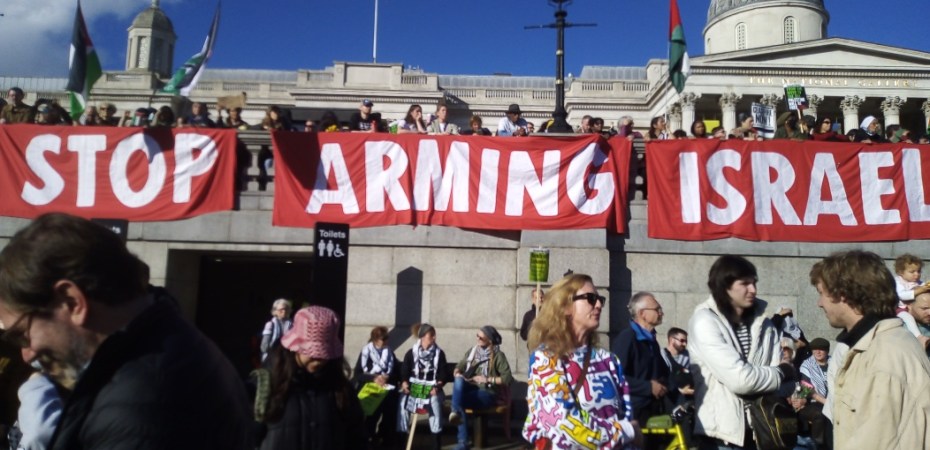
On February 5th, Parliament held a debate entitled “Obligation to Assess the Risk of Genocide Under International Law in Relation to the Occupied Palestinian Territories”, tabled by SNP MP Brendan O’Hara.
As the Campaign Against the Arms Trade point out, “The response from the Government was as usual, to deflect, obfuscate, and say as little as possible in response to the interventions from MPs.” Yet the following week Health Secretary Wes Streeting released text messages to the disgraced Peter Mandelson, in which he privately said in July 2025 that Israel was “committing war crimes before our eyes.” Ministers appear happy to deny Israel’s crimes to both the public and to Parliament, while admitting to them in private.
A number of backbench Labour MPs spoke in the debate, highlights of which are reproduced below.
Andy McDonald (Middlesbrough and Thornaby East): We face a stark legal reality: the UK’s duty to prevent genocide is triggered the moment a serious risk becomes evident. The International Court of Justice made that clear in January 2024…
Words matter too. Israel’s President Herzog declared, “It’s an entire nation out there that is responsible.”
Under international law, such statements are evidence of intent. The UN commission of inquiry confirmed that the ICJ’s provisional measures placed all state parties on notice of a serious risk of genocide in Gaza, triggering legal obligations on third states, including the UK…
Yet in September 2024, UK Government lawyers concluded that there was no serious risk of genocide occurring. That defies the Court, the commission and the law.
The UK itself has argued that genocide is not limited to killings, but includes forced displacement, serious bodily or mental harm and deprivation of food, particularly when children are targeted. Despite that, the UK has failed to acknowledge the risk, failed to respond to the ICJ or the commission and failed to act as it has elsewhere.
Dr Rupa Huq (Ealing Central and Acton): 70,000 Palestinians have been killed—a figure now accepted by Israel—including 500 people since the ceasefire. We have seen repeated forcible displacement and whole neighbourhoods gone. Is this genocide, like Srebrenica and Rwanda? The ICJ will take years to determine that, but the UN commission of inquiry and the International Association of Genocide Scholars say yes. How does Joe Public decide? With 37 non-governmental organisations, including Oxfam, effectively banned and international media excluded, the external mechanisms that should help us make that assessment are gone…
There has been a systematic discrediting of the UN. United Nations Relief and Works Agency buildings have been destroyed, and Francesca Albanese has been accused of being a witch and sanctioned by the US. And what has been proposed in place of the UN? The Gaza board of peace, headed by Donald Trump, which costs $1 billion to join. The board has zero Palestinian representation, but Putin, the President’s son-in-law and Netanyahu all have seats, and its founding charter does not mention Gaza. The UK must not give that vanity project any credence.
Fleur Anderson (Putney): There is a strong case for the Government to ban trade with illegal Israeli settlements on the west bank. No further legal judgment is needed to do that. Although global attention has focused rightly on Gaza, settlement expansion, land confiscation and violence have continued on the west bank and in East Jerusalem. More than 1,000 Palestinians have been killed there, and economic activity linked to settlements risks undermining the UK’s long-standing position on their illegality and on the viability of the Palestinian state…
The UK-Israel trade agreement already differentiates settlement goods, denying them preferential tariffs—postcodes are already provided to show exactly where goods come from. The Government should now consider moving from differentiation to prohibition, using legal tools already available under the Sanctions and Anti-Money Laundering Act 2018, as we have done in relation to Crimea. There is legal precedent, and there is the technical ability to do it.
Steve Witherden (Montgomeryshire and Glyndŵr): I am extremely concerned by the Government’s apparent move towards unblocking the already insufficient 29 out of 350 arms licences to Israel that were suspended in September 2024. It was the Government’s own assessment that there was a serious risk of British-made weapons being used in violation of international law, yet on 12 January 2026, in an interview with The Jewish Chronicle, the Secretary of State committed to revisiting both UK-Israel trade discussions and the decision to pause arms export licences, adding that the two matters were “intrinsically linked”. Such a claim is entirely at odds with the Government’s legal obligations under the UK’s own strategic export licensing criteria and international law, including the genocide convention. In addition to the continuous supply of spare parts enabled by the F-35 carve-out, last month three new F-35s were transferred from the UK RAF station at Mildenhall to Israel. Palestinians continue to be failed by our Government, and the Government must not renege on their arms export control criteria now that Gaza is away from the front pages.
Bell Ribeiro-Addy (Clapham and Brixton Hill):. Since the Israeli attacks began in 2023, more than 70,000 people have been killed and entire bloodlines have been wiped out. We have witnessed targeted attacks on civilians and journalists, the forced displacement of people from their homes, the obstruction of humanitarian aid, the weaponisation of starvation and the destruction of vital civilian infrastructure, including hospitals, schools and universities. Taken together, those actions demonstrate a clear and deliberate attempt by the Israeli Government to ethnically cleanse Palestinians from their land.
Since the ceasefire was announced in October, hundreds more Palestinians have been killed. Aid continues to be blocked from entering the region, and there are severe restrictions on the number of sick and wounded people permitted to leave for medical care.
Warinder Juss (Wolverhampton West): The UN’s “Report of the Independent International Commission of Inquiry on the Occupied Palestinian Territory” concluded that Israel has committed genocide against Palestinians in the Gaza strip under the 1948 genocide convention, and human rights organisations such as the International Association of Genocide Scholars—which has already been mentioned—Human Rights Watch, Amnesty International and Oxfam have expressed the view that genocide has been committed by Israel under international law. Israel has also recently revoked the licences of 37 international NGOs…
It seems quite clear that the reason the licences have been revoked is to prevent aid from going through, which leads to the assumption, at least, that there might be a risk of genocide taking place.
Brian Leishman (Alloa and Grangemouth): Israel commits different types of genocide. Last November I was fortunate enough to be in the west bank, and I heard of the cultural genocide that is taking place, with students and lecturers unable to go to university because of roadblocks and checkpoints. I heard about the universities, colleges and schools that have been flattened throughout Gaza, with lecturers now giving classes in tents as makeshift classrooms. How on earth do we expect Gaza to be rebuilt when Palestinians are unable to be educated?
Netanyahu’s Government have also by design crippled the Palestinian economy by impacting on Palestinians’ ability to trade, making them reliant on Israel for goods, produce and, ultimately, their very survival. Israel uses economic terrorism as a tool of subjugation.
John McDonnell (Hayes and Harlington): I am absolutely perplexed as to why the evidential methods that we have used in the past, when we have determined that there have been genocides, are not simply being accepted by the Government at the moment, given the loss of life—the 70,000, as has been said—and the way in which the genocide has been perpetrated. There are the attacks on health workers and doctors, with 1,700 killed that we know about, and at least 100 who have been imprisoned, tortured, denied access to medical facilities, and even to their own families…
There is also the number of journalists killed—more than 300—because part of this genocide is to prevent the reporting of the genocide. And, yes, there is the forced movement of people, with 9,000 prisoners in Israeli prisons, 100 of whom have died in the past two years. That is the evidence we present time and again. It is the same kind of evidence we have used in the past to determine genocide, so why is it not acceptable now?
Florence Eshalomi (Vauxhall and Camberwell Green): We have heard from doctors in Gaza who have been operating without anaesthetic and performing emergency C-sections on women without painkillers, and there has been a rapid increase in child mortality. We have heard of children who have been shot by snipers not once, but twice. It is sometimes easy for us to become desensitised to what we are seeing, but we must not stop calling it out…
We must listen when the United Nations tells us that “Israeli authorities and Israeli security forces committed four of the five genocidal acts defined by the 1948 Convention on the Prevention and Punishment of the Crime of Genocide, namely killing, causing serious bodily or mental harm, deliberately inflicting conditions of life calculated to bring about the destruction of the Palestinians in whole or in part, and imposing measures intended to prevent births.”
Image: c/o Labour Hub.
 Labour Hub