
Re-empowering members will be good for the Party and the country, argues Mike Phipps.
The last two weeks have seen Labour rocked by one of the most serious scandals of modern times. Gordon Brown was right to refer to the sexual trafficking plotted by Jeffrey Epstein and his fellow criminals as “the most egregious example of a global network of wealthy and powerful men that thinks it can act with impunity.”
A terrible liability
That Peter Mandelson apparently passed secret, market-sensitive information to his friend Epstein and encouraged him to “threaten” the then Chancellor of the Exchequer, his Cabinet colleague Alastair Darling, to get favourable treatment for his wealthy and powerful friends underlines that culture of impunity.
Whatever qualities different Prime Ministers may have seen in Mandelson – and no fewer than three appointed him to high office – the fact is that the Labour Party as a whole had come to see him as a terrible liability some time ago, a divisive figure for whom political principles and personal morality were entirely expendable. But Labour members were not listened to, because the opportunities for them to voice their concerns have been systematically cut down in recent years.
Ordinary members’ views on Mandelson were shaped by the fact that on two previous occasions Mandelson had acted improperly, over a scandal involving an undisclosed loan which precipitated his resignation from government in 1998, and again following accusations of using his position to influence an application for a passport, forcing him to resign again in 2001. Their views were shaped by the popular Mo Mowlam’s characterisation of Mandelson as one of the “back-stabbers” who had tried to replace her when she was the Northern Ireland Secretary in the Blair Government that delivered the historic Good Friday Agreement.
Mandelson’s media role
No wonder Gordon Brown found it more convenient to have the vengeful figure of Mandelson in his Cabinet rather than risk him briefing the media against him from outside – for there was no doubt that Mandelson was a formidable media operator. He played an influential role, for example, in getting the editor of his local Hartlepool newspaper fired after the latter used his pages to successfully back a fringe candidate for the post of local mayor, rather than Mandelson’s chum, millionaire businessman Leo Gillen.
Ed Miliband, when he became Labour leader, to his credit shunned Mandelson’s services. Mandelson responded by attacking him publicly in the media on more than one occasion. When Jeremy Corbyn became Party leader, Mandelson boasted of working “every single day to bring forward the end of his tenure in office.”
Keir Starmer now concedes it was a mistake to bring Mandelson back into government as US Ambassador. Perhaps he was poorly advised. Perhaps he felt a debt of gratitude to a man who by all accounts worked factionally to destroy his opponents in the Party.
But it would be no exaggeration to say that had Labour’s internal democracy been more robust, had MPs not been threatened with action from the Party whips for opposing unpopular policies, had councillors not been threatened with being removed from selection panels, and had wards not been threatened with suspension, or even suspended, for discussing internal matters – then the voices within the Party that believed the appointment of Mandelson was a fundamental mistake would not have been so muted.
Another avoidable scandal
Members were fearful of speaking up against Mandelson for good reason. We now know that Mandelson was a central figure in the shadowy faction that propelled Starmer to power. Worse, Mandelson was given access to spreadsheets of Party candidates with a view to excluding those Mandelson thought were unacceptably left wing. It was clear to council candidates and others that if you crossed Mandelson, he could destroy you.
We are now told that this shadowy organisation, Labour Together, hired a PR firm to investigate journalists from the Sunday Times, and other outlets. Labour Together paid APCO Worldwide at least £30,000 to “investigate the sourcing, funding and origins” of a story about its undeclared donations before the general election. APCO’s report included claims about a journalist’s Jewish faith, relationships and upbringing. It claimed, absurdly, that one of the sources of the journalist’s story was the Russian state or its proxies.
Former Shadow Chancellor John McDonnell MP wrote four times to Labour’s General Secretary to look into this scandal. Finally this week, it was announced that the Cabinet Office, at which Josh Simons is the Parliamentary Secretary, will investigate the allegations involving Labour Together, at which the same Josh Simons served as a director at the time in question. Conflict of interest?
“Nothing less than an independent investigation of Labour Together will have the authenticity and clarity which are needed,” said Jon Trickett MP. “When an organisation makes staff sign non-disclosure agreements the obvious question is what did they have to hide? Only transparency can expunge the odour.”
The plot thickened today when the Telegraph reported today that Josh Simons “used a law firm to smear a journalist who was looking into pro-Starmer group Labour Together.” It claimed he instructed Mishcon de Reya to warn Telegraph journalists that it had ‘serious doubts about [the] motivation’ of Paul Holden, who was writing a book about the Starmerite think tank, and ‘his credibility should be treated with extreme caution’.”
Paul Holden’s book The Fraud lifts the lid on the workings of Labour Together and its role in Starmer’s rise to the Party leadership. It is subtitled Keir Starmer, Morgan McSweeney, and the Crisis of British Democracy. That last phrase is in no way hyperbolic, as these allegations underline that the defining trajectory of Starmer’s government is one of increasing authoritarianism and erosion of democracy – as the now overturned ban on Palestine Action underlines.
Where the rot began
But this erosion of democracy began within the Labour Party itself. Its internal processes continue to remain in a parlous state. Local members in critical by-election seats such as Caerphilly and Gorton and Denton have been denied the right to select the parliamentary candidate of their choice. Hard-working councillors have faced mass exclusion from selection panels despite years of service. MPs who have spoken out against unpopular policies have been disciplined for reflecting the concerns of their constituents.
To the Starmer faction, members are an inconvenience, useful only for their financial contributions and their door-knocking at election time. But the factionally motivated mistreatment of our Party’s most important asset helps explain the current troubles. When Labour sidelines its members and constrains debate, it loosens its connection to communities and weakens its claim to represent working people.
The Mandelson scandal shows that there will always be pressure on Labour in office from the financial elite and corporate capitalism. If the Party, inside Parliament and out, are to withstand those entrenched interests, its members and representatives must be encouraged to speak up for the people they were elected to serve. This means strengthening internal democracy and respecting local parties.
Only by renewing those traditions can we rebuild trust, improve our standing with voters, and offer a credible alternative. If we fail to do so, voters will conclude that mainstream politicians really are all the same, just in it for themselves. Only the far right will benefit from such a perception.
The stakes are high. Strengthening Labour’s internal democracy is not just good for our Party, it’s important for the whole country. That’s why five union General Secretaries and 25 Labour MPs launched a statement this week to Restore Labour Democracy. You can sign it here.
Mike Phipps’ book Don’t Stop Thinking About Tomorrow: The Labour Party after Jeremy Corbyn (OR Books, 2022) can be ordered here.
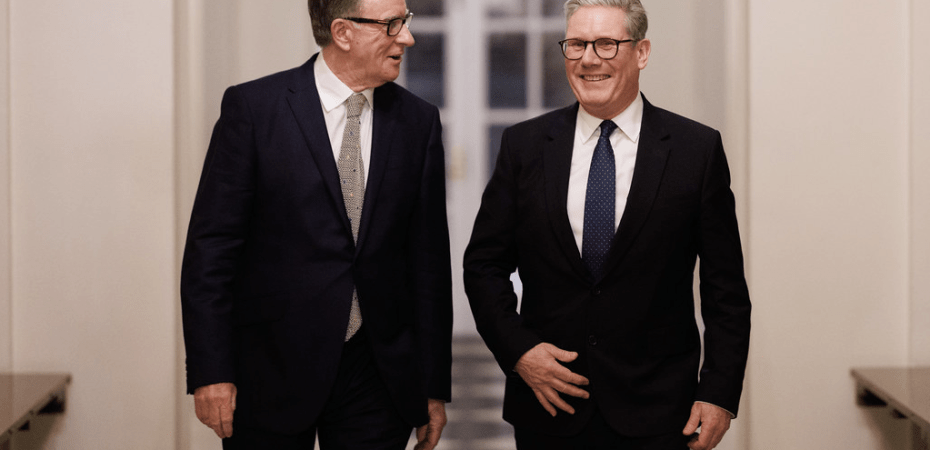
Image: https://www.flickr.com/photos/number10gov/54354501680. Creator: Simon Dawson / No 10 Downing Str |Credit: Simon Dawson / No 10 Downing Str Copyright: Crown copyright. License: Attribution-NonCommercial-NoDerivs 2.0 Generic CC BY-NC-ND 2.0Deed
 Labour Hub
[…] Paul Holden’s book The Fraud lifts the lid on the workings of Labour Together and its role in Keir Starmer’s rise to the Labour leadership. The sources of much of the information collated are Party whistleblowers. As for his personal relationships, they are mentioned in the Acknowledgments at the end of the book – hardly a secret and certainly not a matter for the security services. […]