
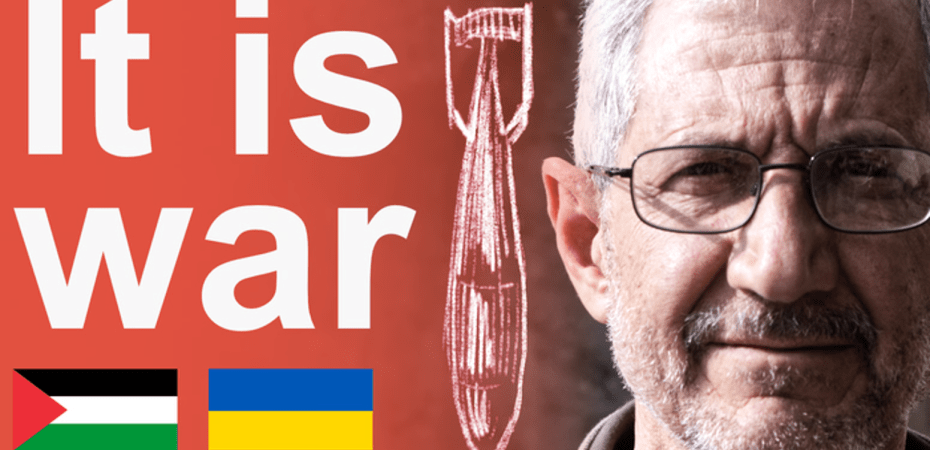
Mike Phipps reviews It is War! or, The Strong Are Shameless: Scattered Pages from a Palestinian-Ukrainian’s Memoirs, by Adeeb Shaheen.
For the last two years, I have marched with others against Israel’s war on Palestine and Russia’s war on Ukraine, behind a banner saying “From Ukraine to Palestine, Occupation is a crime”.
I have handed out a leaflet which says: “Ukraine and Palestine are both small nations resisting a vicious colonial power. Their circumstances and allies are different, but their causes stand on the same foundation. Both Ukrainians and Palestinians have a right to be free and to resist genocide and occupation. Both peoples deserve our international solidarity.”
When Adeeb Shaheen first came to Britain, he tells us at the start of this engrossing memoir, he tried to talk to people about Ukraine and Palestine, only to be told: “No, no, it’s different.” “It’s all the same,” he replied. “It’s always occupation, oppression and aggression against innocent people. And if you are a human being, you have to face that and fight against it.”
Adeeb and his family were living in Kharkiv province in February 2022 when the Russian bombardment began. It reminded him of Israel’s 1967 attack on Nablus, Palestine. The following month, he and his family had to shelter in an underground vegetable store for several days, with Putin’s army massing just a kilometre away. To the sound of Russian artillery fire, “I took a final look at the house I had built and lived in for sixteen years, sat behind the wheel, and we set off.”
The following night they spent in the basement of a block in Kropyvnytskyi, 250 km south of Kyiv, as the air raid sirens blared, before heading on to what they thought was comparative safety in Lviv, near the Polish border. In fact, the day after they arrived, Russian warplanes bombed a residential building, killing 35 civilians and soldiers.
Jailed during the First Intifada
Adeeb Shaheen was born in Nablus, in Jordanian-run Palestine in 1958. In 1967, Israeli forces invaded and a year later his father was arrested and forcibly deported to Jordan; the family followed a year later.
In 1976, he left Jordan to study electrical engineering at the Moscow State University and was assigned to Donetsk in eastern Ukraine, where he interacted with many other international students.
He returns to Jordan in 1986 with his wife and two-year old son. Crossing into Nablus, in the Occupied West Bank, he asks his family how they are. “Every day there are clashes with the occupation army patrols, and the soldiers spare no one,” says his aunt. “They beat the young and the old, forcing everyone out into the street to clear the barricades that the youths of the Intifada had set up to hinder the army patrols. We had a general strike today, because yesterday a ten-year-old boy was martyred by the soldiers’ bullets. May God grant patience to his family.”
Barred from leaving Nablus by the Israeli authorities, Adeeb went to work in the family’s citrus grove. Meanwhile, the First Intifada continued, involving daily clashes with the occupation soldiers. “Legitimate resistance to occupation, by all available means, involved all Palestinians. I was no exception to that rule, as I joined with several of my comrades in this effort.”
In March 1990, Adeeb was arrested by Israeli forces. There were so many detainees at this time that they were held in insanitary conditions in large tents. Within hours of his arrest, the author was organising a group hunger strike demanding the prisoners be given soap to wash with before they ate. They won their demand.
Months passed. Adeeb was isolated in a cell two meters long and half a meter wide and denied family visits. He went on hunger strike for 47 days. Finally allowed to see his wife and son, he was moved out of solitary confinement after eleven months. “The days passed with exercise, reading, language learning, and rare family visits.”
Eventually tried under laws that dated from the British occupation of Palestine, Adeeb was sentenced to four years, 26 months of which he had already served. He was transferred to Nablus Central Prison and placed in the “comrades’ room,” where detainees from leftist Palestinian factions were held, creating opportunities for wide-ranging discussions. Here he took part in another hunger strike for fifteen days, aimed at improving the conditions for Palestinian prisoners in all prisons.
After eleven months, he was transferred again, to the Naqab Desert detention camp, which made family visits more difficult. “My days passed with a routine of eating, sleeping, exercising, roll calls, and confrontations with the camp authorities, which included tear gas, beatings, isolation, transfers from one section to another, visits, and following the news of the Oslo negotiations.”
The Second Intifada
Finally released, Adeeb returned to agriculture. His family grew. Despite the signing of the Oslo Accords, it was clear Israel had no intention of implementing the agreements. Settlement construction escalated at an unprecedented rate. When the Second Intifada broke out, Israeli forces responded with extreme brutality.
One of their ‘recreational’ methods was to force people down into a ditch beside the checkpoint and keep them there under the scorching sun until the soldiers allowed them to continue their journey. “This practice led to the death of my lawyer, who represented me during my detention. He suffered a heart attack in one of these ditches.”
One day the Israeli Air Force bombed Nablus Central Prison, completely destroying it – apparently because the Palestinian Authority refused to hand over one of the detainees held there. Nine people were killed.
When Adeeb learned that the school bus had dropped his daughter off amid heavy Israeli gunfire, he decided to move his family to Jordan. With the help of his cousin, who had moved from Palestine to Moldova to work for a multinational agricultural company, he got a job in Ukraine, selling agricultural products in the country’s east.
Despite, the dire state of the Ukrainian economy and the corruption of its government, which regularly confiscated successful small businesses, Adeeb decided to move his wife and the smaller children there too, while his son stayed at university in Jordan. They enrolled their children at a Ukrainian school – although they lived in a Russian-speaking area and spoke Russian at home – hoping they would become fluent in both languages. By 2006, he had built his own house and Ukrainian citizenship.
Ukraine
The author is even-handed about the build-up to the war which engulfed the country. “In our region of eastern Ukraine,” he writes, “the overwhelming majority of people were Russian-speaking.. . It wasn’t unusual to hear a conversation in both languages… all quite naturally and without hostility. But extremist groups were present, eager to ignite hatred and division whenever possible, often relying on historical events, past grievances, or even fabricated ‘racial characteristics’.”
In 2019, Adeeb voted for Zelensky in the presidential election, but was later appalled when the President said Ukrainians should be “defending their homeland like the Israelis do.” He writes: “Of all the nations that had fought for their land and freedom, he singled out the one that had seized other people’s land, built a state on the skulls of the indigenous people and their misery, and continues to kill, displace, and oppress them.” He was also dismayed by the new government’s accommodation of the corrupt oligarchs which his movement had campaigned against.
With the onset of the Russian bombardment, Adeeb began the perilous journey that took him across the border into Poland. He was able to move to the UK under its Homes for Ukraine scheme and settled in Nottingham. Here he made contact and worked with both Ukraine and Palestine solidarity activists.
Adeeb ends his memoir with a bleak warning: “It is clear that the forces of evil will not surrender their control over the world and its resources, indeed, will fight their last battle against humanity with a savagery and ferocity unmatched in history.” Yet despite the downbeat conclusion, I found his story uplifting and optimistic, largely thanks to his exemplary resourcefulness, humanity and unrelenting internationalism.
At the London launch of his book yesterday, Adeeb insisted: “Palestinian, Ukrainian, Kurdish, Iranian, Congolese and Yemeni blood is one. We must unite and fight back.”
Mike Phipps’ book Don’t Stop Thinking About Tomorrow: The Labour Party after Jeremy Corbyn (OR Books, 2022) can be ordered here.
 Labour Hub
[…] “Left” conscription paradox/ Kherson defiant/ Displaced Ukrainians/ Under Russian & Israeli bombardment/ Russia tortures & kills Ukrainian POWs: the evidence/ Russia abducts Ukrainian […]