
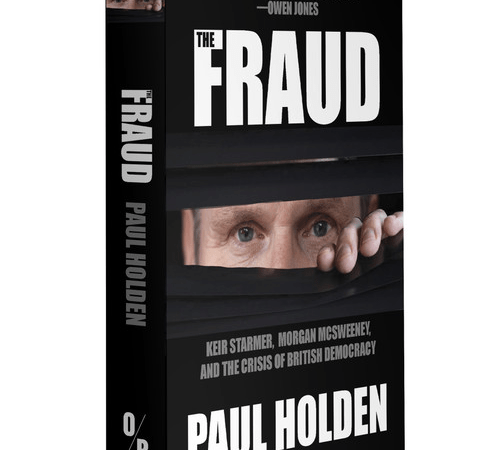
With Labour Together, the shadowy faction that propelled Keir Starmer to the leadership of his Party still dominating the headlines, Paul Holden’s book The Fraud, which exposes the group’s inner workings, is now essential reading. Labour Hub interviewed its author.
LH: Labour Party activists will be familiar with the workings of Labour First and Labour to Win who have regularly put up slates supporting the Party’s right wing in internal elections. They will be a lot less familiar – until recently – with Labour Together, which seems to have operated altogether more secretively. Can you tell us a bit about its main activities – and also how it evolved in a way that sidelined some of its original key people, such as Jon Cruddas?
PH: The story of Labour Together is best understood as a shifting project running over first phase.
The first phase ran from 2015 to 2017, when it was first formed. Jon Cruddas MP was one of the major animating forces behind the organisation. He explained to me that Labour Together was formed to both try to understand why the Labour Party had lost the 2010 and 2015 elections. He was also concerned that the Labour’s right-wing would refuse to accept the election of Jeremy Corbyn, perhaps leading a break-away of some kind as had happened in 1981 with the SDP. He hoped Labour Together could act as a forum to get the Party’s factions to at least keep on talking as a means of preventing a break-away.
The second phase ran from July 2017 to approximately April 2020. The animating figure of this period was Morgan McSweeney, who left a job in the Local Government Association to become Labour Together’s Company Secretary and managing director.. His closest allies in this process were Steve Reed MP, a director of Labour Together and now Cabinet Minister for Local Government and Housing, and Imran Ahmed, a former Labour Party SPAD. McSweeney, Ahmed and Reed all had a deep and profound distaste and disdain for the Labour left and Corbynism in particular.
Covert anti-Corbyn operations
Supported with over £800,000m in donations, of which over £700,000 were unlawfully not declared to the Electoral Commission, McSweeney pursued a covert fight-back against Corbynism, all while Labour Together was presenting in public that it was working as a cross-factional project to bring the Party’s traditions together in collaborative conversation. With Ahmed and the support of Reed, McSweeney incubated – often despicable – projects to destroy the Corbynite information ecosystem, including a vibrant independent media. He and Ahmed also began intervening in the ‘antisemitism crisis’, seeding stories with the media that would report on ‘revelations’ in alarmist and catastrophist tones. From at least 2019, McSweeney also worked closely with the Jewish Labour Movement.
He paid for vast amounts of internal Party polling and helped right-wing Labour candidates, like Damien Egan, in their internal Labour elections. Most notably, from July 2019, McSweeney began working with Sir Keir Starmer to shape his misleading leadership campaign. According to Labour Together’s own legend, the organisation then worked to help Sir Keir win the Labour leadership campaign between January 2020 and April 2020, despite telling the public that they were not supporting any particular candidate.
Jon Cruddas leaves in protest
The third phase ran from approximately late 2022 and July 2024. After a period of relative dormancy, Labour Together was remade and effectively relaunched under the leadership of Josh Simons, a long-time ally and friend of McSweeney and Ahmed. From 2023, Labour Together started receiving huge donations from millionaire, billionaire and pro-Israel donors. Jon Cruddas left the organisation in protest. He told me that he opposed the idea that Labour Together would effectively become an ‘adjunct’ of the Sir Keir’s office. A long-time employee, Hannah O’Rourke, also left.
Labour Together, in public, presented itself as the ‘provisional wing’ of Starmerism, and Simons told the media that all of Labour Together’s work was done in conversation with Morgan McSweeney. By then, McSweeney had engineered Peter Mandelson’s return to intervening in the minutiae of Party management, primarily directed at remaking the Labour Party in their joint image.
Labour Together performed three roles in this period. The first was that it acted as a policy shop for the incoming Labour government, and also published reports that rolled the pitch for McSweeney’s electoral strategy to pitch the Party right on economic and cultural issues. The second is that it became a clearing-house through which funds from millionaire, billionaire and pro-Israel donors would be funnelled to provide support to MP candidates who had been hand-picked by McSweeney, with the alleged input and support of Mandelson. In the lead-up to the July 2024 election, Labour Together funded over 100 of Labour’s incoming MP cohort.
Simons would be one of several McSweenyite insiders who would be parachuted into a safe Labour seat during the July 2024 General Election. His campaign was not funded by Labour Together, but his constituency CLP did receive £10,000 from Francesca Perrin, the daughter of billionaire Lord David Sainsbury, who is herself said to control assets of approximately £500m. Perrin had donated £210,000 to Labour Together in 2023 and 2024. Lord Sainsbury has donated £1.1m to Labour Together between April 2024 and December 2025.
Sleazy dark arts
The third, as we have recently discovered, is that Labour Together would act to defend the McSweeney-Starmer project from journalistic scrutiny through a campaign of sleazy dark arts. I was one of the targets of this process, as I had started catalysing – or personally writing – articles from November 2023 about McSweeney and Labour Together. Those articles raised serious questions about whether McSweeney had chosen not to report donations, in violation of the law, between 2018 and 2020. They also began revealing, for the first time, the ugly and possibly unlawful campaigns that McSweeney had started to destroy the viability of left-wing media outlets – and the livelihoods of a range of excellent journalists producing factually accurate reportage that posed an obstacle to McSweeney’s political ambitions.
We now know that Labour Together, under Josh Simons direction, appointed a company called APCO Worldwide to respond to the reporting. The focus was on producing a ‘body of evidence’ that could be used to ‘proactively undermine’ the factually accurate public interest reporting on Labour Together, Morgan McSweeney, Steve Reed and Imran Ahmed.
APCO put together alarming and ludicrous dossiers alleging that myself and my colleague Andrew Feinstein, as well as Sunday Times journalists I had worked with, were embroiled or active agents in a Russia-linked scheme to attack the credibility of McSweeney and Sir Keir Starmer. Simons and Labour Together reported me to the security services, alleging – falsely – that I had received material from a state-sponsored hack of the Electoral Commission, and tried to place stories about me with the Guardian that I believe could have been fatal to my reputation, my livelihood, and the viability of my small anti-corruption organisation that employs a number of excellent young investigative researchers.
The fourth phase of Labour Together runs from July 2024 to date. Labour Together continues to receive very significant amounts of donor funding ultra-rich patrons (£3.3m since the 8th of July 2024 to January 2026). It now uses this money to write largely right-leaning policy, which it uses its access and influence to convince the Labour Party to adopt One recent example of this is Digital ID, a policy pushed by Labour Together and the Tony Blair Institute. The announcement of the adoption of mandatory Digital ID in September 2025 was preceded by Labour Together pitching the policy under the name ‘Britcard.’
LH: Morgan McSweeney was obviously central to the whole project. Get In: The Inside Story of Labour Under Starmer by journalists Gabriel Pogrund and Patrick Maguire suggested that Keir Starmer was sitting in the front of a driverless train, not really in control. There is also a strong sense from your book that Starmer may be the leader but he is a prisoner of a project he does not control and which will outlast him. Is this still the case? How frail is the project without Mandelson and McSweeney?
PH: It is hard to overstate the importance of McSweeney’s departure. He has always been the animating force behind this political project, and also the person tasked with managing – and manipulating – people behind the scenes. He has also been central to pushing the Labour Party’s overall messaging and positioning with an eye on electoral strategy. It is his influence that, for example, has pushed the Labour Party to adopt a strikingly right-wing, authoritarian and punitive approach to immigration, both regular and irregular, which is pursued by one of his longest associates, Shabana Mahmood.
A lame-duck Prime Minister
McSweeney’s departure has left Starmer in a deeply vulnerable and weak position. In normal circumstances, he would have already been challenged for the leadership. He is deeply unpopular with the public and is alienated and isolated from his own Cabinet and Party; for years, he had effectively subcontracted the nitty-gritty of politics and relationship building to McSweeney. Starmer has no constituency in the Party of his own, few friends and close allies, and is widely known to have a limited grasp of, or interest in, a deeper, ideologically grounded politics. He is a lame-duck Prime Minister.
But the broader Labour Together project is also increasingly frail. The appointment of Mandelson, his long-time association with Jeffrey Epstein, and the role played by McSweeney in supporting Mandelson’s appointment, has seriously ‘cut through’ with the public. There is a clear awareness, now, that McSweeney’s political judgment is of the type that it graces the best friend of a notorious paedophile. The recent scandal about Labour Together smearing journalists has tied Labour Together’s brand – whether fairly or not – to the McSweenyite-Mandelsonian dark arts.
Finally, the key Cabinet Ministers associated with the Labour Together Project – Wes Streeting, Rachel Reeves, Bridget Philipson, Steve Reed and Shabana Mahmood – are weakened by McSweeney’s departure and the questions now swirling about Labour Together. Streeting, always seen as the heir apparent of the Labour Together Project, has seen his already serious lack of popularity with the Labour membership suffer because of his own association with Mandelson.
This is a project that is adrift and distrusted, that much is clear. What is less clear is how this project will respond, and what that will mean for Britain’s democratic system and the Labour Party. Will this faction use its typically bureaucratic stitch-ups to retain its death-grip on the Party, potentially pitching it into a existential spiral? Will this faction blow up the Party – like it set out to do in 2017 to 2019 – so that it can hold power and avoid accountability? Or will this moment of weakness allow a relative outsider to make a move and take on the Party’s leadership – and with it, both the bureaucracy of the Party and the state?
There is all to play for.
Mandelson’s role
LH: The role of Peter Mandelson in the rise of Keir Starmer is illuminating. What’s interesting about the history of this individual is how useful he made himself to those who were prepared to work with him and how assiduously he stoked hostility against those who refused his services, like Ed Miliband and Jeremy Corbyn. Gordon Brown gave him a peerage and brought him back into Cabinet as Business Secretary in 2008, “in spite of him being anything but a friend to me, because I thought that his unquestioned knowledge of Europe and beyond could help us.” But another reason was as an olive branch to the Blair camp, a calming measure that would stop what appeared to be Mandelson’s derogatory briefings against Brown’s team in the media. At what point did Mandelson become such an important part of Starmer’s project?
PH: This is still something that is not entirely clear.
What is known is that McSweeney and Mandelson have had some sort of friendly relationship, and that this goes back at least a decade. It seems reasonable to assume that Mandelson had a general favourable view of McSweeney. It is also obvious that McSweeney, between 2017 and 2020, really inhabited and executed a typically Mandelsonian campaign of media manipulation and dark arts. But how much there was active collaboration in this period is unknown.
What is known is that Mandelson was brought increasingly close to the Starmer Project after Starmer’s election as leader. The i Paper, for example, has alleged that Mandelson was involved in the deep guts of Party management, in that he was contributing to a spreadsheet maintained by McSweeney about who could and couldn’t be allowed to stand as councillors or MPs in the Party (the Party has denied this allegation).
We also know that he was exercising considerable influence over the Party’s strategic direction. In May 2021, following the Hartlepool by-election, for example, McSweeney distributed a strategy document called Labour for the Country. It argued that the Starmer leadership should respond to losing Hartlepool by accelerating its project to isolate, alienate and expunge the left of the Labour Party, which is then accepted by the Starmerite leadership. The first draft of this document was written by Mandelson.
From there, Mandelson seems to be repeatedly in touch with a wide range of Starmerite and McSweenyite insiders. It is widely reported that he spoke frequently to Starmer ahead of the 2024 General Election. It has also been claimed that Mandelson was a regular guest of McSweeney and his MP wife Imogen Walker at their large home in rural Lanarkshire after the election.
LH: Starmer’s team has been accused of being something of a boys’ club. Can you comment on the significance of this?
PH: I think this is accurate. But I also think people misunderstand, or do not appreciate, the longer history of this claim.
In The Fraud, I describe the content of the so-called Leaked Report, which was put into the public domain by unknown actors in April 2020. The ‘Leaked Report’ was a report drafted by pro-Corbyn Labour Party staffers in response to questions posed by the Equalities and Human Rights Commission, which was investigating the Party’s handling of antisemitism complaints. The staffers used search tools to look through the Party’s servers to try and answer the questions posed by the EHRC.
The Leaked Report investigation found a truly vast set of evidence pointing to extreme and destructive factionalism on the part of the Labour Party’s right-leaning bureaucracy in the period between 2015 and 2018. It also alleged to have uncovered very significant evidence that staff were exchanging racially loaded, sexist, ableist and misogynistic messages. Martin Forde KC, who was asked to investigate the claims in the Leaked Report, found that this depiction of the bureaucracy was accurate.
An utterly toxic political culture
What both the Leaked Report and the Forde Inquiry revealed was an utterly toxic political culture, dominated by a handful of men. Many of these men were friends with Morgan McSweeney or had worked as his factional allies. One of these figures was Paul Ovenden, who was forced to resign as the Chief of Strategy in Number 10 in September 2025 after I revealed Party messages where he had made sexualised comments about Diane Abbott.
What has not been properly appreciated is that the Leaked Report and the Forde Inquiry presented an opportunity. They evidenced a deeply factionalised and toxic political culture, which could have been challenged and displaced. Instead, the Starmer project spurned this chance. In fact, despite the evidence in the Leaked Report, key figures like Ovenden, who had left the Party in 2018, were brough back into the Starmerite leadership.
It is against this backdrop that many prominent women have complained about a hyper-macho and morally suspect culture at the top of the Labour Party and government. I believe that this was best expressed in the ousting of Sue Gray as Chief of Staff, who was somehow made responsible for all sorts of broader failures that had nothing to do with her – like Starmer’s predilection for taking luxury freebies.
Although I suspect that Gray might not share my politics, I do get the sense that she was a competent, disciplined and professional civil servant. I also think she would have posed an important countervailing force to the McSweeney-Mandelson axis. It is unlikely that Gray would have supported and facilitated Mandelson’s appointment as US ambassador – unlike McSweeney, who seems to have been central to this appointment.
LH: The Fraud seems exceptionally relevant to the way Labour’s crisis has developed in recent weeks, yet seems to have had very little coverage from mainstream media outlets, compared to other narratives. Is this simply media bias, or something else?
PH: It is likely a number of factors. Media bias is definitely one of them. It is always hard – sometimes nearly impossible – to have accounts written from a left-wing, or leftish, perspective admitted into the mainstream. But the book is also critical of many media outlets, like the Guardian, whose news and lobby desk has done a poor job in scrutinising the Starmer Project – and, at times, has run cover for the Starmer-McSweeney-Mandelson project, when it should have been questioning it. It is unlikely that these outlets will want to draw attention to a book that includes revelations that might anger their own readers.
The book also tackles thorny and difficult topics, like the antisemitism crisis. I believe I treat this in as a respectful and balanced way as possible. But there is a near-total and universal hostility to reconsidering this crisis, which, upon cursory investigation, covers very few people in glory.
That said, I do think this point can be overstated, and I’m not overly concerned. Many of the stories of the book have, to my great surprise, been covered in the mainstream, even if this has happened in sub-optimal ways, with a degree of reluctance and sometimes baroque spins. I’ve also been really gratified to see how much the book has been acknowledged, reviewed and reported on by the independent and left-wing media ecosystem – an ecosystem that is growing in reach, importance and cut-through with ordinary left-leaning people.
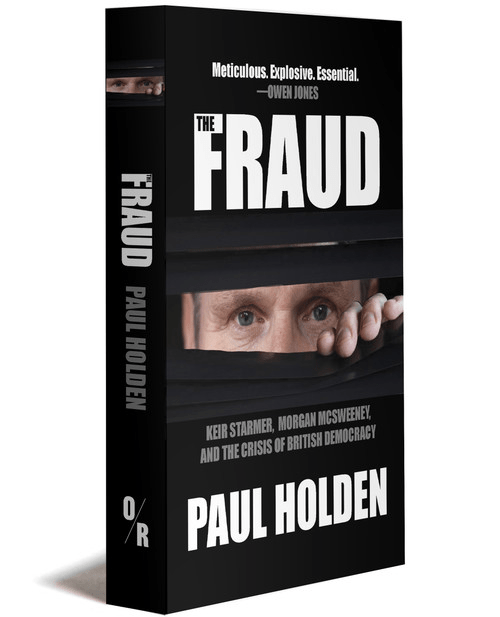
Paul Holden is an investigative journalist and author with 15 years’ experience of investigating corruption. The Fraud: Keir Starmer, Morgan McSweeney, and the Crisis of British Democracy, by Paul Holden is published by OR Books.
 Labour Hub
[…] The Fraud: Keir Starmer, Morgan McSweeney, and the Crisis of British Democracy, and in his recent interview with Labour […]
[…] of the key allegations made in his book, summarised from a recent Labour Hub interview with its author Paul Holden […]
[…] Paul Holden, author of The Fraud, spoke of his nearly four-year investigation into the shadowy Labour Together faction, headed by the now dismissed Morgan McSweeney, which propelled Keir Starmer to power and organised the accompanying war on Jeremy Corbyn supporters. “There was a pretty profound relationship between Morgan McSweeney and Peter Mandelson,” he said. McSweeney and his allies effectively took over the Labour bureaucracy and used this to clamp down on internal democracy. He explained how a small cabal of Party bureaucrats were effectively able to choose around a couple of hundred Labour MPs, many of whom had undeclared donations funnelled into their election campaigns. This takeover has had profound repercussions, in terms of the adoption of unpopular policies, the consequences of which the Party was now reaping in byelection defeats. […]
[…] Useful links: Report on Restore Labour Democracy rally here; Labour Left Podcast interview with Paul Holden, author of The Fraud here; Mandelson: his role in the Labour Party also needs investigating – here Labour Together: who benefited? – here; Labour Hub interview with Paul Holden here. […]