
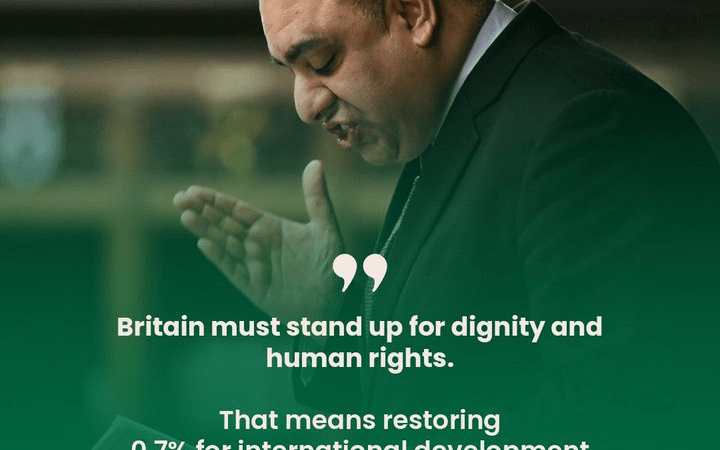
Britain must lead with solidarity, not retreat into short-termism, argues Imran Hussain MP.
When Britain chose to spend 0.7% of our Gross National Income on international development, it was never an act of charity. It was a statement of values. It said that in an interconnected world, we would not turn away from hunger, conflict, disease or climate catastrophe. It said that we understood prevention is wiser than crisis management.
That commitment, rooted in a 1970 UN resolution, was finally met by the UK in 2013 and enshrined in law through the International Development (Official Development Assistance Target) Act 2015. It symbolised a country prepared to lead.
Today, that leadership is being dismantled.
After the reduction from 0.7% to 0.5% in 2021, justified on the basis of pandemic-related economic pressures, the Government has now confirmed a further cut to 0.3% from 2027, linking the decision directly to increased defence spending. By 2026–27, UK Official Development Assistance is projected to fall to around £7.7 billion – the steepest reduction among G7 countries.
The move from 0.5% to 0.3% alone represents more than £6 billion less each year by 2027 compared to maintaining the current level. That is not an accounting adjustment. It is a political choice.
And it will cost lives.
Under the 0.7% framework, UK-supported programmes helped lift around 3 million people out of poverty each year. More than 40 million children were supported into school. Three million people gained access to HIV treatment. Water and sanitation reached over 1.5 million people.
In Sudan, expert evidence has shown that aid reductions led to a 41% cut in programming tackling violence against women and girls and a 66% reduction in funding to women’s rights organisations. In Bangladesh, in the Rohingya refugee camps of Cox’s Bazar, severe acute malnutrition has surged by around 27% over a single year amid chronic underfunding. Analysis suggests that by 2026, reductions could result in 44 million fewer women and girls receiving essential support compared to 2019 levels.
These are not abstract figures. They are children without vaccines. Mothers without safe births. Families without food.
And we know that development spending works. UK-backed malaria programmes contributed to cutting global malaria deaths by more than 60% since 2000, helping save an estimated 6.8 million lives. It can cost as little as £3.25 to avert a case of malaria, generating roughly £36 in social and economic return for every £1 invested.
Prevention is not just moral. It is the rational, realpolitik choice to take.
In Parliament, I have consistently argued that international development is not about charity, it is about who we are and the values we stand for. I voted in July 2021 to reinstate 0.7% without delay. I opposed attempts to tie restoration to arbitrary economic tests. And I have repeatedly raised humanitarian crises in Gaza, Sudan and the Rohingya refugee camps, pressing ministers on safe access to food, water, fuel and medicine.
Where preventable suffering is ignored, instability follows. When fragile states collapse, displacement rises. When hunger deepens and opportunity shrinks, conflict intensifies. Retreating from development does not make Britain safer. It makes the world more volatile and that volatility does not respect borders.
In Bradford East, this is not a distant debate.
Bradford is home to one of the largest Rohingya diasporas in Europe. Various local organisations work tirelessly to support families here – many of whom have close relatives in Cox’s Bazar. When food rations and education provision are cut in those camps, my constituents feel it in real time.
Internationalism is not a luxury for good times. It is a principle that defines Labour at its best.
Of course, we face economic pressures. Of course, we must ensure responsible public finances. But framing this as a choice between defence and development is a false dichotomy. Security is not secured solely through weapons systems. It is secured through stability, through opportunity, through tackling the root causes of conflict and displacement.
A Britain that retreats from its global responsibilities is a Britain that diminishes itself.
Labour has always believed in solidarity beyond borders. We must recommit clearly and unapologetically to restoring the 0.7% target. Not when it is politically convenient. But because it is right.
We as Socialists must understand that in an interdependent world, our futures are bound together.
Britain should restore 0.7%. And do so proudly.
Imran Hussain is Labour MP for Bradford East.
For more background on international aid cuts, see this article by Jon Barnes.
 Labour Hub