
Labour Hub’s Bryn Griffiths worked closely with Labour to Reform defector Sir Robin Wales at Newham Council as a local government officer between 1998 and 2000 and again between 2002 and 2003. Bryn dedicated a quarter of a century of his life to local government service so his up close and personal reflections on the subject of Sir Robin’s betrayal are not all that positive!
Nastiness one: Operation Icepick
Robin Wales was born in Kilmarnock, Scotland in 1955. His first political act of note was his involvement in Operation Icepick. He Chaired Scottish Labour Students from 1976 to 1977 and Operation Icepick was a plan to rid the National Organisation of Labour Students of Militant supportersin the 1970s. The ‘icepick’ was a nasty reference to the deadly implement used by Ramón Mercader, one of Stalin’s goons, to murder Leon Trotsky in 1940. The distasteful incident gives us a clear indication of what to expect from an older Wales as his political career unfolded.
Labour Students, except for a heroic minority, has always acted as a finishing school for the very worst of Labour’s politicians. The failing school has turned out the likes of Phil Woolas, Mike Gapes, John Mann, Tom Watson, Jonathon Ashworth, Luke Akehurst and of course the Mandelson protégée that is Wes Streeting. Even by these awful standards, Robin Wales has lowered the bar to new subterranean levels.
In that period, Scottish Labour politics was heavily influenced by Stalinism but I think when Tariq Ali coined the term ‘Stabian’ – to describe the factional nastiness of a Stalinist and the political timidity of a right-wing Labour Fabian – he could have been thinking of Robin Wales.
Newham Council
In 1975 Wales moved to Newham where he was to embark on his municipal political career. He was elected to Newham Council in 1982 and was its Leader by 1995. Newham Council was not known for the radical municipal socialism of the likes of the Greater London Council, Camden, Hackney and Islington, so it was probably the ideal place for a young Stabian like Robin Wales to ply his trade.
Best Value
I first came across Robin Wales just after he became the Newham Leader in 1998. Prime Minister Blair had just been elected the year before and his flagship policy for local government was Best Value. The idea was to move away from the explicit marketisation, through the compulsory competitive tendering of local government services, brought about by Margaret Thatcher’s Local Government Act 1988.
The new approach, in typical New Labour technocratic fashion, was to be ‘what matters is what works’. New Labour was to put every local government service through a process known as the four Cs – the review process would Challenge whether the services were doing the right thing; Compare its services to the ‘best in class’; Consult the public; and finally, if judged necessary subject the service to Competition. The new approach was neutral compared to Thatcher’s drive for the privatisation of local government services, critically backed by the trade unions, but a return to municipal socialism it definitely was not.
Blair was looking for councils to pilot Best Value and the new Newham Labour Leader, Robin Wales, jumped at the chance to review every council service to test the new Best Value concept. I joined the Council’s Best Value team and stayed for two years.
Blair’s flagship
Commenting on the Robin Wales defection, the London Labour Regional Office said on behalf of the Party that Reform were “scraping the barrel” with the announcement. “Neither men [Clive Furness has also defected] have been part of the Labour movement for some time. In Newham, Robin Wales was removed by local members following concerns about his record in office.”
I’ll deal with the Robin Wales de-selection later but for now let’s look at how the London Labour’s Regional Party is massively downplaying Robin Wales’s historic role. In the early years of Blair’s Government, Robin Wales led Tony Blair’s flagship council. He was the Mr New Labour of local government.
Robin Wales’s Best Value Team, which I joined, became the Local Government Chronicle/Local Government Association Management Team of the Year. The officers he employed went on to provide Chief Executives at the reformed Greater London Authority, Birmingham City Council and a replacement as the new Newham Chief Executive. His then Newham Chief Executive, Dr Wendy Thompson CBE, went on to become the Head of the Office of Public Sector Reform in Blair’s Cabinet Office. Wales was clearly a key player in Blairite local government circles.
During the Newham Best Value Pilot, I commissioned the Open University Business School to carry out a study of our work. When their report, Towards Best Value, was published in 1999 Blairite insider Baroness Hilary Armstrong, the Minister of State for Local Government, was all over Robin Wales posing for pictures in the Municipal Journal.
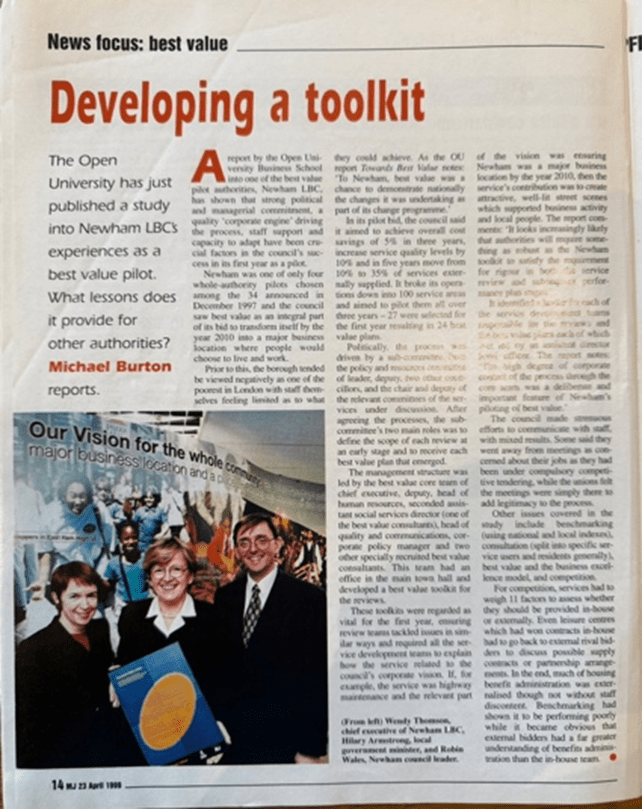
Sir Robin Wales poses for pictures with Hilary Armstrong, Blair’s Minister of State for Local Government and Wendy Thomson, Blair’s Head of the Office of Public Sector Reform.
When Blair was in his pomp, Robin Wales chaired the Association of Local Government from 2000 to 2006. He sat on the London Organising Committee for the Olympic Games and the Olympic Park Legacy Committee.
New Labour
Let’s be clear: Sir Robin Wales wasn’t just any Blairite he was their key figure in local government. Robin Wales was the local government poster boy of New Labour. We all know that the Labour is now in the grip of the New Labour continuity faction known variously as Labour Together and Labour To Win. On 4th March 2026, Blair’s old boy in local government defected to Nigel Farage’s Reform!
An alleged positive aspect of Blairism was a veneer of social liberalism but even as long ago as the 1990s Robin Wales showed no sign of these more positive characteristics. Councillors involved in a scrutiny investigation into East London’s traveller community may remember him fulminating against environmental crime and wanting to crush their vehicles. He already had an unhealthy obsession with the New York Mayor Rudy Giuliani’s zero tolerance on crime policy a policy, that relied heavily on stop-and-frisk tactics. Data indicate that this, along with other enforcement, disproportionately targeted New York’s Black and Hispanic individuals.
Nastiness two: the bully
In the summer of 1998, I found myself on the receiving end of the nastiness of Robin Wales. My good friend and comrade Liz Davies, the first guest on the Labour Left Podcast, had been selected to be Labour’s candidate in Leeds North East but Blair had other ideas. The Labour right wasn’t removing left-wing MPs other than Militant supporters in that period but the Socialist Campaign Group had been consigned to what Peter Mandelson had described as the “sealed tomb”. The addition of an articulate young socialist-feminist to the group was not part of the plan so the attack dogs of New Labour’s client journalist pack were released. David Aaronovitch wrote a filthy Independent piece Watch out Labour, the Trots are back with a vengeance and he used an editorial I had written for Labour Left Briefing: Irish peace in jeopardy … Who’s to blame? to attack Liz by association. Aaronovitch spiced up the article by telling untruths that inferred that I was some form of supporter of the Continuity IRA. Nothing could have been further from the truth from what I was doing which was advocating for a peace process that eventually bore fruit in the Good Friday Agreement.
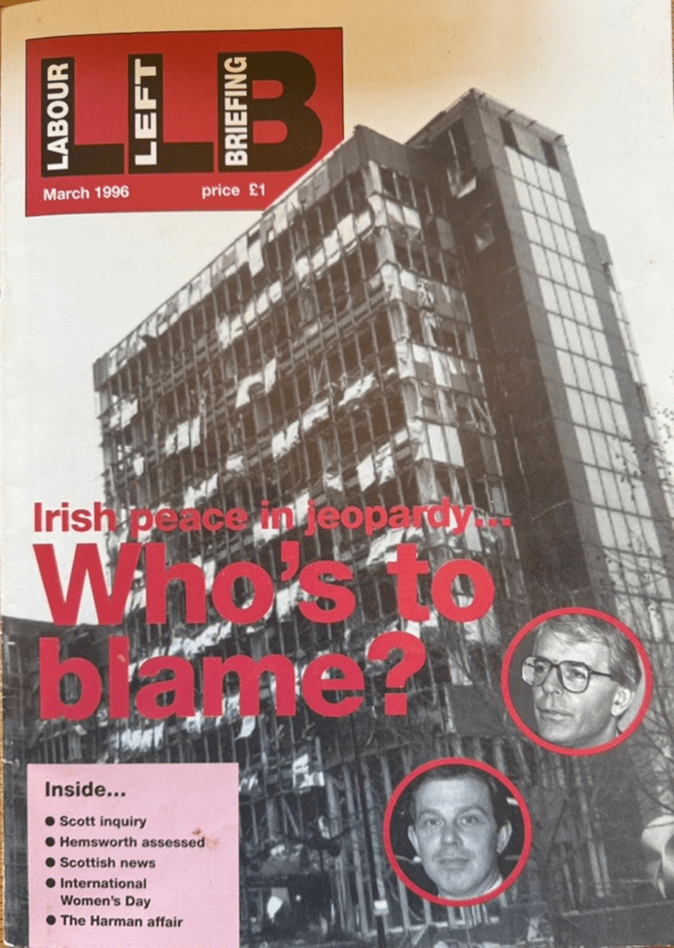
The front-page Labour Left Briefing March 1996 story which was distorted so badly by David Aaronovitch to attack Liz Davies.
Robin Wales found out about the article and attacked me in what was a public committee of the council. He knew as a politically neutral officer I could not respond. What he was saying was untrue and damaging to my reputation but he just got stuck in. I feared for my job and I think it was only the intervention of Wendy Thomson, the Newham Chief Executive, to defend the political neutrality of her officer that saved my skin.
Labour’s first executive mayor
Another Blairite project for local government in the 1990s was the election of the all-powerful executive mayors which in New Labour terms could get things done in a manner that the old committee-based system could not. Many Labour members saw it as a diminution of local democracy but it did result in influential mayors such as London’s Ken Livingstone, the North of Tyne’s Jamie Driscoll and Manchester’s King of the North Andy Burnham.
With another New Labour initiative unleashed, Robin Wales stepped forward and became Labour’s first executive mayor in 2002. Mayor Livingstone preceded him but he was elected originally as an Independent. Newham had a problem in that it not only had an all-powerful executive mayor but it also had a council which was 100% Labour so it didn’t look like the checks and balances of good governance were in place. The solution to this problem was to beef up the council’s overview and scrutiny function which was designed to mimic the role of parliamentary select committees and in the process give the back benchers a voice. I had left Newham in 2000 but in 2002 I returned to become the new Head of Overview and Scrutiny, renewed my acquaintance with Robin Wales and had the role of supporting backbench scrutiny of the new mayor. It was a role Wales did not always value!
Nastiness three: patronage
In his new role he made sure he made good use of patronage to make his position even safer from challenge. He created paid roles for more than half of the councillors, a payroll vote which ensured loyalty.
Some of the less favoured councillors ended up as scrutiny members, one of them being Cllr John Saunders who headed up a scrutiny on affordable housing. The scrutiny led by Cllr Saunders was seen as very good by officers and even involved a fact-finding day trip from the nearby London City Airport to see social housing in Amsterdam. The problem was that Cllr Saunders had had the temerity to stand against Robin Wales for the Labour mayoral nomination. The Robin Wales solution to this problem of a high performing opponent was to praise the officer team who supported Cllr Saunders’ work in private and then slaughter the councillor and his report when it was brought to him in a public council meeting.
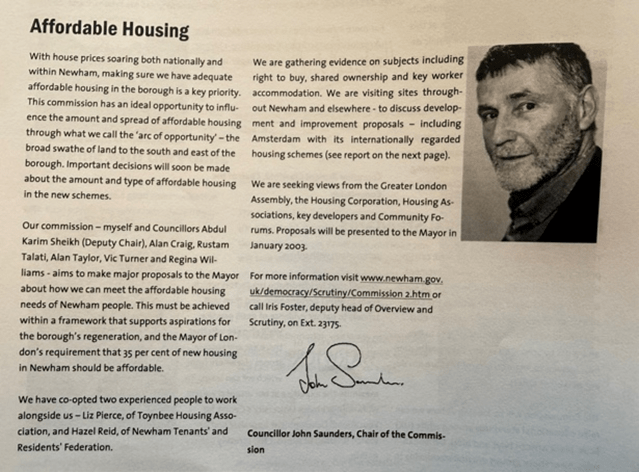
Newham’s Cllr John Saunders reports on the impressive 2003 affordable housing scrutiny investigation
By 2003 I had again left Newham Council and afterwards in 2006 Cllr Saunders took aim at Robin Wales’s patronage system and said in the local paper The Guardian: “The mayor has almost unlimited powers and now makes nearly all decisions. There is almost no discussion in council, there is little input from most of our elected councillors and scrutiny of the mayor’s decisions is virtually non-existent.” The article also asked: does the mayor really need to pay for advisers for community intelligence and external relations, trade unions and community facilities and electoral engagement and registration?
I think we can say the attempt to beef up the council’s overview and scrutiny function as a check and balance on Mayor Robin Wales’s powers had run aground!
Toppled
Long after I had left Newham, Mayor Wales was toppled in 2018, after 23 years in office, by a trigger ballot to hold a selection followed by a members’ ballot. Even this democratic process was mired in controversy as his opponents claimed in a BBC London report that the original trigger ballot was subject to irregularities.
He eventually lost to Rokhsana Fiaz by 861 votes to 503. With a delicious twist of irony Rokhsana Fiaz returned to Cllr John Saunders’ theme of social housing promising an “ambitious programme of genuinely affordable housing, with an initial target of 1,000 over four years.”
The BBC London Report went on to say he had made enemies in his own Party along the way – with some unhappy at his forthright leadership style. The chickens had come home to roost. I would add that by this point he had in particular come into conflict with Newham’s minoritised communities.
Life after Newham
In 2019, the defeated Robin Wales moved to Suffolk, where I was working for the County Council, but alas our paths did not cross again.
As recently as 2024 he stood as a Suffolk Labour candidate for the Police and Crime Commissioner. Unlike Newham, a Suffolk-wide election is not rich pickings for a Labour candidate so he lost.
Like any former Blairite elected representative he followed up his public service role with some lucrative consultancy. He is currently working at the Policy Exchange described by the Daily Telegraph as “the most influential think tank of the right.”
The defection to Reform UK
On 4th March 2026, Sir Robin Wales defected to Nigel Farage’s Reform UK. If you have the stomach for it you can watch the full press conference here on the Daily Express You Tube Channel.
Robin Wales made his resignation statement along with Clive Furness, the future Reform candidate for the Mayor of Newham, in Spiked, of all places. The statement is littered with all the usual and awful references to grooming gangs, a failure to tackle immigration, opposition to the policing of Islamophobia, attacks on the Trans community, opposition to the Employment Rights Act (the most notable achievement of Starmer’s Government) and attacks on economic welfare.
Robin Wales’s departure begs the question: how did the mayor of New Labour’s flagship council become London director of local government at Reform UK? He may be past his peak and not as prominent as he was in the past but in his pomp he was New Labour’s local government poster boy. The Sir Robin Wales defection is the responsibility of the Labour right and they must own it.
It is ironic that a Robin Wales that cut his political teeth in the anti-Trotskyist Operation Ice Pick should announce his defection to the populist right in Spiked, the mutant offspring of the Revolutionary Communist Party, the very worst of the British Trotskyist tradition.
One of my former local government colleagues observed that Robin Wales has gone from being a big fish in a small pool, to becoming a dangerous shark in a toxic pool. She explained he’s dangerous because he has an understanding of local government, what electoral tactics work and how to undermine officers.
Finally, on a personal note, can I give Sir Robin Wales all my ill will. By joining Reform UK he has not only betrayed the Labour Party but every single local government officer I ever worked with in Newham. In Newham he was surrounded by officers striving to make public services better. I don’t think anybody envisaged that Best Value, Robin Wales-style, would one day mutate into a United States Department of Government Efficiency-style attack on the very notion of public service.
I hope his new endeavour goes very badly indeed.
Bryn Griffiths is an activist in Colchester Labour Party and North Essex World Transformed. He is the Vice-Chair of Momentum and sits on the Campaign for Labour Party Democracy’s Executive. Bryn hosts Labour Hub’s spin off – the Labour Left Podcast. You can find all the episodes of the podcast here or if you prefer audio platforms (for example Amazon, Audible, Spotify, Apple etc,) go to your favourite podcast provider and just search for the Labour Left Podcast.
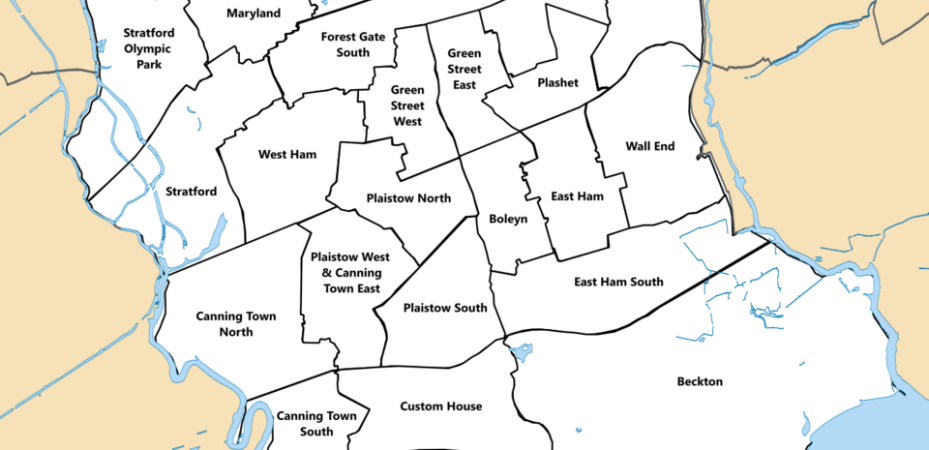
Main image; https://commons.wikimedia.org/wiki/File:Newham_Ward_Map_2022.png. Newham Ward Map. Source:
https://www.newham.gov.uk/downloads/file/3484/new-ward-map-2022 Author: Ordinance Survey, licensed under the Creative Commons Attribution 3.0 Unported license.
 Labour Hub
