

On International Women’s Day, Lynne Segal surveys over sixty years of thinking and activity and draws some lessons for the way forward.
Early on, International Women’s Day always had ties to socialism. The Socialist Party of America declared the first National Woman’s Day on 28th February 1909; the following year the German Marxist Clara Zetkin called for a day to celebrate women at the International Conference of Working Women, which took place on 19th March 1911. Finally, in the footsteps of women in Russia striking for “bread and peace”, 8th March, 1917, Women’s Day shifted, and has remained on that day, with women’s protests that year helping to ignite the Russian Revolution later that year.
These celebrations all occurred during the decades of first–wave feminism, between the late 19th and early 20th century. In Britain, the Suffragettes, headed up by the Women’s Social and Political Union (WSPU), launched numerous rallies and resistance demanding women’s rights to vote, work, and hold public office. Their bravery is applauded today, despite the violence of some of their activism, including bombings and arson attacks on property. Women’s franchise was brought in line with men’s rights in 1928, after which feminism would begin to fade from the political scene in the conservative mid-century.
Hence, when second-wave feminism burst onto the scene at the close of the 1960s, it seemed to appear out of the blue, with its sudden energy and high hopes eager to change the world higher. I was part of that wave, after arriving as a single mother in Britian in 1970. Like other women I had already imbibed the rebellious spirit of the late 1960s, with talk of sexual liberation and equality for all, but with pervasive sexism, even misogyny also prevalent.
By the 1970s, it was the newly emerging feminists of second wave liberation who would prove the buoyant heirs of Sixties radicalism, soon with new demands on every front: better lives for mothers, more childcare provision and men’s sharing of domestic tasks; better training, job opportunities and equal treatment for women at work. We called for an end to rape and violence against women, along with an overall cultural shift to dignify and celebrate the strength and autonomy of women everywhere. We read Simone de Beauvoir’s The Second Sex, on the age-old cultural subordination of women, soon highlighted and expanded in the powerful writing of newly minted feminists.
From the USA, Shulamit Firestone, Adrienne Rich, Grace Paley, Barbara Ehrenreich, Ursula Le Guin and grassroots activists were inspiring the women’s groups at home and elsewhere, variously emphasising the importance of solidarity, collectivity and the creativity and significance of women working for a better world for all.
In the UK, it was Juliet Mitchell, Sheila Rowbotham and many others sharing their thoughts on the need for emancipation from male dominance, at that time usually hoping to align women with broader socialist goals. Meanwhile, black feminists such as Toni Morrison, Alice Walker, Audre Lord and Angela Davis, along with Amrit Wilson, Margaret Busby, and others such as the Brixton Black Women’s group began to be widely read and influential in shifting most progressive political outlooks.
However, a decade later, as the right came to power first in Britain under Thatcher in 1979, then Reagan in the USA the following year, we began to see a retreat from the widespread hopes of Seventies feminism. This accompanied greater emphasis on women’s difference from men with the growth of “cultural feminism”, less interested in issues of equality and power while applauding women’s distinct feminine traits of nurturing and eco-consciousness, as exemplified in the writing of radical feminists such as Susan Griffin, from the USA. Feminism in the 1980s also included women’s growing peace activism, exemplified at Greenham Common, where women camped out for over a decade opposing the US nuclear missiles installed there. Some Black and Asian women’s groups also flourished in the 1980s, including The Southall Black Sisters.
For those who think in terms of waves of feminism, a “third wave” was seen as emerging in the 1990s, with renewed emphasis on exploring women’s extensive diversity, whether as black, working class, third world, Islamic, queer, or other distinct identities and difference. Greater theoretical abstraction was now appearing in feminist theorizing, most prominently, if aways controversially, in the writing of the US philosopher Judith Butler, deploying post-structuralist reflections on language and meaning in her book Gender Trouble. Butlercomplicated all forms of identity politics, stressing instead the culturally inflected ways we come to enact our expected identities, leaving them contingent rather than fixed, but always open to subversive performances or resistance.
However, while feminist thinking became more influential in parts of academia, a more distorted and dismissive view of movement feminism was evident in the media, presenting it as dull and obsolete. As Angela McRobbie and others noted, glamorous media images of professional women were being widely promoted by the close of the twentieth century, with programs celebrating women’s new freedoms, concerned only with the struggle for success and excitement plus the pursuit of ‘Mr Right’, as in Sex and the City or Friends in the 1990s.
Some feminists began studying this new form of media-promoted ‘aspirational feminism’, especially evident once powerful figures, such as Hilary Clinton, Teresa May or Michelle Obama proclaimed themselves feminist, from the heart of the neoliberal order, while urging more women to aspire to be winners in a capitalist world. The iconic figurehead was Facebook’s one and only female chief, Sheryl Sandberg, producing what she called “a sort of feminist manifesto” in her bestselling Lean In: Women, Work, and the Will to Lead in 2013, with its celebration of ‘top girls’ and regret over most women’s supposed lack of ambition.
What this strange new brand of feminism worked to disguise was a reality where life was getting tougher for so many women, becoming even more precarious and underpaid in jobs now essential for their survival, while having less time to care, even for their own dependents, given harsh welfare cuts, worsening especially from 2010. Before her tragically early death, the young British journalist Dawn Foster wrote Lean Out, rightly accusing Sandberg of encouraging women’s “complicity in the economic structures that perpetuate inequality”.
So where are we now, almost six decades on from those hopes of women’s liberation? There is no doubt that today more women have a stronger voice, some with access to significant power, with apparently more choices than ever.
Yet, just as firmly we also see the very opposite in the lives of other women. This stems from the rising individualism and above all the significantly greater inequality we have seen over recent decades of near total subservience to neoliberal market logics, attentive only to profits, with more women, young, and especially old, living in poverty, worsening over the last 15 years. Moreover, the ubiquitous cultural landscape of sexism and belittlement of women we condemned, with women judged by their looks, has far from disappeared. We don’t need to witness Epstein’s world, or the continuing rise in rape figures, to be reminded of that.
Hence, goals feminists fought for and seemed to win, beginning with a new appreciation of and support for mothers and the work of caring have disappeared. We find real misery experienced by many mothers today, many simply unable to cope with the extra burdens placed on them. This connects with women, often working long hours in paid work, having little time to care – affecting not only mothers, but those caring for the sick, disabled or fragile elderly.
Women still shoulder more of the responsibilities for caring, as I discussed in my last book Lean on Me: A Politics of Radical Care. So far, with some exceptions at municipal level, Starmer’s Labour Party has done little to address this, while threatening rights to protest. In our ultra-competitive era, earlier ideas of collectivity and shared caring, so important for Seventies feminists, have almost – but not quite – disappeared. Today, women’s poverty still exceeds that of men, especially in single-parent households and the old. Shockingly, women’s life expectancy overall has dropped three years over the last decade.
More positively, there is greater concern with green issues today, as articulated by feminist economists here such as Ann Pettifor or Sue Himmelweit, along with the growth of the Green Party – attracting many women. Many feminists are also actively opposing racism and cruelty towards migrants, evident in the work of feminist human rights and anti-racist activists, along with the legacies of Black Lives Matter. Confronting the rise of the right, including both Trump and Netanyahu, we have the forceful speech and writing of iconic figures such as Sara Roy in India, the Canadian writer Naomi Klein, or Judith Butler from the USA. Indeed, as Butler shows, the right’s attacks on women’s equality and what they call ‘gender ideology’ is what fuels populist reactionary rhetoric generally.
Feminist activists might well feel undermined today, confronting the ongoing kleptocratic behaviour of the few billionaires now dominating global markets, plus the continuation of reckless military violence on several fronts, including Israel’s genocidal violence in Gaza. Yet feminist resilience remains, in some ways taking us back to those women who created Women’s Day over a century ago.
The lessons we must retain are the importance of inclusiveness and alliance in the face of conservative political backlash. Everything is to be gained by recognizing women’s rich diversity, alongside men’s, and working together for a more caring, peaceful, egalitarian and greener world. Nothing is to be gained by divisiveness or targeting distinct groups of people as ‘the problem’. Feminism needs an inclusive agenda, including trans women, while insisting that women’s interests remain at the heart of all our politics.
Lynne Segal is the author of several books. Her latest, Lean on Me: A Politics of Radical Care, is published by Verso.
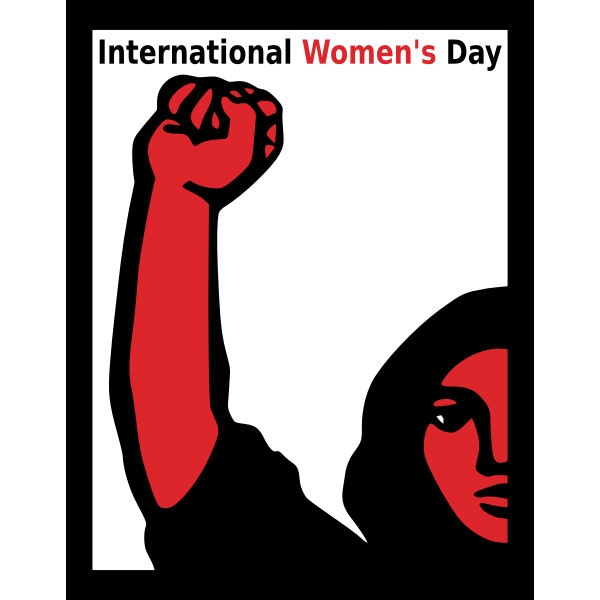
Image: https://freesvg.org/international-womens-day Licence: CC0 1.0 Universal CC0 1.0 Deed
 Labour Hub