

Mike Phipps looks at a new Compass report on the broken nature of our electoral system.
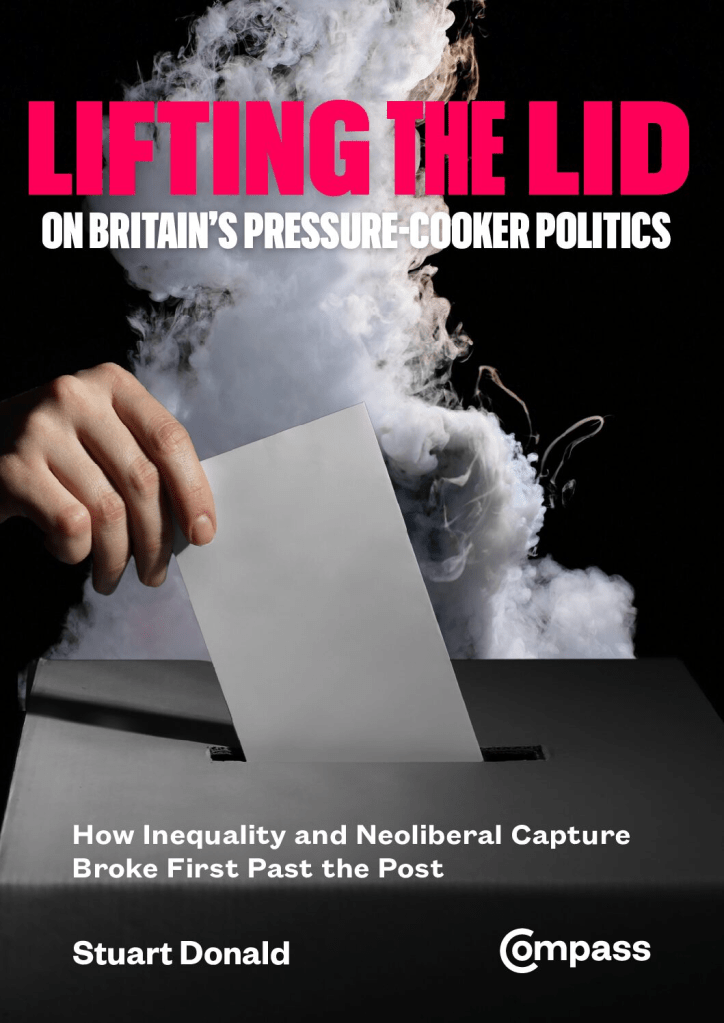
A new report from the centre-left thinktank Compass, Lifting the Lid on Britain’s Pressure Cooker Politics, by Stuart Donald, advances an unconventional argument against our electoral system and in favour of proportional representation (PR).
The argument
“Britain’s present instability,” it argues, “cannot be understood through culture-first explanations of populism, nor through party-specific accounts of Conservative failure or Labour timidity.” Rather, it is the First Past the Post (FPTP) voting system that “actively filtered redistributive demands out of politics.”
Under neoliberal economic governance, inequality has widened and decline spread into new regions of the UK, once thought to be secure. In the process, FPTP “systematically orphaned whole electorates. Low-income voters lost leverage first, as safe seats and declining turnout rendered deprivation electorally disposable. Middle-income voters followed later, as loyalty insulated their constituencies from political consequence even as living standards eroded.”
A proportional electoral system would have been more responsive to such pressures. The failure of FPTP to represent such sections of the electorate became a pressure cooker, enabling far right populists. “Brexit was not the cause of Britain’s crisis but the moment its underlying pressures briefly escaped FPTP’s electoral filters. Reform UK represents the return of those same pressures.”
Donald argues that Britain is unique in Europe in its readiness to hand a single-party parliamentary majority to one of the continent’s most extreme populist-right movements. Other European countries have given power to far right populists, he concedes, but their more proportional electoral systems have mitigated the effects, because PR embeds institutional consensus through the need for coalitions and party negotiations. However, we should note that Britain too has had blasts of right wing populism from the Tory party in recent years, and the latest defections increasingly make Farage’s outfit a rerun of much of that.
Donald presents the key premises of his argument in five different chapters. The first shows how the rise of neoliberalism made inequality the central driver of Britain’s political breakdown. One cannot argue with that.
The second premise is that “FPTP made it unnervingly easy for a single party with a geographically efficient electoral base” to overturn the post-war consensus and embark on a programme of radical neoliberalism that would drive up inequality. Well, yes it did – and it delivered Margaret Thatcher three electoral victories, followed by one for John Major – all on a minority of the popular vote.
Nothing is inevitable
But it is more questionable to suggest that New Labour too, and its continued embrace of neoliberal macroeconomics, was the inevitable outcome of the UK electoral system. First, there is little doubt that John Smith could have won a Labour majority from late 1992 onwards, before New Labour was even dreamed of. When the general election did come in 1997, most Labour voters wanted something far more radical than Tony Blair was offering and many in fact voted Labour in the hope that taxes would rise to address mushrooming social inequality.
Some 72% of voters in May 1997 wanted an income tax increase to fund better education and public services. 74% wanted no further privatisations. 58% wanted wealth redistribution. While it is true that the 1997 Labour landslide meant that the government, sitting on scores of safe seats, could safely ignore the views of their voters, the fact remains that the failure to embrace the demands of millions of Labour supporters was a political choice by the Blair government. Donald overstates the dependence of Labour on middle England marginal seats, and assumes, questionably, that they embodied a moderation that Blair had to pander to.
Less disputable is Blair’s neglect of low income voters, among whom electoral turnout plummeted alongside their political exclusion. The now disgraced ‘Third Man’ of New Labour, Peter Mandelson, smugly scoffed that these voters had nowhere else to go – until they began voting for overtly fascist parties and UKIP – but also progressive nationalists in Scotland and Wales.
It’s worth underlining that the drift towards far right populism, seemingly so unavoidable, did not happen in Scotland. Every council area north of the border voted against Brexit, partly because the SNP was able to promote a progressive and inclusive nationalism very different from the conservative, backward-looking version on offer in England. So to claim “economic decline and instability spread, and these downwardly mobile communities were also politically ignored culminating in the rupture of Brexit” leaves an important part of the UK out of the equation.
Was, as Donald concludes, the rise of Reform UK the logical end-point of this process? It was certainly not pre-determined to be. The increasing sidelining of traditional working class and poorer voters during the Blair-Brown years was one of the reasons that the Labour membership, with the help of key affiliated unions, were keen to reorient the Party following the Party’s ejection from office in 2010. Ed Miliband – despite the financial and media advantages of his more right wing brother, won the Party leadership in that year.
More spectacularly, the disenfranchising of Labour’s heartlands was one of the key reasons for Corbyn’s decisive leadership win in 2015. In the 2017 general election, Labour won 40% of the vote on a 69% turnout – the highest since the Tories had been thrown out of office in 1997. The far right were marginalised.
The 2017 general election result underlined the fact that the gains made subsequently by the populist right were not inevitable and that an alternative perspective of “common sense socialism” could appeal to a very wide layer of the electorate – including traditional Labour voters ignored by the Blair governments. But there were plenty of forces, not least in the Labour Party itself, who were keen to draw a line under this experience, and within weeks of the 2017 achievement, the Labour right, aided by the mainstream media and others, began to concentrate their fire on the Party leadership. The exploitation by the Boris Johnson-led Conservatives of nationalist sentiment over Brexit was one of several reasons why the Corbyn advance could not be repeated.
Life after Starmer
The rise of the Starmer leadership was less a coherent political project – every single one of Keir Starmer’s ten pledges when he ran to become leader has long been abandoned – and more a factional campaign to expunge Corbynism from the Party. This meant rigged selections, the closure of local parties and individual expulsions, all at great cost to the pluralist and democratic traditions of the Party. Small wonder that voters who want change – promised by Labour in 2024 – may be looking elsewhere.
What’s interesting, however, as the Caerphilly and Gorton and Denton byelections underline, is that voters are still finding – despite the rise of Reform UK and Labour’s increasing tendency to emulate aspects of their social policy – ways to elect progressive representatives. And as Donald himself underlines, the bulk of Reform’s current support comes not form disenchanted Labour voters, but historical Conservative voters. As Farage’s party opens itself to more and more of the deadbeat retreads who crashed the economy in the Tories’ last years, it will be increasingly difficult for these charlatans to posture as purveyors of genuine change.
Whether Reform can displace the Conservatives in the bulk of their safest seats, as current polls suggest, remains to be seen. There is some evidence that the party may be peaking, now people are experiencing their policies in practice. At the same time, the search goes on in Conservative ranks for a new Boris Johnson figure to lead it, an important venture for those sections of the ruling elite unwilling to bet everything on the unpredictable Farage. Nonetheless, on current soundings, a non-aggression pact between the two parties would probably be enough to create a right wing parliamentary bloc following the next general election.
More contentious is Donald’s suggestion that Reform could win half of Labour’s safest seats next time around. By then, the Party may well be under new leadership – in fact, both main parties might be. None of this is to deny that Reform are a serious threat.
First Past the Post is no longer a system that can express the wishes of an increasingly fragmented electorate – of that there is no doubt. But as Nye Bevan said, “The language of priorities is the religion of socialism.” Any government prioritising electoral reform over the urgent cost of living, energy, climate, health, education and public services crises may well be judged harshly by the voters.
Furthermore, it would be tricky to impose an entirely different electoral without a referendum to legitimise it. Any government attempting to do so would be accused of gerrymandering. The last attempt to change the UK system for general elections was in 2011, when the Conservative-Lib Dem Coalition proposed the flawed, non-proportional system of Alternative Vote. Over two-thirds of those voting voted no, with all regions of the country showing a majority for the status quo. Only ten areas of the country registered a majority for change: this comprised six London boroughs, Oxford and Cambridge and Glasgow Kelvin and Edinburgh Central – no more. The vast majority of the country still needs to be convinced.
This is an immense challenge. Perhaps the campaign for electoral reform needs to take a more populist turn itself. If large numbers of voters could be shown that a system like Single Transferable Vote, for all its complexity, could take power out of the hands of small party selectorates and end the existence of super-safe seats and jobs for life, then they might be persuaded to vote for it. Campaigners are gradually winning the argument, but a lot more people need to be persuaded of the both need for the change – and the urgency of it.
Lifting the Lid on Britain’s Pressure Cooker Politics, by Stuart Donald is available here.
Mike Phipps’ book Don’t Stop Thinking About Tomorrow: The Labour Party after Jeremy Corbyn (OR Books, 2022) can be ordered here
 Labour Hub