
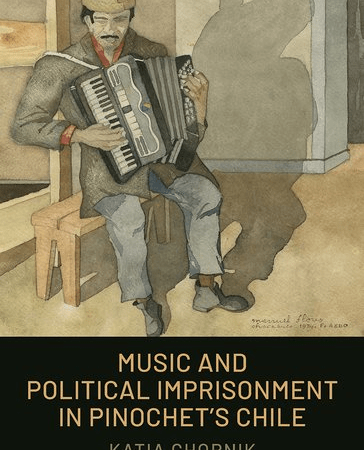
Sue Lukes reviews Music and Political Imprisonment in Pinochet’s Chile, by Katia Chornik, published by Oxford University Press.
About 20 years ago I was asked to speak briefly at the Royal Academy of Music, by a student performing as part of her masters degree. Her thesis was on music played and heard by those held in Nazi concentration camps and Chilean political prisons.
Katia Chornik left a great impression on me: it was a fascinating topic. My grandparents were held in Terezin, where there was a strange flowering of musical talent, and I liked to think that they had heard the music of Viktor Ullmann or Gideon Klein in those grim barracks. Katia played Klein’s unfinished string trio at the concert.
My Chilean friends and family talked about and performed the songs that had sustained them through their imprisonment following the 1973 Pinochet coup. Candombe para José is a regular on the playlist I have to give me focus when writing: it was a popular hit by the folk group Illapu just before the Chilean coup, and its celebration of friendship acquired a special meaning for political prisoners looking after each other, often sung as those released left the jail.
Another I listen to often is Palabras para Julia, described here by a woman imprisoned as “a song with lyrics by José Agustín Goytisolo and music by Paco Ibáñez. It speaks of strength, love, resistance, and it became the anthem of the women of the Tres Álamos political prison camp. With it, we greeted those who arrived and said goodbye to those who were freed.” You can see why it has such power:
Life is beautiful, you’ll see
despite its sorrow
you’ll have friends, you’ll have love
you’ll have friends.
I don’t know what more to tell you
but you should understand
that I am still on the road.
But always, always remember
what I wrote one day
thinking of you, thinking of you
as I am thinking of you now.
Some of those women sing it here. They were celebrating the launch of Cantos Cautivos, the website that Katia went on to set up, to collect the testimonies of those held in Pinochet’s jails about the music they shared.
And then in February 2026 I went to the Chilean embassy for the launch of the book that was initially inspired by the thesis. But Music and Political Imprisonment in Pinochet’s Chile is not solely the narrative of musical resistance and resilience that Cantos Cautivos has commemorated. Katia tells darker and different stories too, as she says, a “memory cacophony” a “discordant kaleidoscope, including the role that music played in torture. There are even interviews with some of the most notorious torturers about their relationship to music.
She unearths and celebrates the music created or made by prisoners, but does not flinch from describing the conflicts that arose around it, with some songs seen as too frivolous, for example. She looks for the truth behind the story of Julio Iglesias’ visit to Valparaiso prison- his attempt to be the Spanish Johnny Cash ended with the political prisoners booing and swearing at him for both his support of the Chilean regime (and Franco) and his insensitivity to their imprisonment.
She returns again and again to the role of memory, remembrance and what music means. Even Candombe Para José was used briefly during the election campaign of Jose Antonio Kast, the new far right President of Chile who has promised to release those convicted of human rights abuses from jail. Music will inspire and comfort those who are already mobilising against Kast, just as Victor Jara’s anthem, El Derecho de Vivir en Paz, inspired the uprising against another right wing Chilean President, Sebastián Piñera, in 2020. It is a brilliant, complex, disturbing and fascinating book that inspires and challenges. Read it!
But let’s not leave it there, because I did not. That concert over 20 years ago inspired us in the UK as well. Hear Me Out was set up soon afterwards, as Music in Detention, to take music into immigration detention centres and to make detainees’ voices heard outside. It has flourished, and now works with people trapped in the asylum system, in hotels, in barracks and bases and in detention, to find connection, support and hope in deeply isolating circumstances, uplifting voices of hope and building an empowering community that stands for dignity in the face of hostility.
And right now, you can help, Hear Me Out has a fundraising campaign and donations to it will be doubled if made by 23rd March. Please give, and just as importantly, please watch, like and share this amazing video by Ardavan, who found hope in an asylum hotel and with whom I am so proud to be a trustee of Hear Me Out. You can share it on Instagram, on Facebook, on Linked In. We stand in solidarity with all those trapped in the asylum and immigration detention systems. We are building a community that supports and uplifts voices of hope, and we are doing it with music. Please join us.
Sue Lukes was an Islington Labour Councillor from 2018 to 2022 and is a writer and consultant on migration issues.
 Labour Hub