
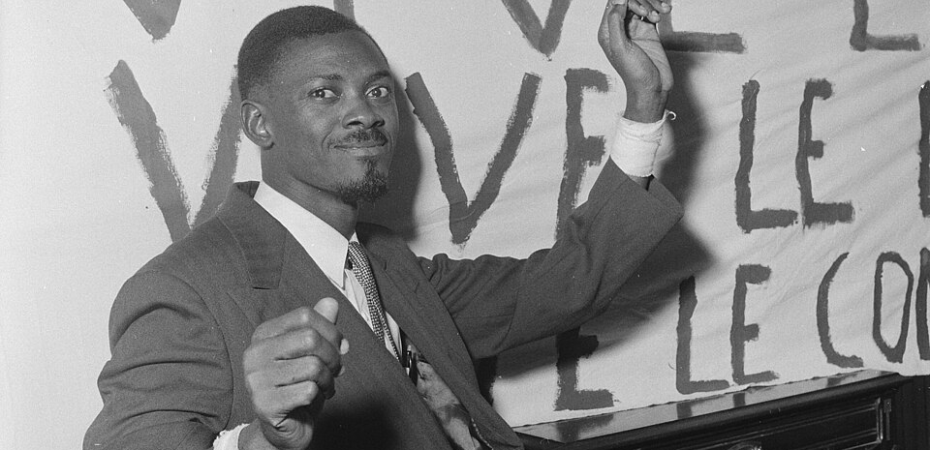
A Belgian court has ordered that a 93-year-old former diplomat stand trial for the 1961 assassination of Congo’s former prime minister and independence leader, Patrice Lumumba.
Lumumba was killed at age 35, after serving for just three months as the first prime minister of the Congolese Republic, now known as the Democratic Republic of Congo (DRC). He was ousted in a political coup and assassinated a few months later by mercenaries.
It was only in 2002 that Belgium admitted moral responsibility for Lumumba’s assassination. Lumumba’s remaining family brought the case to the Belgian courts some 15 years ago. Etienne Davignon, a junior diplomatic intern in Kinshasa at the time of the coup, is the last living among ten Belgians with suspected involvement in the killing.
Prosecutors allege that the ex-diplomat participated in Lumumba’s unlawful detention and transfer and was complicit in denying Lumumba’s right to a fair trial, and subjecting him to “humiliating and degrading treatment”. He also stands accused of complicity in the murders of Maurice Mpolo and Joseph Okito, who were prominent allies of Lumumba. Taken together, these accusations amount to war crimes.
To understand the significance of Patrice Lumumba and the movement he led, we republish below an interview conducted by Maurin Picard with Susan Williams, who has written extensively on this subject. Susan Williams told Labour Hub that the legal ruling is a significant step forward — but it’s important not to absolve the United States from involvement, as was pointed out by the 2001 report of the Belgian parliamentary inquiry into Lumumba’s assassination.
The interview
Maurin Picard: What is left of Patrice Lumumba’s legacy in Africa today?
Susan Williams: Patrice Lumumba belongs to the pantheon of great Pan-Africanist leaders of the twentieth century, alongside Kwame Nkrumah, Frantz Fanon, Amilcar Cabral, and Thomas Sankara. Currently, it is his brutal death that is being remembered. But the power of his legacy in Africa today rests on the strength of his ideals: democracy, non-violence, freedom from colonialism and white minority rule, non-tribalism, and non-alignment.
This legacy has also thrown up reasons to distrust the West. The CIA-backed overthrow and killing of Lumumba was a direct attack on the elected and legitimate government of the Congo. Such aggression was incompatible with America’s portrayal of itself as the world’s champion of democracy.
MP: How do you explain the extraordinary success of this man, then, and his incredible popularity, comparable to Che Guevara? Is it well deserved and if yes, why?
SW: It is indeed deserved. Both Lumumba and Che Guevara can be seen as martyrs: courageous men still in their thirties who were murdered in CIA-backed operations. But, unlike Guevara, Lumumba was against the use of violence in the struggle for liberation. Barely three months after his election he realized that everything was against him and he told his supporters that it was up to them to carry on the fight. “For me,” he said, “it’s finished. I feel that I am going to die. I will die like Gandhi.”
MP: Your book White Malice uncovers efforts made by the CIA and the Eisenhower Administration to keep a tight leash on newly independent African countries, starting with Congolese political elites… What was the end goal?
SW: The end goal was clear: to assert US control over the former colonial territories of Africa and their resources. US administrations feared that the newly-independent nations might become satellites of the Soviet Union. The Congo was seen as central in this concern, because of its geographical position and its strategic mineral resources, especially the Shinkolobwe uranium mine in Katanga. This mine produced the uniquely rich ore that was used to build the atomic bombs dropped on Japan in 1945. A CIA agent explained: “We didn’t want the Russians to get all of the Uranium. They had Uranium of their own, but we certainly didn’t want them to control any of the ores that were coming out of Congo. We did our best to prevent them…”
Some American leaders’ attitudes to Africa were fuelled by racial prejudice. At a meeting in January 1960, Vice President Richard Nixon revealed his extremely racist views when he stated: “Some of the peoples of Africa have been out of the trees for only about fifty years.”
MP: When does the US turn against Patrice Lumumba (in other words, can we identify a watershed or a point of no return)?
SW: American hostility against Lumumba started to brew even before the Congo’s independence at the end of June 1960. But matters accelerated swiftly. A watershed moment occurred in late July, when Lumumba was visiting New York and was asked whether Americans would still have access to Congolese uranium, as they had when Belgium ruled the country. Lumumba’s response was a clear no: “From now on we are an independent and sovereign state. Belgium doesn’t produce any uranium; it would be to the advantage of both our countries if the Congo and the US worked out their own agreements in the future.” Eisenhower was outraged. He cancelled his planned meeting with Lumumba, saying he preferred to play golf. A month later, at a meeting of the National Security Council, he backed the plan to assassinate the democratically-elected Prime Minister of the Congo.
MP: Very early on, US spies start plotting against Lumumba. Yet, the last hours seem to involve only Belgian and Katangese personnel. Where is the American touch in Lumumba’s demise?
SW: Yes: the Americans seem to be invisible. But they were lurking in the shadows of events in multiple covert and sinister ways, facilitating the steps that led tragically to Lumumba’s death. Important details about the involvement of the CIA are starting to emerge, especially from recent releases of documents under the JFK Assassination Records Collection Act. The US managed events in such a way that their policy of assassination was enacted by others, who have been held responsible ever since.
MP: With Lumumba gone, have you established a sense of relief on the American side, or did it prove to be in vain, with regards to American plans for the Congo?
SW: It was not so much in vain, as a stage in the process of establishing American control of the Congo through the insertion of puppet leaders. Kennedy’s inauguration as the new president of the US in January 1961 – just a few days after Lumumba’s assassination – was perceived by newly-independent nations as a reason for hope. But the new administration did not alter Eisenhower’s policy in the Congo; if anything, it strengthened it. There were even contingency plans for a military intervention.
MP: What was Lumumba’s ultimate weakness? Too naive (re: Mobutu), too inexperienced on the international stage as it is often said (threatening the UN and the US to appeal to the USSR to oust Belgian troops)? Something else?
SW: Lumumba was too trusting; he found it difficult to accept that people might behave dishonourably. This weakness led him to trust Mobutu, even against the warnings of his advisors. But Lumumba’s murder was not the result of mistakes or failings on his part. The reason for his death was his commitment to the genuine and unfettered independence of his nation, including control over its own extremely valuable mineral resources. Lumumba never had a chance.
MP: Is there any form of US guilt and apologies regarding American involvement in Lumumba’s death, comparable to Belgium’s formal ‘regrets’ in 2002?
SW: Thus far, Belgium has taken all the blame. The US Senate Committee that was set up in 1975 under Senator Frank Church to investigate the abuses of US intelligence agencies, acknowledged the fact of American plots to kill Lumumba. But it acquitted the CIA of any responsibility for his actual death. The 2001 report of the Belgian commission of inquiry does not accept this: it states that Belgian government files do not support the modest role claimed by CIA officials. This finding is abundantly supported by my own research, as set out in White Malice.
Belgium is trying to find a way of coming to terms with its colonial past and of shouldering its responsibilities for the terrible things that were done. It is a step forward and in sharp contrast with the approach of the UK government, which firmly resists the idea of facing up to any of the realities – and horrors – of its own colonial history. Indeed, the UK itself – as the junior partner to the US – supported plots to kill Lumumba, as official documents reveal.
Maurin Picard, a former correspondent in the USA for French and Belgian publications, is the author of Katanga! La guerre oubliée de la Françafrique contre l’ONU (2024) and Ils ont tué Monsieur H. (2019). Susan Williams, a Senior Fellow at the School of Advanced Study, University of London, is the author of White Malice. The CIA and the Neocolonisation of Africa (2021) and Who Killed Hammarskjöld? (2011). This is a slightly edited version of an article that was published in Africa Briefing and is a translation of an interview published in French in Le Soir.
Image: https://commons.wikimedia.org/wiki/File:LumumbaBruxelles1960.jpg Source:
GaHetNa (Nationaal Archief NL) 910-9732.Author: Herbert Behrens (ANEFO), licensed under the Creative Commons CC0 1.0 Universal Public Domain Dedication.
 Labour Hub
